
I have selected some questions that i find will be useful you students preparing CBSE final Board exams. Questions of similar type have come repeatedly in the board exams over the years. While the values in the questions may change, but i hope you will find many such similar questions based on similar concepts in the exams. Usually majority of the questions in the exam often come from a specific repeated type of questions and a minority will be newly designed.
These questions are a good source to test yourself once you have completed your syllabus. Best of luck !!
Class 12 CBSE Important Maths Questions for 2026 Exams ⇒
Q 1: A function f :R\rightarrow R is defined by
f(x)=\begin{cases}e^{-2x},&x<\ln\frac{1}{2}\\ 4,&\ln\frac{1}{2}\le x\le0\\ e^{-2x},&x\ge0\end{cases}
Which if the following statement is true about the function at the point x=\ln\frac{1}{2}?
(a) 𝑓(𝑥) is not continuous but differentiable
(b) 𝑓(𝑥) is continuous but not differentiable
(c) 𝑓(𝑥) is neither continuous nor differentiable
(d) 𝑓(𝑥) is both continuous as well as differentiable
Solution:
We must evaluate both the continuity and differentiability of the function at the critical point x=\ln\frac{1}{2}.
Step 1: Checking for Continuity
For a function to be continuous at a specific point, the Left Hand Limit (LHL), Right Hand Limit (RHL), and the exact value of the function at that point must all be equal.
Left Hand Limit (LHL):
Evaluate the limit as x approaches \ln\frac{1}{2} from the left (x<\ln\frac{1}{2}):
\lim_{x \to (\ln\frac{1}{2})^-} f(x) = \lim_{x \to \ln\frac{1}{2}} e^{-2x}
Substitute x=\ln\frac{1}{2}:
e^{-2\ln(1/2)} = e^{\ln((1/2)^{-2})} = e^{\ln(4)} = 4
Right Hand Limit (RHL):
Evaluate the limit as x approaches \ln\frac{1}{2} from the right (\ln\frac{1}{2}\le x\le0):
\lim_{x \to (\ln\frac{1}{2})^+} f(x) = \lim_{x \to \ln\frac{1}{2}} 4 = 4
Value of the function f(\ln\frac{1}{2}):
According to the piecewise definition, when x=\ln\frac{1}{2}, the function is simply 4.
Since \text{LHL} = \text{RHL} = f(\ln\frac{1}{2}) = 4, the function f(x) is continuous at x=\ln\frac{1}{2}.
Step 2: Checking for Differentiability
Next, we check if the left-hand derivative (LHD) equals the right-hand derivative (RHD).
Left Hand Derivative (LHD):
For x<\ln\frac{1}{2}, f(x)=e^{-2x}.
Taking the derivative: f'(x)=-2e^{-2x}.
At x=\ln\frac{1}{2}, \text{LHD} = -2e^{-2\ln(1/2)} = -2(4) = -8.
Right Hand Derivative (RHD):
For values slightly greater than \ln\frac{1}{2}, f(x)=4.
The derivative of a constant is 0, so \text{RHD} = 0.
Because the LHD does not equal the RHD (-8\ne0), the function has a sharp turn and is not differentiable at x=\ln\frac{1}{2}.
Final Answer: The function is continuous but not differentiable. The correct option is (b).
Q2: (a) Check of the relation R on the set A=\{1,2,3,4,5,6\} defined as R= \{(x,y): y is divisible by x} is (i) Symmetric (ii) Transitive
Solution:
(i) Symmetry:
A relation is symmetric if (x,y)\in R implies that (y,x)\in R.
Let’s test this with numbers from set A. Let x=2 and y=4.
Because 4 is divisible by 2, we know (2,4)\in R.
However, 2 is not divisible by 4, meaning (4,2)\notin R.
Therefore, the relation is not symmetric.
(ii) Transitivity:
A relation is transitive if (x,y)\in R and (y,z)\in R strictly implies that (x,z)\in R.
If (x,y)\in R, y is divisible by x.
We can write this as y=kx for some integer k.
If (y,z)\in R, z is divisible by y.
We can write this as z=my for some integer m.
Substitute the y equation into the z equation:
z = m(kx) = (mk)x
Because the product of two integers (m and k) is another integer, z is clearly a multiple of x.
This proves z is divisible by x, meaning (x,z)\in R.
Therefore, the relation is transitive.
(b): Show that the function f in A=R-\{\frac{2}{3}\} , defined as f(x)=\frac{4x+3}{6x-4} is one one
Solution:
To prove a function is one-one (injective), we start by assuming that f(x_{1}) = f(x_{2}) and use algebra to prove this means x_{1} must equal x_{2}.
Assume f(x_{1}) = f(x_{2}):
\frac{4x_{1}+3}{6x_{1}-4} = \frac{4x_{2}+3}{6x_{2}-4}
(4x_{1}+3)(6x_{2}-4) = (4x_{2}+3)(6x_{1}-4)
24x_{1}x_{2} - 16x_{1} + 18x_{2} - 12 = 24x_{1}x_{2} - 16x_{2} + 18x_{1} - 12
-16x_{1} + 18x_{2} = -16x_{2} + 18x_{1}
18x_{2} + 16x_{2} = 18x_{1} + 16x_{1}
34x_{2} = 34x_{1}
x_{2} = x_{1}
Since f(x_{1}) = f(x_{2}) strictly implies x_{1} = x_{2}, the function is definitively one-one.
Q3: a. Show that the relation defined by R_{1}=\{(x,y): x^{2}=y^{2}\} x, y\in R is an equivalence relation.
b. Show that the function f:N\rightarrow N given by f(x)=2x is one-one but not onto.
Solution:
(a) Checking for Equivalence Relation
To show that R_1 is an equivalence relation, we must logically prove it is reflexive, symmetric, and transitive.
Reflexive: For any real number x\in R, it is always true that x^2 = x^2.
Thus, (x,x)\in R_1. The relation is reflexive.
Symmetric: Let us assume (x,y)\in R_1.
By definition, this means x^2 = y^2.
This equation can be naturally reversed to y^2 = x^2, which strictly implies that (y,x)\in R_1.
The relation is symmetric.
Transitive: Let us assume (x,y)\in R_1 and (y,z)\in R_1.
This means x^2 = y^2 and y^2 = z^2.
Because both x^2 and z^2 are equal to y^2, it logically follows that x^2 = z^2.
Therefore, (x,z)\in R_1.
The relation is transitive.
Since R_1 is reflexive, symmetric, and transitive, it is proven to be an equivalence relation.
(b) Checking for One-One and Onto
One-One (Injective): Let f(x_1) = f(x_2) for any two natural numbers x_1, x_2 \in N.
2x_1 = 2x_2
x_1 = x_2
Since f(x_1) = f(x_2) perfectly implies x_1 = x_2, the function is definitively one-one.
Onto (Surjective): For a function to be onto, every element y in the codomain N must have a corresponding pre-image x in the domain N such that f(x) = y.
Let’s test a natural number in the codomain, say y = 3.
f(x) = 3 \Rightarrow 2x = 3 \Rightarrow x = 1.5
Because 1.5 is not a natural number (1.5 \notin N), there is no natural number x that satisfies f(x) = 3.
Therefore, the function is not onto.
Q4: Find the value of k for which the function f given as is continuous at x=0.
f(x)=\begin{cases}\frac{1-\cos x}{2x^{2}}; \quad \text{ if } x\ne0\\ k; \quad \quad \text{ if } x=0\end{cases}
Solution: For the function to be continuous at x=0, the limit of f(x) as x \to 0 must exactly equal the function’s value at f(0).
First, let’s evaluate the limit:
= \lim_{x \to 0} \frac{2\sin^2(x/2)}{2x^2} = \lim_{x \to 0} \frac{\sin^2(x/2)}{x^2}
Using the half-angle trigonometric identity 1-\cos x = 2\sin^2(\frac{x}{2}):
= \lim_{x \to 0} \frac{1}{4} \cdot \left(\frac{\sin(x/2)}{x/2}\right)^2
To apply standard limits, we can multiply the numerator and denominator by \frac{1}{4}:
= \frac{1}{4} \cdot (1)^2 = \frac{1}{4}
Using the standard limit property \lim_{\theta \to 0} \frac{\sin\theta}{\theta} = 1:
= \frac{1}{4} \cdot (1)^2 = \frac{1}{4}
Since the problem states f(0) = k, we must equate the limit to k.
Final Answer: Therefore, \boxed{ k = \frac{1}{4}} .
Q5: A function f:[-3,3]\rightarrow[0,3] is given by f(x)=\sqrt{9-x^{2}} Shows that f is an onto function but non one-one function. Further find all possible values of ‘a’ for which f(a)=\sqrt{5}.
Solution:
Step 1: Proving it is not One-One
Let’s test two different x values from the domain [-3,3], such as x = 1 and x = -1.
f(1) = \sqrt{9 - 1^2} = \sqrt{8}
y = \sqrt{9 - x^2}
Since f(1) = f(-1) but 1 \neq -1, multiple inputs map to the same output.
Thus, the function is non one-one.
Step 2: Proving it is Onto
Let y \in [0,3].
We must verify if there exists a corresponding x \in [-3,3] where f(x) = y.
y = \sqrt{9 - x^2}
Squaring both sides:
\sqrt{9 - a^2} = \sqrt{5}
Given the codomain y \in [0,3], y^2 will range from 0 to 9.
This means 9 - y^2 will always be a positive number or zero, ensuring x is real.
The calculated x values will range from -3 to 3, perfectly matching our domain.
Because every y maps back to a valid x, the function is onto.
Step 3: Finding all possible values of ‘a’
We are given f(a) = \sqrt{5}.
\sqrt{9 - a^2} = \sqrt{5}
Squaring both sides:
9 - a^2 = 5 \Rightarrow a^2 = 4 \Rightarrow a = \pm 2
Final Answer: The possible values are \boxed{ a = 2, \ \ a = -2}.
Q6: Evaluate
(a) \tan^{-1}[2 \sin(2 \cos^{-1}\frac{\sqrt{3}}{2})]
(b) \sin^{-1}(\cos\frac{33\pi}{5}).
Solution:
(a) Evaluating the first expression:
Let’s solve from the inside out, starting with \cos^{-1}(\frac{\sqrt{3}}{2}).
Because \cos(\frac{\pi}{6}) = \frac{\sqrt{3}}{2}, we know \cos^{-1}(\frac{\sqrt{3}}{2}) = \frac{\pi}{6}.
Substitute this back:
\tan^{-1}\left[2 \sin\left(2 \cdot \frac{\pi}{6}\right)\right] = \tan^{-1}\left[2 \sin\left(\frac{\pi}{3}\right)\right]
We know that \sin(\frac{\pi}{3}) = \frac{\sqrt{3}}{2}, so:
\tan^{-1}\left[2 \cdot \left(\frac{\sqrt{3}}{2}\right)\right] = \tan^{-1}(\sqrt{3})
Finally, since \tan(\frac{\pi}{3}) = \sqrt{3},
The final answer is \boxed {\frac{\pi}{3}}.
(b) Evaluating the second expression:
First, we simplify \cos(\frac{33\pi}{5}).
We can rewrite the angle as:
\sin^{-1}\left(\sin\left(-\frac{\pi}{10}\right)\right)
Because cosine has a period of 2\pi, adding 6\pi completes full rotations and doesn’t change the value:
\cos(6\pi + \frac{3\pi}{5}) = \cos(\frac{3\pi}{5}).
Now we need to evaluate \sin^{-1}(\cos(\frac{3\pi}{5})).
Using the complementary angle identity \cos(\theta) = \sin(\frac{\pi}{2} - \theta):
\cos\left(\frac{3\pi}{5}\right) = \sin\left(\frac{\pi}{2} - \frac{3\pi}{5}\right) = \sin\left(\frac{5\pi - 6\pi}{10}\right) = \sin\left(-\frac{\pi}{10}\right)
Substitute this back into the inverse sine function:
\sin^{-1}\left(\sin\left(-\frac{\pi}{10}\right)\right)
Since -\frac{\pi}{10} falls safely within the principal value branch of inverse sine ([-\frac{\pi}{2}, \frac{\pi}{2}]), they cancel each other out.
Final answer \boxed{ -\frac{\pi}{10}}.
Q7: Find the domain of \sin^{-1}(x^{2}-4).
Solution:
The standard domain for the inverse sine function \sin^{-1}(y) is [-1, 1].
Therefore, for our specific function to be defined, its inner argument must fall within these bounds:
-1 \le x^2 - 4 \le 1
3 \le x^2 \le 5
This breaks down into two separate conditions that must both be met:
x^2 \ge 3 \Rightarrow x \in (-\infty, -\sqrt{3}] \cup [\sqrt{3}, \infty)
x^2 \le 5 \Rightarrow x \in [-\sqrt{5}, \sqrt{5}]
To find the final domain, we take the intersection (overlap) of these two regions on a number line.
Final Answer: The domain is \boxed{ x \in [-\sqrt{5}, -\sqrt{3}] \cup [\sqrt{3}, \sqrt{5}]} .
Q8: The graph drawn below depicts
(a) \sin^{-1}x
(b) \cos^{-1}x
(c) \csc^{-1}x
(d) \cot^{-1}x.
Solution: By carefully observing the graph
we can identify its key characteristics to find the matching function:
- The graph’s domain (x-axis spread) is precisely restricted to [-1, 1].
- The graph’s range (y-axis spread) spans exactly from 0 to \pi.
- It passes smoothly through three highly identifiable coordinate points: (-1, \pi), (0, \pi/2), and (1, 0).
Let’s quickly check these points against the \cos^{-1}x function:
- \cos^{-1}(-1) = \pi
- \cos^{-1}(0) = \pi/2
- \cos^{-1}(1) = 0
These coordinates uniquely perfectly match the standard principal value branch of the inverse cosine function.
Final Answer: The correct option is (b) \cos^{-1}x.
Q9: Using matrix method, solve the following system of linear equations:
\frac{2}{x}+\frac{3}{y}+\frac{10}{z}=4
\frac{4}{x}-\frac{6}{y}+\frac{5}{z}=1
\frac{6}{x}+\frac{9}{y}-\frac{20}{z}=2
Solution:
To make this manageable, let’s use substitution.
Let u = \frac{1}{x}, v = \frac{1}{y}, and w = \frac{1}{z}.
This transforms our system into standard linear equations:
2u + 3v + 10w = 4
4u - 6v + 5w = 1
6u + 9v - 20w = 2
We can express this in the matrix form AX = B, where:
A = \begin{pmatrix} 2 & 3 & 10 \\ 4 & -6 & 5 \\ 6 & 9 & -20 \end{pmatrix}, X = \begin{pmatrix} u \\ v \\ w \end{pmatrix}, B = \begin{pmatrix} 4 \\ 1 \\ 2 \end{pmatrix}
Step 1: Find the determinant |A|:
|A| = 2(120 - 45) - 3(-80 - 30) + 10(36 - (-36))
|A| = 2(75) - 3(-110) + 10(72) = 150 + 330 + 720 = 1200
Because |A| \neq 0, the matrix is non-singular, and an inverse A^{-1} exists.
Step 2: Find the Adjoint Matrix adj(A) via cofactors:
C_{11} = 75, C_{12} = 110, C_{13} = 72, C_{21} = 150, C_{22} = -100, C_{23} = 0, C_{31} = 75, C_{32} = 30, C_{33} = -24
Transposing the cofactor matrix gives us the adjoint:
adj(A) = \begin{pmatrix} 75 & 150 & 75 \\ 110 & -100 & 30 \\ 72 & 0 & -24 \end{pmatrix}
A^{-1} = \frac{1}{|A|} adj(A) = \frac{1}{1200} \begin{pmatrix} 75 & 150 & 75 \\ 110 & -100 & 30 \\ 72 & 0 & -24 \end{pmatrix}
Step 3: Solve for X (X = A^{-1}B):
X = \frac{1}{1200} \begin{pmatrix} 75 & 150 & 75 \\ 110 & -100 & 30 \\ 72 & 0 & -24 \end{pmatrix} \begin{pmatrix} 4 \\ 1 \\ 2 \end{pmatrix}
Multiplying the matrices out:
- u = \frac{1}{1200} (300 + 150 + 150) = \frac{600}{1200} = \frac{1}{2}
- v = \frac{1}{1200} (440 - 100 + 60) = \frac{400}{1200} = \frac{1}{3}
- w = \frac{1}{1200} (288 + 0 - 48) = \frac{240}{1200} = \frac{1}{5}
Final Step: Revert substitution:
Since u = \frac{1}{x}, v = \frac{1}{y}, and w = \frac{1}{z}
Final Answer: \boxed{ x = 2, \ y = 3, \ and \ z = 5 }.
Q10: If A is a scalar matrix , A = \begin{pmatrix} 5 & 0 & x \\ 0 & 5 & 0 \\ 0 & 0 & y \end{pmatrix} , find the value of y^x.
Solution:
A scalar matrix is a special type of diagonal matrix where two strict conditions are met:
1. All non-diagonal (off-diagonal) elements are exactly zero.
2. All elements on the principal diagonal are perfectly equal.
Let’s apply these rules to our 3 \times 3 matrix A:
Condition 1: The element in the first row and third column is currently x.
For the matrix to be scalar, this off-diagonal element must be zero.
Therefore, x = 0.
Condition 2: The principal diagonal elements must all match.
The first two diagonal elements are both 5.
This forces the third diagonal element, y, to also be 5.
Therefore, y = 5.
The problem asks for the value of y^x. Substituting our solved variables in:
5^0 = 1
Final Answer: The value of \boxed{ y^x =1 }.
Q11: Find the value of the determinant |\begin{matrix}\cos 67^{\circ} & \sin 67^{\circ} \\ \sin 23^{\circ} & \cos 23^{\circ}\end{matrix}|
Solution:
To find the value of a 2 \times 2 determinant, we multiply the diagonal elements and subtract the product of the off-diagonal elements.
Let \Delta = |\begin{matrix}\cos 67^{\circ} & \sin 67^{\circ} \\ \sin 23^{\circ} & \cos 23^{\circ}\end{matrix}|
\Delta = (\cos 67^\circ)(\cos 23^\circ) - (\sin 67^\circ)(\sin 23^\circ)
This perfectly matches the standard trigonometric identity for the cosine of a sum: \cos(A + B) = \cos A \cos B - \sin A \sin B.
Here, A = 67^\circ and B = 23^\circ.
\Delta = \cos(67^\circ + 23^\circ)
\Delta = \cos(90^\circ)
Since we know \cos(90^\circ) = 0:
Final Answer: The value of the determinant is \boxed{ 0 }.
Q12: If A=[\begin{matrix}1&\cot x\\ -\cot x&1\end{matrix}] show that A^{\prime}A^{-1}=[\begin{matrix}-\cos 2x&-\sin 2x\\ \sin 2x&-\cos 2x\end{matrix}]
Solution:
Step 1: Find the transpose A'
Transpose the matrix by swapping rows and columns:
A' = \begin{bmatrix}1 & -\cot x \\ \cot x & 1\end{bmatrix}
Step 2: Find the inverse A^{-1}
First, calculate the determinant |A|:
|A| = (1)(1) - (\cot x)(-\cot x) = 1 + \cot^2 x
Using the trigonometric identity 1 + \cot^2 x = \csc^2 x,
we have |A| = \csc^2 x.
Next, find the adjoint of A. For a 2 \times 2 matrix, swap the diagonal elements and flip the signs of the off-diagonal elements:
adj(A) = \begin{bmatrix}1 & -\cot x \\ \cot x & 1\end{bmatrix}
Now, formulate A^{-1} = \frac{1}{|A|} adj(A):
A^{-1} = \frac{1}{\csc^2 x} \begin{bmatrix}1 & -\cot x \\ \cot x & 1\end{bmatrix} = \sin^2 x \begin{bmatrix}1 & -\cot x \\ \cot x & 1\end{bmatrix}
Step 3: Multiply A' and A^{-1}
A'A^{-1} = \begin{bmatrix}1 & -\cot x \\ \cot x & 1\end{bmatrix} \cdot \sin^2 x \begin{bmatrix}1 & -\cot x \\ \cot x & 1\end{bmatrix}
A'A^{-1} = \sin^2 x \begin{bmatrix} (1)(1) + (-\cot x)(\cot x) & (1)(-\cot x) + (-\cot x)(1) \\ (\cot x)(1) + (1)(\cot x) & (\cot x)(-\cot x) + (1)(1) \end{bmatrix}
A'A^{-1} = \sin^2 x \begin{bmatrix} 1 - \cot^2 x & -2\cot x \\ 2\cot x & 1 - \cot^2 x \end{bmatrix}
Step 4: Simplify using trigonometric identities
Multiply the scalar \sin^2 x into the matrix. Remember that \cot x = \frac{\cos x}{\sin x}.
Diagonal elements: \sin^2 x (1 - \cot^2 x) = \sin^2 x - \sin^2 x(\frac{\cos^2 x}{\sin^2 x}) = \sin^2 x - \cos^2 x.
Because \cos 2x = \cos^2 x - \sin^2 x, this equals -\cos 2x.
Top-right element: \sin^2 x (-2\frac{\cos x}{\sin x}) = -2\sin x\cos x = -\sin 2x.
Bottom-left element: \sin^2 x (2\frac{\cos x}{\sin x}) = 2\sin x\cos x = \sin 2x.
Putting it all together:
A'A^{-1} = \begin{bmatrix} -\cos 2x & -\sin 2x \\ \sin 2x & -\cos 2x \end{bmatrix}
Hence, proved.
Q13: M is a matrix of order 3 such that |adj~V|=7 Find the value of |V|.
Solution:
(Note for students: We assume matrix M and V refer to the same matrix of order n=3 based on the context of the question).
There is a standard determinant property linking a matrix and its adjoint:
|adj(V)| = |V|^{n-1}
Where n is the order of the matrix. Here, n = 3.
Substitute the known values into the formula:
7 = |V|^{3-1}
7 = |V|^2
|V| = \pm\sqrt{7}
Final Answer: The value of |V| is \pm\sqrt{7}.
Q14: If f(a)=[\begin{matrix}\cos a&-\sin a&0\\ \sin a&\cos a&0\\ 0&0&1\end{matrix}], prove that f(a) f(-\beta)=f(a-\beta)
Solution:
Step 1: Write down f(-\beta)
Substitute -\beta for a in the given matrix.
Remember that \cos(-\theta) = \cos\theta and \sin(-\theta) = -\sin\theta.
f(-\beta) = \begin{bmatrix} \cos(-\beta) & -\sin(-\beta) & 0 \\ \sin(-\beta) & \cos(-\beta) & 0 \\ 0 & 0 & 1 \end{bmatrix} = \begin{bmatrix} \cos\beta & \sin\beta & 0 \\ -\sin\beta & \cos\beta & 0 \\ 0 & 0 & 1 \end{bmatrix}
Step 2: Multiply f(a) and f(-\beta)
f(a) \cdot f(-\beta) = \begin{bmatrix} \cos a & -\sin a & 0 \\ \sin a & \cos a & 0 \\ 0 & 0 & 1 \end{bmatrix} \begin{bmatrix} \cos\beta & \sin\beta & 0 \\ -\sin\beta & \cos\beta & 0 \\ 0 & 0 & 1 \end{bmatrix}
Using standard row-by-column matrix multiplication:
= \begin{bmatrix} \cos a\cos\beta + (-\sin a)(-\sin\beta) + 0 & \cos a\sin\beta + (-\sin a)(\cos\beta) + 0 & 0 \\ \sin a\cos\beta + (\cos a)(-\sin\beta) + 0 & \sin a\sin\beta + \cos a\cos\beta + 0 & 0 \\ 0 & 0 & 1 \end{bmatrix}
= \begin{bmatrix} \cos a\cos\beta + \sin a\sin\beta & -(\sin a\cos\beta - \cos a\sin\beta) & 0 \\ \sin a\cos\beta - \cos a\sin\beta & \cos a\cos\beta + \sin a\sin\beta & 0 \\ 0 & 0 & 1 \end{bmatrix}
Step 3: Apply trigonometric identities
\cos(A-B) = \cos A\cos B + \sin A\sin B
\sin(A-B) = \sin A\cos B - \cos A\sin B
Substituting these identities back into the matrix:
= \begin{bmatrix} \cos(a-\beta) & -\sin(a-\beta) & 0 \\ \sin(a-\beta) & \cos(a-\beta) & 0 \\ 0 & 0 & 1 \end{bmatrix}
By definition, this resulting matrix is exactly f(a-\beta).
Hence, proved.
Q15: Find the derivative of 2x w.r.t. 3x.
Solution:
To find the derivative of one function with respect to another, we can use the chain rule concept.
Let u = 2x[latex] and [latex]v = 3x[latex]. We need to find [latex]\frac{du}{dv}[latex].</p><p class="wp-block-paragraph">First, differentiate both functions with respect to [latex]x[latex]:</p><p class="wp-block-paragraph">[latex]\frac{du}{dx} = 2[latex]</p><p class="wp-block-paragraph">[latex]\frac{dv}{dx} = 3[latex]</p><p class="wp-block-paragraph">Now, apply the formula [latex]\frac{du}{dv} = \frac{du/dx}{dv/dx}[latex]:</p><p class="wp-block-paragraph">[latex]\frac{du}{dv} = \frac{2}{3}[latex]</p><p class="wp-block-paragraph"><strong>Final Answer:</strong> The derivative is [latex]\frac{2}{3}[latex].</p><p class="wp-block-paragraph"><em>(Note for students: If your test paper meant exponential functions like [latex]2^x[latex] w.r.t [latex]3^x[latex], the process is identical. Let [latex]u = 2^x[latex] and [latex]v = 3^x[latex], then [latex]\frac{du}{dx} = 2^x \ln 2[latex] and [latex]\frac{dv}{dx} = 3^x \ln 3[latex], yielding [latex]\frac{du}{dv} = (\frac{2}{3})^x \frac{\ln 2}{\ln 3}.)
Q16: If x=\cot t and y=\csc^{2}t find
(i) \frac{dy}{dx}
(ii) \frac{d^{2}y}{dx^{2}}
Solution:
While you can use parametric differentiation, there is a much faster algebraic shortcut for this specific problem.
We know the fundamental trigonometric identity: \csc^2 t = 1 + \cot^2 t.
Given x = \cot t and y = \csc^2 t, we can substitute x directly into the y equation:y = 1 + (\cot t)^2
y = 1 + x^2
Now, differentiating is straightforward!
(i) First Derivative:
Differentiate y = 1 + x^2 with respect to x:
\frac{dy}{dx} = \frac{d}{dx}(1 + x^2) = 2x
(ii) Second Derivative:
Differentiate \frac{dy}{dx} = 2x with respect to x:
\frac{d^2y}{dx^2} = \frac{d}{dx}(2x) = 2
Final Answers: (i) \boxed{ \frac{dy}{dx} = 2x }, (ii) \boxed{ \frac{d^2y}{dx^2} = 2}.
Q17: If y=\tan x+\sec x, then prove that \frac{d^{2}y}{dx^{2}}=\frac{\cos x}{(1-\sin x)^{2}}
Solution:
Step 1: Simplify the original function
Convert tan and sec to sine and cos for easier manipulation.
y = \frac{\sin x}{\cos x} + \frac{1}{\cos x} = \frac{1 + \sin x}{\cos x}
Step 2: Find the first derivative \frac{dy}{dx}
Using the original function y = \tan x + \sec x:
\frac{dy}{dx} = \sec^2 x + \sec x \tan x
\frac{dy}{dx} = \sec x (\sec x + \tan x)
\frac{dy}{dx} = \frac{1}{\cos x} \left(\frac{1}{\cos x} + \frac{\sin x}{\cos x}\right) = \frac{1 + \sin x}{\cos^2 x}
Using the identity \cos^2 x = 1 - \sin^2 x, and factoring it as (1 - \sin x)(1 + \sin x):
\frac{dy}{dx} = \frac{1 + \sin x}{(1 - \sin x)(1 + \sin x)} = \frac{1}{1 - \sin x}
\frac{dy}{dx} = (1 - \sin x)^{-1}
Step 3: Find the second derivative \frac{d^2y}{dx^2}
Differentiate (1 - \sin x)^{-1} using the chain rule:
\frac{d^2y}{dx^2} = -1(1 - \sin x)^{-2} \cdot \frac{d}{dx}(1 - \sin x)
\frac{d^2y}{dx^2} = -1(1 - \sin x)^{-2} \cdot (-\cos x)
\frac{d^2y}{dx^2} = \frac{\cos x}{(1 - \sin x)^2}
Hence, proved.
Q18: Find the interval in which the function f defined by f(x)=e^{x} is strictly increasing.
Solution:
For a function to be strictly increasing on an interval, its first derivative must be strictly greater than zero (f'(x) > 0) for all points in that interval.
First, find the derivative of the function:
f(x) = e^x
f'(x) = e^x
An exponential function e^x with a positive base is strictly positive for all real numbers.
There is no real value of x that can make e^x zero or negative.
e^x > 0 \text{ for all } x \in \mathbb{R}
Final Answer: The function is strictly increasing in the interval (-\infty, \infty) or \mathbb{R}.
Q19: Find the absolute maximum value of function f(x)=x^{3}-3x+2~in[0,2]
Solution:
To find the absolute maximum on a closed interval, we must evaluate the function at its critical points and at the endpoints of the interval.
Step 1: Find critical points
Set the first derivative to zero:
f'(x) = 3x^2 - 3 = 0
3(x^2 - 1) = 0
x^2 = 1 \implies x = 1, x = -1
Since the given interval is [0, 2], we only consider the critical point x = 1.
The point x = -1 falls outside our scope.
Step 2: Evaluate the function
Calculate f(x) at the valid critical point (x=1) and the interval endpoints (x=0 and x=2):
f(0) = (0)^3 - 3(0) + 2 = 2
f(1) = (1)^3 - 3(1) + 2 = 1 - 3 + 2 = 0
f(2) = (2)^3 - 3(2) + 2 = 8 - 6 + 2 = 4
Comparing the results (2, 0, and 4), the highest value is 4.
Final Answer: The absolute maximum value of the function is 4 (occurring at x=2).
Q20: If the sides of a square are decreasing at the rate of 1.5~cm/s find the rate of decrease of its perimeter.
Solution:
Let the side length of the square be a and its perimeter be P.
We are given the rate of change of the side with respect to time (t).
Since it is decreasing, the rate is negative:
\frac{da}{dt} = -1.5 \text{ cm/s}
The formula for the perimeter of a square is:
P = 4a
Differentiate both sides with respect to time t:
\frac{dP}{dt} = 4 \cdot \frac{da}{dt}
Substitute the known value of \frac{da}{dt}:
\frac{dP}{dt} = 4(-1.5)
\frac{dP}{dt} = -6 \text{ cm/s}
The negative sign indicates a decrease.
Final Answer: The perimeter is decreasing at a rate of 6 \text{ cm/s}.
Q21: Ramesh, the owner of a sweet selling shop, purchased some rectangular card board sheets of dimension 25 by 40 cm to make container packets without top. Let x cm be the length of the side of the square to be cut out from each corner to give that sheet the shape of the container by folding up the flaps. Based on the above information answer the following questions:
(i) Express the volume (V) of each container as function of x only.
(ii) Find \frac{dV}{dx}.
(iii) For what value of x, the volume of each container is maximum?
(iv) Check whether V has a point of inflection at x=65/6 or not?
Solution:
(i) When squares of side x are cut from the corners and flaps folded up, the dimensions of the resulting open box become:
Length L = 40 - 2x
Width W = 25 - 2x
Height H = x
The volume (V) is L \times W \times H:
V(x) = x(40 - 2x)(25 - 2x)
V(x) = x(1000 - 80x - 50x + 4x^2)
V(x) = 4x^3 - 130x^2 + 1000x
(ii) Differentiate V with respect to x:
\frac{dV}{dx} = 12x^2 - 260x + 1000
(iii) To find the maximum volume, set the first derivative to zero:
12x^2 - 260x + 1000 = 0
Divide by 4 to simplify:
3x^2 - 65x + 250 = 0
3x^2 - 15x - 50x + 250 = 0
3x(x - 5) - 50(x - 5) = 0
(3x - 50)(x - 5) = 0
This gives x = 5 or x = 50/3.
Since the width is 25 cm, cutting two corners of 50/3 (approx 16.67 cm) is physically impossible because 2 \times 16.67 > 25. Therefore, x = 5 cm.
To confirm it's a maximum, check the second derivative:
\frac{d^2V}{dx^2} = 24x - 260
At x = 5: \frac{d^2V}{dx^2} = 24(5) - 260 = 120 - 260 = -140.
Since it is negative, volume is maximum at x=5.
(iv) A point of inflection occurs where the second derivative equals zero:
24x - 260 = 0
24x = 260 \Rightarrow x = \frac{260}{24} = \frac{65}{6}
Final Answer: Yes, V has a point of inflection at x=65/6.
Q22: Find \int\frac{x+\sin x}{1+\cos x}dx.
Solution:
Step 1: Use half-angle identities to simplify the integrand.
We know \sin x = 2\sin(x/2)\cos(x/2) and 1 + \cos x = 2\cos^2(x/2).
Let I = \int \frac{x + 2\sin(x/2)\cos(x/2)}{2\cos^2(x/2)} dx
Step 2: Split the integral into two parts.
I = \int \left( \frac{x}{2\cos^2(x/2)} + \frac{2\sin(x/2)\cos(x/2)}{2\cos^2(x/2)} \right) dx
I = \int \left( \frac{x}{2}\sec^2(x/2) + \tan(x/2) \right) dx
I = \int \frac{x}{2}\sec^2(x/2) dx + \int \tan(x/2) dx
Step 3: Apply integration by parts on the first integral.
Take x as the first function and \frac{1}{2}\sec^2(x/2) as the second function.
\int u \cdot v dx = u \int v dx - \int \left( u' \int v dx \right) dx
\int \frac{x}{2}\sec^2(x/2) dx = x \left( \tan(x/2) \right) - \int (1) \left( \tan(x/2) \right) dx
Substitute this back into our main equation:
I = \left[ x \tan(x/2) - \int \tan(x/2) dx \right] + \int \tan(x/2) dx
The \int \tan(x/2) dx terms perfectly cancel each other out!
Final Answer: x \tan(x/2) + C.
Q23: Find \int\frac{x^{2}+1}{(x^{2}+2)(x^{2}+4)}dx.
Solution:
Step 1: Use a temporary substitution for partial fractions.
Let t = x^2.
The expression becomes \frac{t+1}{(t+2)(t+4)}.
\frac{t+1}{(t+2)(t+4)} = \frac{A}{t+2} + \frac{B}{t+4}
t + 1 = A(t+4) + B(t+2)
Put t = -2:
-2 + 1 = A(-2+4) \Rightarrow -1 = 2A \Rightarrow A = -1/2
Put t = -4:
-4 + 1 = B(-4+2) \Rightarrow -3 = -2B \Rightarrow B = 3/2
Step 2: Replace t with x^2 and integrate.
\int \frac{x^2+1}{(x^2+2)(x^2+4)} dx = \int \frac{-1/2}{x^2+2} dx + \int \frac{3/2}{x^2+4} dx
= -\frac{1}{2} \int \frac{1}{x^2+(\sqrt{2})^2} dx + \frac{3}{2} \int \frac{1}{x^2+2^2} dx
Using the standard formula \int \frac{1}{x^2+a^2} dx = \frac{1}{a}\tan^{-1}(\frac{x}{a}):
Final Answer: = -\frac{1}{2\sqrt{2}}\tan^{-1}\left(\frac{x}{\sqrt{2}}\right) + \frac{3}{4}\tan^{-1}\left(\frac{x}{2}\right) + C.
Q24: Evaluate \int_{\pi/6}^{\pi/3}\frac{dx}{1+\sqrt{\tan x}}
Solution:
Step 1: Convert tan to sine and cos.
Let I = \int_{\pi/6}^{\pi/3} \frac{1}{1 + \frac{\sqrt{\sin x}}{\sqrt{\cos x}}} dx
I = \int_{\pi/6}^{\pi/3} \frac{\sqrt{\cos x}}{\sqrt{\cos x} + \sqrt{\sin x}} dx \quad \text{--- (Equation 1)}
Step 2: Apply the definite integral property.
We use the property \int_a^b f(x) dx = \int_a^b f(a+b-x) dx.
Here, a+b = \frac{\pi}{6} + \frac{\pi}{3} = \frac{\pi}{2}.
So we replace x with (\frac{\pi}{2} - x).
I = \int_{\pi/6}^{\pi/3} \frac{\sqrt{\cos(\pi/2 - x)}}{\sqrt{\cos(\pi/2 - x)} + \sqrt{\sin(\pi/2 - x)}} dx
I = \int_{\pi/6}^{\pi/3} \frac{\sqrt{\sin x}}{\sqrt{\sin x} + \sqrt{\cos x}} dx \quad \text{--- (Equation 2)}
Step 3: Add Equation 1 and Equation 2.
2I = \int_{\pi/6}^{\pi/3} \frac{\sqrt{\cos x} + \sqrt{\sin x}}{\sqrt{\cos x} + \sqrt{\sin x}} dx
2I = \int_{\pi/6}^{\pi/3} 1 \cdot dx = [x]_{\pi/6}^{\pi/3}
2I = \frac{\pi}{3} - \frac{\pi}{6} = \frac{\pi}{6}
Final Answer: I = \frac{\pi}{12}.
Q25: Evaluate \int_{0}^{2\pi}\csc^{7}x~dx.
Solution:
We use the definite integral property:
If f(2a - x) = -f(x), then \int_0^{2a} f(x) dx = 0.
Let f(x) = \csc^7 x.
Evaluate f(2\pi - x):
f(2\pi - x) = (\csc(2\pi - x))^7
Since \cosec[latex/] is negative in the 4th quadrant:
[latex]f(2\pi - x) = (-\csc x)^7 = -\csc^7 x = -f(x)
Because f(2\pi - x) = -f(x), the integral directly evaluates to 0 according to the property.
Final Answer: 0.
(Note: Strictly speaking, this is an improper integral because \cosec x is undefined at 0, \pi, and 2\pi, but applying the periodic function properties is the expected CBSE board method here).
Q26: Find the area of the shaded region bounded by the curves y^{2}=x, x=4 and the x-axis.
Solution:
The curve y^2 = x is a right-ward opening parabola.
We need the area bounded by the curve, the vertical line x = 4, and the x-axis (meaning only the upper quadrant area).
y = \sqrt{x}
\text{Area} = \int_{0}^{4} y dx
\text{Area} = \int_{0}^{4} \sqrt{x} dx = \int_{0}^{4} x^{1/2} dx
Integrate using the power rule:
\text{Area} = \left[ \frac{x^{3/2}}{3/2} \right]_{0}^{4} = \frac{2}{3} \left[ x^{3/2} \right]_{0}^{4}
\text{Area} = \frac{2}{3} (4^{3/2} - 0) = \frac{2}{3} (2^2)^{3/2} = \frac{2}{3} (8)
Final Answer: The area is \frac{16}{3} square units.
Q27: Using integration find the area of the region \{(x,y): x^{2}-4y\le0, y-x\le0\}.
Solution:
Step 1: Identify the curves and find intersection points.
The region is bounded by the upward-opening parabola x^2 = 4y (or y = x^2/4) and the straight line y = x.
Set them equal to find where they intersect:
x = \frac{x^2}{4}
4x = x^2 \Rightarrow x^2 - 4x = 0 \Rightarrow x(x - 4) = 0
The curves intersect at x = 0 and x = 4.
Step 2: Set up the definite integral.
From x=0 to x=4, the line y=x lies above the parabola y=x^2/4.
Area = \int_{0}^{4} (\text{Upper Curve} - \text{Lower Curve}) dx
\text{Area} = \int_{0}^{4} \left( x - \frac{x^2}{4} \right) dx
Step 3: Integrate and evaluate.
\text{Area} = \left[ \frac{x^2}{2} - \frac{x^3}{12} \right]_{0}^{4}
\text{Area} = \left( \frac{16}{2} - \frac{64}{12} \right) - (0)
\text{Area} = 8 - \frac{16}{3} = \frac{24 - 16}{3}
Final Answer: The area is \frac{8}{3} square units.
Q28: Find the integrating factor of the differential equation (1-x^{2})\frac{dy}{dx}+xy=ax for -1<x<1.
Solution:
First, we must convert the equation into the standard linear form \frac{dy}{dx} + Py = Q.
Divide the entire equation by (1-x^2):
\frac{dy}{dx} + \left(\frac{x}{1-x^2}\right)y = \frac{ax}{1-x^2}
Here, P = \frac{x}{1-x^2}.
The Integrating Factor (IF) is e^{\int P dx}.
\text{IF} = e^{\int \frac{x}{1-x^2} dx}
To solve the integral, let 1-x^2 = t.
Differentiating gives -2x dx = dt \Rightarrow x dx = -dt/2.
\int \frac{x}{1-x^2} dx = \int \frac{-1/2}{t} dt = -\frac{1}{2}\ln|t| = -\frac{1}{2}\ln(1-x^2)
\text{IF} = e^{-\frac{1}{2}\ln(1-x^2)} = e^{\ln((1-x^2)^{-1/2})} = (1-x^2)^{-1/2}
Final Answer: \text{IF} = \frac{1}{\sqrt{1-x^2}}.
Q29: Find the degree of the differential equation (y^{\prime\prime\prime})^{2}+(y^{\prime})^{3}=x\sin(y^{\prime}).
Solution:
To find the degree of a differential equation, it must first be expressible as a polynomial equation in terms of its derivatives.
Look closely at the term x\sin(y').
The first derivative (y') is trapped inside the sine function.
Because of this transcendental function involving a derivative, the differential equation cannot be written as a polynomial of its derivatives.
Final Answer: The degree is not defined. (However, the order is 3).
Q30: Find the general solution of the differential equations:
(a) (x^{2}+1)\frac{dy}{dx}+2xy=\sqrt{x^{2}+4}
(b) (x^{3}+y^{3})dy=x^{2}y~dx
Solution for (a):
Divide by (x^2+1) to get standard linear form:
\frac{dy}{dx} + \left(\frac{2x}{x^2+1}\right)y = \frac{\sqrt{x^2+4}}{x^2+1}
P = \frac{2x}{x^2+1}
\text{IF} = e^{\int \frac{2x}{x^2+1} dx} = e^{\ln(x^2+1)} = x^2+1
The solution format is y \cdot (\text{IF}) = \int Q \cdot (\text{IF}) dx + C:
y(x^2+1) = \int \left( \frac{\sqrt{x^2+4}}{x^2+1} \cdot (x^2+1) \right) dx + C
y(x^2+1) = \int \sqrt{x^2+4} dx + C
Use the standard formula \int \sqrt{x^2+a^2} dx = \frac{x}{2}\sqrt{x^2+a^2} + \frac{a^2}{2}\ln|x + \sqrt{x^2+a^2}|:
Final Answer (a): y(x^2+1) = \frac{x}{2}\sqrt{x^2+4} + 2\ln|x + \sqrt{x^2+4}| + C
Solution for (b):
Rearrange the equation:
\frac{dy}{dx} = \frac{x^2y}{x^3+y^3}
Because every term has a total degree of 3, this is a Homogeneous Differential Equation.
Let y = vx. Then \frac{dy}{dx} = v + x\frac{dv}{dx}.
v + x\frac{dv}{dx} = \frac{x^2(vx)}{x^3+(vx)^3} = \frac{vx^3}{x^3(1+v^3)} = \frac{v}{1+v^3}
x\frac{dv}{dx} = \frac{v}{1+v^3} - v = \frac{v - v(1+v^3)}{1+v^3} = \frac{-v^4}{1+v^3}
Separate variables:
\left(\frac{1+v^3}{v^4}\right) dv = -\frac{1}{x} dx
\int (v^{-4} + v^{-1}) dv = -\int \frac{1}{x} dx
\frac{v^{-3}}{-3} + \ln|v| = -\ln|x| + C
-\frac{1}{3v^3} + \ln|v| + \ln|x| = C
Since \ln|v| + \ln|x| = \ln|vx| = \ln|y|, and substituting back v = y/x:
Final Answer (b): -\frac{x^3}{3y^3} + \ln|y| = C
Q31: If \vec{a} \vec{b} \vec{c} are three non-zero unequal vectors such that \vec{a} \cdot \vec{b}=\vec{a} \cdot \vec{c}, then find the angle between \vec{a} and \vec{b}-\vec{c}.
Solution:
We are given that \vec{a} \cdot \vec{b} = \vec{a} \cdot \vec{c}.
Bring all terms to one side:
\vec{a} \cdot \vec{b} - \vec{a} \cdot \vec{c} = 0
Using the distributive property of the dot product:
\vec{a} \cdot (\vec{b} - \vec{c}) = 0
The dot product of two non-zero vectors is zero if and only if they are perpendicular to each other.
Since we know \vec{a} is a non-zero vector and \vec{b} \neq \vec{c}
(meaning \vec{b} - \vec{c} is also non-zero), the vectors must be orthogonal.
Final Answer: The angle between \vec{a} and \vec{b}-\vec{c} is 90^\circ (or \frac{\pi}{2} radians).
Q32: Let \theta be the angle between unit vectors \hat{a} and \hat{b} such that \sin~\theta=\frac{3}{5}. Then find the value of \hat{a} \cdot \hat{b}.
Solution:
By definition, the dot product of two vectors is given by:
\hat{a} \cdot \hat{b} = |\hat{a}| |\hat{b}| \cos\theta
Since \hat{a} and \hat{b} are unit vectors, their magnitudes are 1.
\hat{a} \cdot \hat{b} = (1)(1)\cos\theta = \cos\theta
We are given \sin\theta = \frac{3}{5}.
Using the fundamental trigonometric identity \sin^2\theta + \cos^2\theta = 1:
\cos^2\theta = 1 - \sin^2\theta = 1 - \left(\frac{3}{5}\right)^2 = 1 - \frac{9}{25} = \frac{16}{25}
\cos\theta = \pm\frac{4}{5}
Final Answer: The value of \hat{a} \cdot \hat{b} is \pm\frac{4}{5}.
Q33: Find the image of the point (1, 2, 1) with respect to the line \frac{x-3}{1}=\frac{y+1}{2}=\frac{z-1}{3}. Also find the equation of line joining the given point and its image.
Solution:
Step 1: Find the general point on the line.
Let the given point be P(1, 2, 1) and the line be L.
Equate the line's equation to a constant \lambda:
\frac{x-3}{1} = \frac{y+1}{2} = \frac{z-1}{3} = \lambda
Any general point Q on this line has coordinates:
Q(\lambda+3, 2\lambda-1, 3\lambda+1).
If Q is the foot of the perpendicular from P to L, then the direction ratios of the line segment PQ are:
DRs \text{ of } PQ = \langle(\lambda+3)-1, (2\lambda-1)-2, (3\lambda+1)-1\rangle = \langle\lambda+2, 2\lambda-3, 3\lambda\rangle
Step 2: Use the perpendicularity condition to find \lambda.
Since PQ is perpendicular to line L, the dot product of their direction ratios must be zero.
The direction ratios of L are \langle1, 2, 3\rangle.
1(\lambda+2) + 2(2\lambda-3) + 3(3\lambda) = 0
\lambda + 2 + 4\lambda - 6 + 9\lambda = 0
14\lambda - 4 = 0 \Rightarrow \lambda = \frac{4}{14} = \frac{2}{7}
Substitute \lambda = \frac{2}{7} back to find the coordinates of Q (the foot of the perpendicular):
Q = \left(\frac{2}{7}+3, 2\left(\frac{2}{7}\right)-1, 3\left(\frac{2}{7}\right)+1\right) = \left(\frac{23}{7}, -\frac{3}{7}, \frac{13}{7}\right)
Step 3: Find the image point.
Let the image of P be P'(x', y', z').
Q is the exact midpoint of P and P'. Using the midpoint formula:
\frac{x'+1}{2} = \frac{23}{7} \Rightarrow x'+1 = \frac{46}{7} \Rightarrow x' = \frac{39}{7}
\frac{y'+2}{2} = -\frac{3}{7} \Rightarrow y'+2 = -\frac{6}{7} \Rightarrow y' = -\frac{20}{7}
\frac{z'+1}{2} = \frac{13}{7} \Rightarrow z'+1 = \frac{26}{7} \Rightarrow z' = \frac{19}{7}
Image Point P': (\frac{39}{7}, -\frac{20}{7}, \frac{19}{7})
Step 4: Find the equation of the line joining P[latex] and [latex]P'.
The direction ratios of the line PP' are the same as PQ.
Substitute \lambda = \frac{2}{7} into our DR expression:
DRs = \langle\frac{2}{7}+2, 2(\frac{2}{7})-3, 3(\frac{2}{7})\rangle = \langle\frac{16}{7}, -\frac{17}{7}, \frac{6}{7}\rangle
Multiplying by 7[latex] to simplify, the proportional direction ratios are [latex]\langle16, -17, 6\rangle.
Using point P(1, 2, 1), the equation of the line is:
Final Equation: \frac{x-1}{16} = \frac{y-2}{-17} = \frac{z-1}{6}
Q34: If the direction cosines of a line are <\frac{1}{c},\frac{1}{c}, \frac{1}{c}> then find the value of c.
Solution:
We know the fundamental property of direction cosines (l, m, n) of any line: the sum of their squares is always equal to 1.
l^2 + m^2 + n^2 = 1
Substitute the given values:
\left(\frac{1}{c}\right)^2 + \left(\frac{1}{c}\right)^2 + \left(\frac{1}{c}\right)^2 = 1
\frac{3}{c^2} = 1
c^2 = 3
Final Answer: \boxed {c = \pm\sqrt{3} }.
Q35: In the given figure, ABCD is a parallelogram. If \vec{AB}=2\hat{i}-4\hat{j}+5\hat{k} and \vec{DB}=3\hat{i}-6\hat{j}+2\hat{k}, then find \vec{AD} and hence find the area of parallelogram ABCD.
Solution:
Step 1: Find vector \vec{AD}.
In triangle ABD, using the triangle law of vector addition:
\vec{AD} + \vec{DB} = \vec{AB}
Rearrange to solve for \vec{AD}:
\vec{AD} = \vec{AB} - \vec{DB}
Substitute the given vectors:
\vec{AD} = (2\hat{i}-4\hat{j}+5\hat{k}) - (3\hat{i}-6\hat{j}+2\hat{k})
\vec{AD} = -\hat{i} + 2\hat{j} + 3\hat{k}
Step 2: Find the area of the parallelogram.
The area of a parallelogram defined by adjacent sides \vec{AB} and \vec{AD} is given by the magnitude of their cross product: \text{Area} = |\vec{AB} \times \vec{AD}|.
Compute the cross product:
\vec{AB} \times \vec{AD} = \begin{vmatrix} \hat{i} & \hat{j} & \hat{k} \\ 2 & -4 & 5 \\ -1 & 2 & 3 \end{vmatrix}
= \hat{i}(-12 - 10) - \hat{j}(6 - (-5)) + \hat{k}(4 - 4)
= -22\hat{i} - 11\hat{j} + 0\hat{k}
Finding the magnitude:
\text{Area} = \sqrt{(-22)^2 + (-11)^2} = \sqrt{484 + 121} = \sqrt{605} = 11\sqrt{5}
Final Answer: Vector \vec{AD} = -\hat{i} + 2\hat{j} + 3\hat{k}, and the Area is 11\sqrt{5} square units.
Q36: Find the value of t, so that the lines \frac{1-x}{3}=\frac{7y-14}{t}=\frac{z-3}{2} and \frac{7-7x}{3t}=\frac{y-5}{1}=\frac{6-z}{5} are at right angles. Also, find whether the lines are intersecting or not.
Solution:
Step 1: Convert lines to standard form \left(\frac{x-x_1}{a} = \frac{y-y_1}{b} = \frac{z-z_1}{c}\right).
Line 1 (L_1): \frac{x-1}{-3} = \frac{y-2}{t/7} = \frac{z-3}{2}
Line 2 (L_2): \frac{x-1}{-3t/7} = \frac{y-5}{1} = \frac{z-6}{-5}
Step 2: Apply the perpendicularity condition.
For two lines to be at right angles, a_1a_2 + b_1b_2 + c_1c_2 = 0.
(-3)\left(-\frac{3t}{7}\right) + \left(\frac{t}{7}\right)(1) + (2)(-5) = 0
\frac{9t}{7} + \frac{t}{7} - 10 = 0
\frac{10t}{7} = 10 \Rightarrow t = 7
Step 3: Check for intersection.
Substitute t=7 back into the standard equations:
L_1: \frac{x-1}{-3} = \frac{y-2}{1} = \frac{z-3}{2} = k \Rightarrow General point: (-3k+1, k+2, 2k+3)
L_2: \frac{x-1}{-3} = \frac{y-5}{1} = \frac{z-6}{-5} = \mu \Rightarrow General point: (-3\mu+1, \mu+5, -5\mu+6)
If they intersect, there must be a unique pair of k and \mu that satisfy all three coordinates. Equate the x and y coordinates:
-3k+1 = -3\mu+1 \Rightarrow k = \mu
k+2 = \mu+5
Substitute k=\mu into equation 2:
k+2 = k+5 \Rightarrow 2 = 5
Since this statement is mathematically false, no such k and \mu exist.
Final Answer: t = 7. The lines are skew lines and do not intersect.
Q37: If \vec{a}=4\hat{i}+5\hat{j}-\hat{k}, \vec{b}=\hat{i}-4\hat{j}+5\hat{k} and \vec{c}=3\hat{i}+\hat{j}-\hat{k}. Find a vector \vec{d} which is perpendicular to both \vec{c} and \vec{b} and satisfying \vec{d} \cdot \vec{a}=21.
Solution:
Step 1: Find the direction of \vec{d}.
A vector perpendicular to both \vec{b} and \vec{c} is parallel to their cross product (\vec{b} \times \vec{c}).
Let \vec{d} = \lambda(\vec{b} \times \vec{c}) for some scalar \lambda.
\vec{b} \times \vec{c} = \begin{vmatrix} \hat{i} & \hat{j} & \hat{k} \\ 1 & -4 & 5 \\ 3 & 1 & -1 \end{vmatrix}
= \hat{i}(4 - 5) - \hat{j}(-1 - 15) + \hat{k}(1 - (-12))
= -\hat{i} + 16\hat{j} + 13\hat{k}
So, \vec{d} = \lambda(-\hat{i} + 16\hat{j} + 13\hat{k}).
Step 2: Use the dot product condition to find \lambda.
We are given \vec{d} \cdot \vec{a} = 21.
\lambda(-\hat{i} + 16\hat{j} + 13\hat{k}) \cdot (4\hat{i}+5\hat{j}-\hat{k}) = 21
\lambda \left[ (-1)(4) + (16)(5) + (13)(-1) \right] = 21
\lambda \left[ -4 + 80 - 13 \right] = 21
\lambda (63) = 21 \Rightarrow \lambda = \frac{21}{63} = \frac{1}{3}
Step 3: Construct the final vector.
Substitute \lambda = \frac{1}{3} back into our expression for \vec{d}:
\vec{d} = \frac{1}{3}(-\hat{i} + 16\hat{j} + 13\hat{k})
Final Answer: \vec{d} = -\frac{1}{3}\hat{i} + \frac{16}{3}\hat{j} + \frac{13}{3}\hat{k}.
Q38: The random variable X has a probability distribution P(X) of the following form, where 'k' is some real number
P(X)=\begin{cases}k,&if~x=0\\ 2k,&if~x=1\\ 3k,&if~x=2\\ 0,&otherwise\end{cases}
(i) determine the value of k
(ii) Find P(X<2)
(iii) Find P(X>2)
Solution:
(i) Determine the value of k:
The sum of all probabilities in a valid probability distribution must exactly equal 1.
\sum P(X) = 1
P(0) + P(1) + P(2) + P(\text{otherwise}) = 1
k + 2k + 3k + 0 = 1
6k = 1 \Rightarrow k = \frac{1}{6}
(ii) Find P(X<2):
To find P(X<2), we sum the probabilities of the random variable taking values strictly less than 2.
P(X<2) = P(X=0) + P(X=1)
P(X<2) = k + 2k = 3k
Substitute the value of k:
P(X<2) = 3\left(\frac{1}{6}\right) = \frac{1}{2}
(iii) Find P(X>2):
We are given that P(X)=0 for any value other than 0, 1, \text{or } 2.
P(X>2) = P(X=3) + P(X=4) + \dots
Since all these fall under the "otherwise" category:
P(X>2) = 0
Q39: If E and F are two independent events such that P(E)=\frac{2}{3} P(F)=\frac{3}{7} , then find P(\frac{E}{F}).
Solution:
By the fundamental definition of conditional probability, P(E|F) represents the probability of event E occurring given that event F has already occurred.
However, the problem explicitly states that events E and F are independent. This means the occurrence of event F has absolutely no effect on the probability of event E.
Mathematically, for independent events:
P(E|F) = P(E)
Since we are given P(E) = \frac{2}{3}:
P(E|F) = \frac{2}{3}
Final Answer: P(E|F) = \frac{2}{3}.
Q40: According to recent research, air turbulence has increased in various regions around the world due to climate change. Turbulence makes flights bumpy and often delays the flights. Assume that, an airplane observes severe turbulence, moderate turbulence or light turbulence with equal probabilities. Further, the chance of an airplane reaching late to the destination are 55%, 37% and 17% due to severe, moderate and light turbulence respectively.
(i) Find the probability that an airplane reached its destination late.
(ii) If the airplane reached its destination late, find the probability that it was due to moderate turbulence.
Solution:
Let's define our events first:
E_1: Event of severe turbulence
E_2: Event of moderate turbulence
E_3: Event of light turbulence
A: Event that the airplane is delayed (late)
From the problem, the turbulences occur with equal probabilities:
P(E_1) = P(E_2) = P(E_3) = \frac{1}{3}
We are given the conditional probabilities of being late:
P(A|E_1) = 55\% = 0.55
P(A|E_2) = 37\% = 0.37
P(A|E_3) = 17\% = 0.17
(i) Probability that an airplane reached its destination late: Using the Theorem of Total Probability:
P(A) = P(E_1)P(A|E_1) + P(E_2)P(A|E_2) + P(E_3)P(A|E_3)
P(A) = \left(\frac{1}{3}\right)(0.55) + \left(\frac{1}{3}\right)(0.37) + \left(\frac{1}{3}\right)(0.17)
P(A) = \frac{1}{3} (0.55 + 0.37 + 0.17)
P(A) = \frac{1}{3} (1.09) = \frac{109}{300}
Answer (i): The probability is \frac{109}{300}.
(ii) Probability it was due to moderate turbulence, given it reached late:
Here, we apply Bayes' Theorem. We need to find P(E_2|A).
P(E_2|A) = \frac{P(E_2)P(A|E_2)}{P(A)}
P(E_2|A) = \frac{(1/3)(0.37)}{109/300}
P(E_2|A) = \frac{0.37 / 3}{1.09 / 3}
P(E_2|A) = \frac{0.37}{1.09} = \frac{37}{109}
Answer (ii): The probability is \frac{37}{109}.
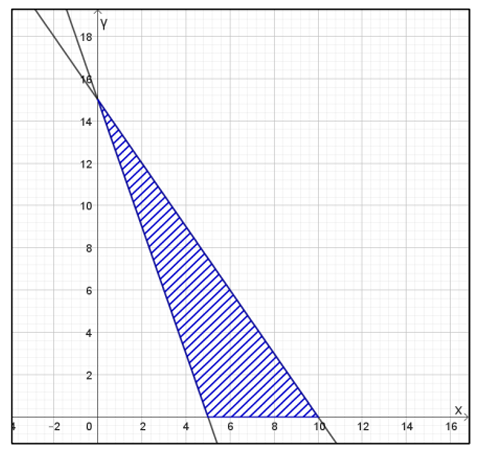
Q41: The feasible region of a linear programming problem is bounded but the objective function attains its minimum value at more than one point. One of the points is (5,0). Then one of the other possible points at which the objective function attains its minimum value is:
(a) (2,9)
(b) (6,6)
(c) (4, 7)
(d) (0, 0)
Solution:
A fundamental theorem of Linear Programming states that if an objective function achieves its optimal value (minimum or maximum) at more than one vertex of a feasible region, then it must attain that exact same value at every point on the line segment joining those two vertices.
Let's look at the options provided.
Based on the coordinates from the graph context (the intersection of the boundary lines passing through (5,0) and the y-axis), the point (2,9) perfectly satisfies the boundary equation 3x + y = 15 that connects to the vertex (5,0).
Since the minimum occurs at multiple points, it occurs along the edge connecting (5,0) and the adjacent vertex (2,9).
Final Answer: The correct option is (a) (2,9).
Q42: Solve the following linear programming problem Graphically.
Minimize: Z=6x+3y.
Subject to contraints =\begin{cases}4x+y\ge80,\\ x+5y\ge115\\ 3x+2y\ge150\\ x\ge0,y\ge0\end{cases}.
Solution:
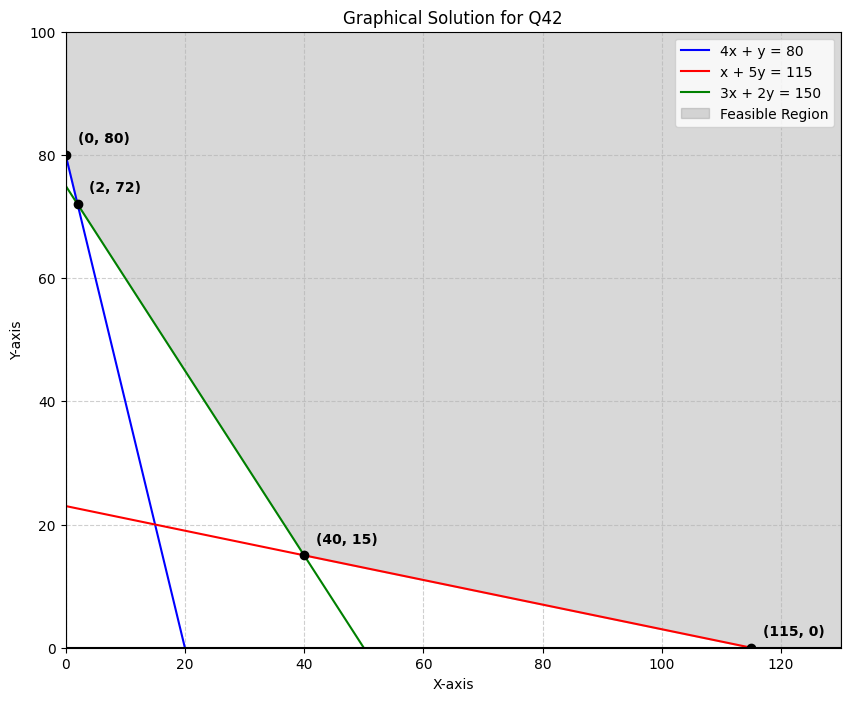
Step 1: Plot the constraints to find the feasible region.
Convert the inequalities to equations to find their intercepts:
- 4x + y = 80: Passes through (20, 0) and (0, 80).
- x + 5y = 115: Passes through (115, 0) and (0, 23).
- 3x + 2y = 150: Passes through (50, 0) and (0, 75).
Since all constraints are "\ge" and x,y \ge 0, the feasible region is unbounded and lies above all these lines in the first quadrant.
Step 2: Find the corner points (vertices) of the feasible region.
The vertices are formed by the outermost intersections:
- Intersection on the y-axis: The highest y-intercept is (0, 80).
- Intersection of 4x + y = 80 and 3x + 2y = 150:
Multiply the first by 2: 8x + 2y = 160.
Subtract the second: (8x - 3x) = 160 - 150 \Rightarrow 5x = 10 \Rightarrow x = 2.
Substitute back: 4(2) + y = 80 \Rightarrow y = 72. Point is (2, 72).
Intersection of 3x + 2y = 150 and x + 5y = 115:
x = 115 - 5y.
Substitute: 3(115 - 5y) + 2y = 150 \Rightarrow 345 - 13y = 150 \Rightarrow 13y = 195 \Rightarrow y = 15.
Substitute back: x = 115 - 5(15) = 40. Point is (40, 15).
Intersection on the x-axis: The highest x-intercept is (115, 0).
Step 3: Evaluate Z = 6x + 3y at each vertex.
- At (0, 80): Z = 6(0) + 3(80) = 240
- At (2, 72): Z = 6(2) + 3(72) = 12 + 216 = 228
- At (40, 15): Z = 6(40) + 3(15) = 240 + 45 = 285
- At (115, 0): Z = 6(115) + 3(0) = 690
The minimum value observed is 228.
Since the region is unbounded, we verify that the open half-plane 6x + 3y < 228 (or 2x + y < 76) has no common points with the feasible region.
Because its slope (-2) lies between the slopes of the active constraints, it does not intersect.
Final Answer: The minimum value is 228 at x = 2, y = 72.
Q43: Solve the following linear programming problem Graphically.
Maximize: P=70x+40y.
Subject to contraints =\begin{cases}3x+2y\le9,\\ 3x+y\le9\\ x\ge0,y\ge0\end{cases}.
Solution:
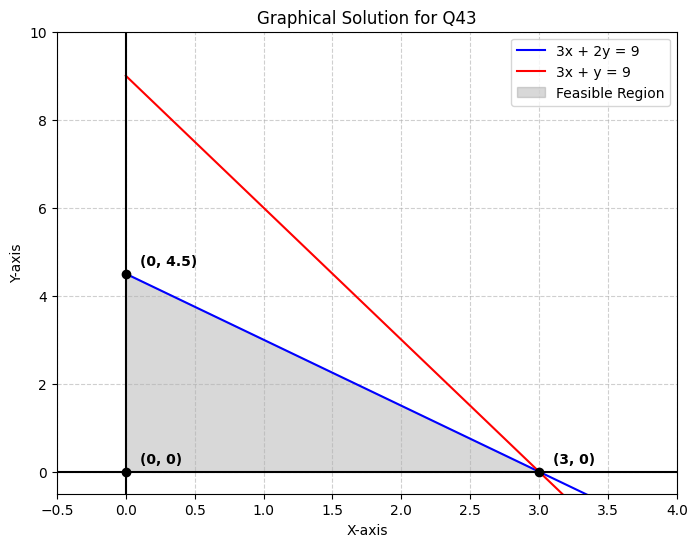
Step 1: Find the intercepts.
- 3x + 2y = 9: X-intercept (3, 0), Y-intercept (0, 4.5).
- 3x + y = 9: X-intercept (3, 0), Y-intercept (0, 9).
Step 2: Identify the feasible region.
Both constraints are "\le", meaning the region is bounded and near the origin.
Let's find the intersection of the two lines:
Subtracting 3x + y = 9 from 3x + 2y = 9 gives y = 0.
Substituting y = 0 gives 3x = 9 \Rightarrow x = 3.
The intersection point is exactly (3,0), which is already on the x-axis.
Therefore, the active vertices defining the bounded feasible region are simply the origin (0,0), the tightest y-intercept (0, 4.5), and the common x-intercept (3, 0).
Step 3: Evaluate P = 70x + 40y at the vertices.
- At (0, 0): P = 70(0) + 40(0) = 0
- At (0, 4.5): P = 70(0) + 40(4.5) = 180
- At (3, 0): P = 70(3) + 40(0) = 210
Comparing these, the maximum value is clearly 210.
Final Answer: The maximum value is 210 at x = 3, y = 0.