
Have you solved Class 12 Application of Derivatives Test – 1 and are looking for a solutions to the questions? Here you’ll find complete, step-by-step NCERT-style solutions for every question. Designed for both students and teachers, these answers make board exam revision easier with clear explanations, formula highlights, and downloadable PDF options.
Class 12 Application of Derivatives Test-1 2027 ⇒
Below are the detailed, step-by-step solutions to all 30 marks of the test. Grab your answer sheets, and let’s review!
2-Mark Questions
Q1. The side of an equilateral triangle is increasing at the rate of 2cm/s. At what rate is the area increasing when the side of the triangle is 20cm?
Solution:
Let the side of the equilateral triangle be a.
Given that the rate of change of the side is: \frac{da}{dt}=2\text{ cm/s}.
The formula for the area of an equilateral triangle is A=\frac{\sqrt{3}}{4}a^2.
Differentiating the area with respect to time t: \frac{dA}{dt}=\frac{\sqrt{3}}{4}\cdot 2a\cdot \frac{da}{dt}
\frac{dA}{dt}=\frac{\sqrt{3}}{2}a\cdot \frac{da}{dt}
Now, substitute a=20 and \frac{da}{dt}=2:
\frac{dA}{dt}=\frac{\sqrt{3}}{2}(20)(2)=20\sqrt{3}
Final Answer: The area is increasing at the rate of 20\sqrt{3}\text{ cm}^2\text{/s}.
Q2. Find the point on the curve y^2=4x+8 for which the abscissa and ordinate change at the same rate.
Solution:
Equation of the curve: y^2=4x+8.
We are given that the rate of change of abscissa (x) equals the rate of change of ordinate (y).
Therefore, \frac{dx}{dt}=\frac{dy}{dt}.
Differentiating the curve with respect to t: 2y\frac{dy}{dt}=4\frac{dx}{dt}
Since \frac{dx}{dt}=\frac{dy}{dt} (and assuming the rate is non-zero), we can cancel them out: 2y=4\implies y=2
Substitute y=2 back into the original curve’s equation to find x:
2^2=4x+8\implies 4=4x+8\implies 4x=-4\implies x=-1
Final Answer: The required point on the curve is (-1,2).
Q3. The average cost function associated with producing and marketing x units of an item is given as AC=2x-11+\frac{50}{x}. Find the range of values of the output x, for which AC is increasing.
Solution:
For a function to be increasing, its first derivative must be greater than zero.
Let’s find the derivative of AC with respect to x:
\frac{d(AC)}{dx}=2-\frac{50}{x^2}
Set the derivative strictly greater than zero: 2-\frac{50}{x^2}>0\implies 2>\frac{50}{x^2}\implies x^2>25
Since x represents the physical output (units produced), it cannot be negative (x>0).
Answer: Therefore, the average cost is increasing when x>5, or in interval notation, x\in(5,\infty).
3-Mark Questions
Q4. Sand is pouring from a pipe at the rate of 12\text{ cm}^3\text{/s}. The falling sand forms a cone on the ground in such a way that the height of the cone is always one-sixth of the radius of the base. How fast is the height of the sand cone increasing when the height is 3 cm?
Solution:
Let V, r, and h be the volume, radius, and height of the cone, respectively.
Given: Rate of volume change \frac{dV}{dt}=12\text{ cm}^3\text{/s}.
Relation between height and radius: h=\frac{r}{6}\implies r=6h.
The volume of a cone is given by: V=\frac{1}{3}\pi r^2h
Substitute r=6h into the volume formula to express it entirely in terms of h:
V=\frac{1}{3}\pi(6h)^2h=\frac{1}{3}\pi(36h^2)h=12\pi h^3
Differentiate both sides with respect to t:
\frac{dV}{dt}=36\pi h^2\frac{dh}{dt}
Now, substitute the known values \frac{dV}{dt}=12 and h=3:
12=36\pi(3)^2\frac{dh}{dt}\implies 12=324\pi\frac{dh}{dt}
\frac{dh}{dt}=\frac{12}{324\pi}=\frac{1}{27\pi}
Final Answer: The height of the sand cone is increasing at a rate of \frac{1}{27\pi}\text{ cm/s}.
Q5. Find the absolute maximum and minimum value of the function f(x)=(x-2)\sqrt{x-1} in the interval [1, 9].
Solution:
First, find the critical points by taking the first derivative using the product rule:
f'(x)=1\cdot\sqrt{x-1}+(x-2)\cdot\frac{1}{2\sqrt{x-1}}
f'(x)=\frac{2(x-1)+(x-2)}{2\sqrt{x-1}}=\frac{3x-4}{2\sqrt{x-1}}
To find critical points, set f'(x)=0:
3x-4=0\implies x=\frac{4}{3}
(Note: The derivative is undefined at x=1, which is already an endpoint of our interval).
Next, evaluate the function at the critical point and the endpoints of the interval
x=1, x=\frac{4}{3}, and x=9:
- At endpoint x=1: f(1)=(1-2)\sqrt{1-1}=0
- At critical point x=\frac{4}{3}: f(\frac{4}{3})=(\frac{4}{3}-2)\sqrt{\frac{4}{3}-1}=(-\frac{2}{3})\sqrt{\frac{1}{3}}=-\frac{2}{3\sqrt{3}}=-\frac{2\sqrt{3}}{9}
- At endpoint x=9: f(9)=(9-2)\sqrt{9-1}=7\sqrt{8}=14\sqrt{2}
Final Answer: The absolute maximum value is 14\sqrt{2} (at x=9).
The absolute minimum value is -\frac{2\sqrt{3}}{9} (at x=\frac{4}{3}).
4-Mark Questions
Q6. Write the interval in which the function f(x)=\frac{3}{10}x^4-\frac{4}{5}x^3-3x^2+\frac{36}{5}x+11 is strictly increasing and strictly decreasing.
Solution:
First, find the derivative f'(x): f'(x)=\frac{12}{10}x^3-\frac{12}{5}x^2-6x+\frac{36}{5}
Factor out the common term \frac{6}{5}: f'(x)=\frac{6}{5}(x^3-2x^2-5x+6)
To find critical points, set f'(x)=0.
By trial and error, we see that x=1 is a root because 1-2-5+6=0.
Using synthetic division or long division to factor out (x-1):
x^3-2x^2-5x+6=(x-1)(x^2-x-6)=(x-1)(x-3)(x+2)
So, the critical points are x=-2, x=1, and x=3.
Plotting these on a number line divides the domain into four intervals:
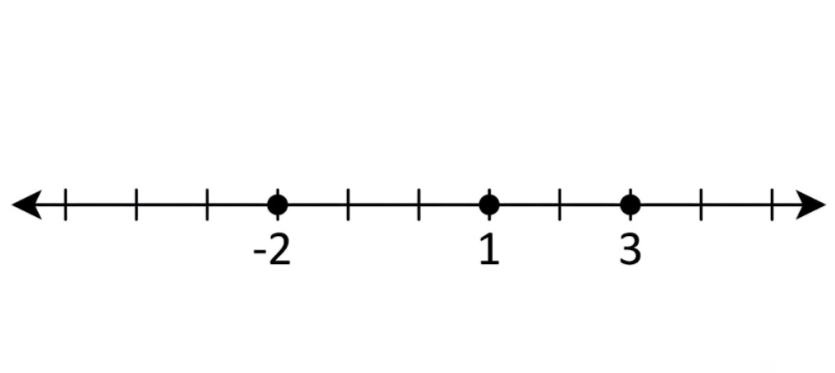
(-\infty,-2), (-2,1), (1,3), and (3,\infty).
Testing a value in each interval reveals the sign of f'(x):
- For x<-2, f'(x)<0
- For -2<x<1, f'(x)>0
- For 1<x<3, f'(x)<0
- For x>3, f'(x)>0
Final Answer: Strictly Increasing in the intervals: (-2,1)\cup(3,\infty)
Strictly Decreasing in the intervals: (-\infty,-2)\cup(1,3)
Q7. Prove that y=\frac{4\sin\theta}{2+\cos\theta}-\theta is an increasing function in [0,\frac{\pi}{2}].
Solution:
To prove a function is increasing, we need to show that its derivative with respect to \theta is non-negative in the given interval.
Differentiate using the quotient rule: \frac{dy}{d\theta}=\frac{(2+\cos\theta)(4\cos\theta)-(4\sin\theta)(-\sin\theta)}{(2+\cos\theta)^2}-1
\frac{dy}{d\theta}=\frac{8\cos\theta+4\cos^2\theta+4\sin^2\theta}{(2+\cos\theta)^2}-1
Using the fundamental trigonometric identity \sin^2\theta+\cos^2\theta=1:
\frac{dy}{d\theta}=\frac{8\cos\theta+4(1)}{(2+\cos\theta)^2}-1=\frac{8\cos\theta+4}{(2+\cos\theta)^2}-1
Take the LCM to combine terms: \frac{dy}{d\theta}=\frac{8\cos\theta+4-(2+\cos\theta)^2}{(2+\cos\theta)^2}
Expand the squared term: \frac{dy}{d\theta}=\frac{8\cos\theta+4-(4+4\cos\theta+\cos^2\theta)}{(2+\cos\theta)^2}
\frac{dy}{d\theta}=\frac{4\cos\theta-\cos^2\theta}{(2+\cos\theta)^2}=\frac{\cos\theta(4-\cos\theta)}{(2+\cos\theta)^2}
Now, let’s analyze the expression in the interval [0,\frac{\pi}{2}]:
- \cos\theta\ge0 (in the first quadrant).
- The maximum value of \cos\theta is 1, so (4-\cos\theta) is always positive.
- The denominator (2+\cos\theta)^2 is a perfect square and thus always positive.
Since all factors are positive or zero, \frac{dy}{d\theta}\ge0.
Conclusion: Therefore, y is an increasing function in [0,\frac{\pi}{2}].
5-Mark Questions
Q8. Show that the altitude of the right circular cone of maximum volume that can be described in a sphere of radius r is \frac{4r}{3}. Also show that the maximum volume of the cone is \frac{8}{27} of the volume of the sphere.
Solution:
Let the sphere have a fixed radius r.
Let the inscribed cone have base radius R and altitude h.
Let the distance from the center of the sphere to the base of the cone be x.
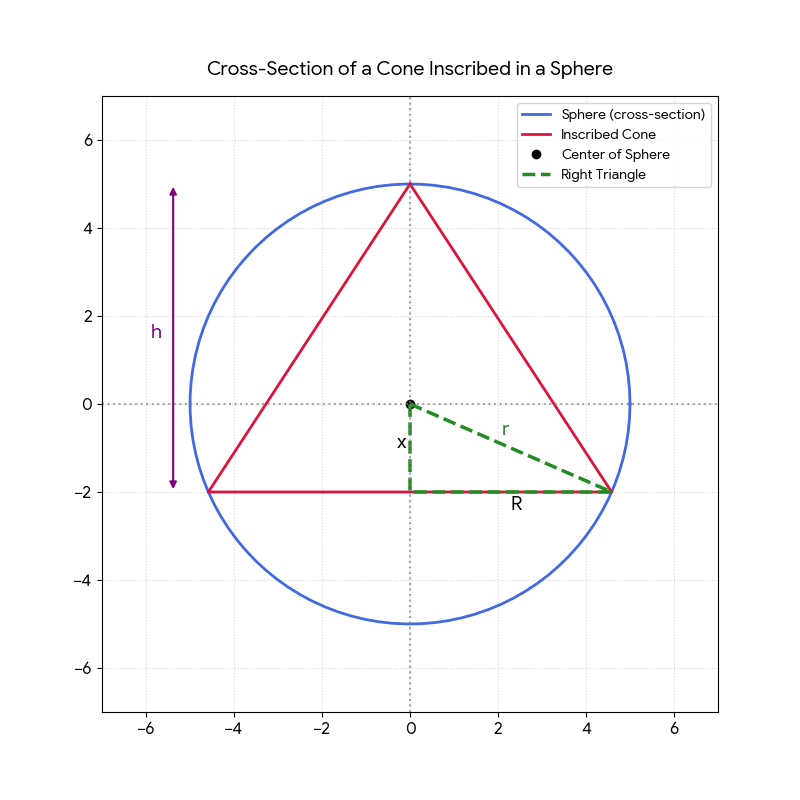
From the geometry of the figure, the altitude of the cone is h=r+x.
Using the Pythagorean theorem inside the sphere, we relate the radii: R^2+x^2=r^2\implies R^2=r^2-x^2
The volume of the cone is V=\frac{1}{3}\pi R^2h.
Substitute R^2 and h:
V=\frac{1}{3}\pi(r^2-x^2)(r+x)
To maximize the volume, find \frac{dV}{dx}: \frac{dV}{dx}=\frac{\pi}{3}[(-2x)(r+x)+(r^2-x^2)(1)]
\frac{dV}{dx}=\frac{\pi}{3}[-2rx-2x^2+r^2-x^2]=\frac{\pi}{3}[r^2-2rx-3x^2]
Set \frac{dV}{dx}=0 to find the critical points:
3x^2+2rx-r^2=0
(3x-r)(x+r)=0
x=\frac{r}{3} or x=-r.
We reject x=-r because it would mean the altitude h=0.
So, the altitude is h=r+x=r+\frac{r}{3}=\frac{4r}{3}.
To verify it’s a maximum, check the second derivative:
\frac{d^2V}{dx^2}=\frac{\pi}{3}[-2r-6x]
At x=\frac{r}{3}, \frac{d^2V}{dx^2}=\frac{\pi}{3}[-4r]<0.
Since it is negative, the volume is indeed maximized!
Now, substitute x=\frac{r}{3} back into the volume formula to find V_{max}:
V_{max}=\frac{1}{3}\pi(r^2-(\frac{r}{3})^2)(r+\frac{r}{3})
V_{max}=\frac{1}{3}\pi(r^2-\frac{r^2}{9})(\frac{4r}{3})=\frac{1}{3}\pi(\frac{8r^2}{9})(\frac{4r}{3})=\frac{32\pi r^3}{81}
To relate this to the volume of the sphere
(V_{sphere}=\frac{4}{3}\pi r^3):
V_{max}=\frac{8}{27}(\frac{4}{3}\pi r^3)=\frac{8}{27}V_{sphere} (Hence Proved).
Q9. Find the area of the greatest rectangle that can be inscribed in the ellipse \frac{x^2}{a^2}+\frac{y^2}{b^2}=1.
Solution:
Let the vertex of the rectangle in the first quadrant be defined parametrically as (a\cos\theta,b\sin\theta).
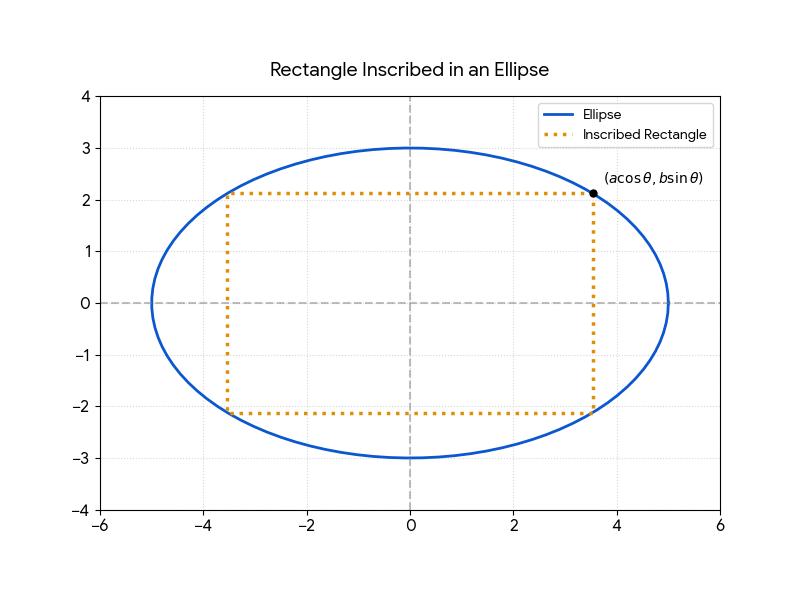
Due to symmetry, the total length of the rectangle is 2a\cos\theta and the total width is 2b\sin\theta.
The area A of the rectangle is: A=(2a\cos\theta)(2b\sin\theta)=4ab\sin\theta\cos\theta
Using the double angle identity, \sin(2\theta)=2\sin\theta\cos\theta, we can rewrite the area as: A=2ab\sin(2\theta)
To find the greatest area, we must maximize A.
We know the maximum value of the sine function is 1, which occurs when 2\theta=\frac{\pi}{2}
(or \theta=\frac{\pi}{4}).
Substituting the maximum sine value: A_{max}=2ab(1)=2ab
Final Answer: The area of the greatest rectangle that can be inscribed in the ellipse is 2ab square units.
I hope you found these solutions clear and helpful. Let me know in the comments below if you have any doubts or need clarifications about a specific step from any of the questions.
Class 12 Application of Derivatives Test-1 2027 ⇒