
Class 12 Linear Programming Problem Test ⇒
Q1. For the linear programming problem (LPP), the objective function is Z=4x+3y and the feasible region determined by a set of constraints is shown in the graph.
Which of the following statements is true?
(A) Maximum value of Z is at R(40,0)
(B) Maximum value of Z is at Q(30,20)
(C) Value of Z at R(40,0) is less than the value at P(0,40)
(D) The value of Z at Q(30,20) is less than the value at R(40,0)
Solution:
The objective function to be maximized or minimized is given as Z = 4x + 3y.
Identify the corner points of the feasible region:
From the provided graph of the LPP, the bounded feasible region has four distinct corner points (vertices):
O(0,0),
P(0,40),
Q(30,20), and
R(40,0).
According to the Corner Point Theorem in Linear Programming, the optimal value (maximum or minimum) of a linear objective function will always occur at one of the vertices of the feasible region.
Evaluate the objective function Z at each corner point:
- At point O(0,0): Z = 4(0) + 3(0) = 0
- At point P(0,40): Z = 4(0) + 3(40) = 0 + 120 = 120
- At point Q(30,20): Z = 4(30) + 3(20) = 120 + 60 = 180
- At point R(40,0): Z = 4(40) + 3(0) = 160 + 0 = 160
Analyze the given options based on our calculated values:
The calculated maximum value of Z across all points is 180.
This maximum is achieved precisely at point Q(30,20). This confirms statement (B) is true.
The value at R(40,0) is 160, and the value at P(0,40) is 120.
Because 160 is strictly greater than 120, statement (C) is false.
The value at Q(30,20) is 180, and the value at R(40,0) is 160.
Because 180 is strictly greater than 160, statement (D) is false.
Correct Option: (B)
Q2. An LPP has an objective function Z=18x+10y that needs to be minimized, with a stated smallest value of 134 occurring at the corner point (3,8).
Based on the corresponding graph showing an unbounded feasible region, what is the status of this optimal solution?
(A) It does not exist as the feasible region is unbounded.
(B) It does not exist as the inequality 18x+10y<134 does not have any point in common with the feasible region.
(C) It exists as the inequality 18x+10y>134 has infinitely many points in common with the feasible region.
(D) It exists as the inequality 18x+10y<134 does not have any point in common with the feasible region.
Solution:
In Linear Programming, when a feasible region is unbounded, a calculated minimum value m (in this case, 134) is only the true optimal minimum if the open half-plane formed by ax + by < m shares absolutely no points with the feasible region.
Therefore, for 134 to be the confirmed minimum, the region defined by the strict inequality 18x+10y < 134 must not overlap or have any points in common with the unshaded feasible region on the graph.
Since this mathematical condition guarantees the existence of the minimum in an unbounded region, statement (D) correctly explains the justification.
Correct Option: (D)
Q3. A student of class XII studying Mathematics comes across an incomplete question in a book.
Maximize: Z=3x+2y+1
Subject to the constraints: x\ge0, y\ge0, and 3x+4y\le12.
He/ She notices the below shown graph for the said LPP problem, and finds that a constraint is missing in it:
Help him/her choose the required constraint from the graph.
The missing constraint is:
(A) x+2y\le2
(B) 2x+y\ge2
(C) 2x+y\le2
(D) x+2y\ge2
Solution:
Analyze the two boundary lines visible in the provided graph.
#Upper Boundary.
The upper boundary line connects the y-intercept (0,3) and the x-intercept (4,0).
Using the intercept form of a line equation \frac{x}{a} + \frac{y}{b} = 1,
this gives \frac{x}{4} + \frac{y}{3} = 1,
which simplifies to 3x+4y = 12.
The region is below this line, confirming the given constraint 3x+4y\le12.
#Lower Boundary
Identify the lower boundary line on the graph.
It passes perfectly through the x-axis at 1, making the x-intercept (1,0), and through the y-axis at 2, making the y-intercept (0,2).
Formulate the equation for this second line using the intercepts:
\frac{x}{1} + \frac{y}{2} = 1
2x + y = 2.
Determine the direction of the inequality.
The shaded feasible region is located above and to the right of this line, directed away from the origin (0,0).
We can verify this by picking a test point clearly inside the shaded region, such as (2,2).
Substitute (2,2) into the expression: 2(2) + 2 = 6.
Since 6 is strictly greater than or equal to 2, the inequality must be 2x+y\ge2.
Correct Option: (B)
Q4. If the objective function Z=ax+by+c (where a, b, c > 0) attains its maximum value at exactly two corner points, (4,0) and (0,3), of a feasible region, determined by the system of linear inequalities which relationship is true?
(A) 4a=3b
(B) 3a=4b
(C) 4a+c=3b
(D) 3a+c=4
Solution:
According to the principles of Linear Programming, if an objective function attains a maximum (or minimum) at two distinct corner points, the value of the objective function must be perfectly equal at both of those points.
Calculate the value of Z at the first corner point (4,0):
Z_{(4, 0)} = a(4) + b(0) + c = 4a + c
Calculate the value of Z at the second corner point (0,3):
Z_{(0 , 3)} = a(0) + b(3) + c = 3b + c
Equate the two maximum values:
4a + c = 3b + c
4a = 3b
Correct Option: (A)
Q5. The graph of the inequality 3x+5y<10 geometrically represents the:
(A) Entire XY-plane
(B) Open Half plane that doesn’t contain origin
(C) Open Half plane that contains origin, but not the points of the line 3x+5y=10
(D) Half plane that contains origin and the points of the line 3x+5y=10
Solution:
Check the type of inequality.
Because it is a strict inequality (“<” rather than “\le“), the boundary line 3x+5y=10 is not included in the solution set.
This means the region must be an “open” half-plane.
This immediately eliminates option (D) and option (A).
Determine which side of the open half-plane is valid by using the origin (0,0) as a test point.
Substitute x=0 and y=0 into the inequality:
3(0) + 5(0) < 10
0 < 10
Since the statement 0 < 10 is mathematically true, the open half-plane representing the solution set does indeed contain the origin.
Correct Option: (C)
Q6. Solve graphically:
Maximise Z=2x+y
subject to
x+y \le 1200,
x+y\ge600,
y\le\frac{x}{2},
x\ge0, y\ge0
Solution:
First, convert the inequalities into equations to find the boundary lines and their coordinate intercepts.
Line 1: x+y = 1200.
The intercepts are (1200, 0) and (0, 1200).
The region is below this line (towards origin).
Line 2: x+y = 600.
The intercepts are (600, 0) and (0, 600).
The region is above this line (away from origin).
Line 3: y = \frac{x}{2},
which rewrites to x - 2y = 0.
This line passes through the origin (0,0).
To find another point, if x=1000, y=500.
The constraint y\le\frac{x}{2} means the region lies below and to the right of this line.
The constraints x\ge0 and y\ge0 restrict the feasible region entirely to the first quadrant.
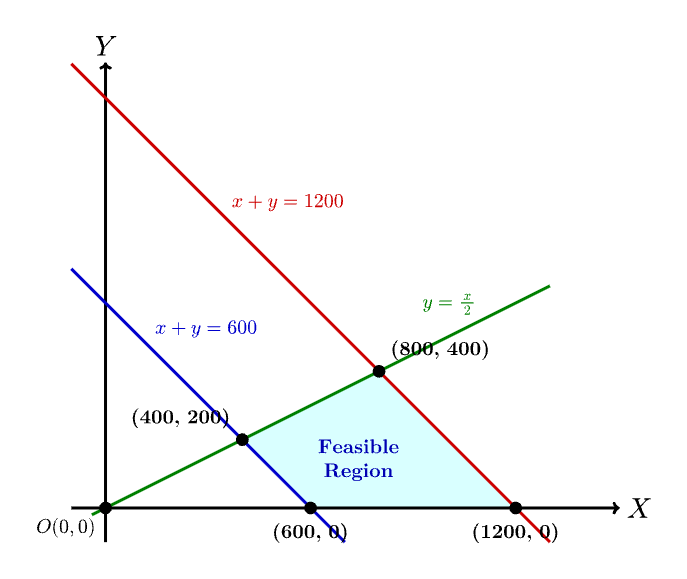
Identify the corner points (vertices) by finding the intersections of these boundary lines:
Intersection A (Line 2 and x-axis):
Set y=0 in x+y=600 \Rightarrow x=600.
Point is (600, 0).
Intersection B (Line 1 and x-axis):
Set y=0 in x+y=1200 \Rightarrow x=1200.
Point is (1200, 0).
Intersection C (Line 1 and Line 3):
Substitute x=2y into x+y=1200 \Rightarrow 2y+y=1200 \Rightarrow 3y=1200 \Rightarrow y=400.
Thus, x=800.
Point is (800, 400).
Intersection D (Line 2 and Line 3):
Substitute x=2y into x+y=600 \Rightarrow 2y+y=600 \Rightarrow 3y=600 \Rightarrow y=200.
Thus, x=400.
Point is (400, 200).
Evaluate the objective function Z=2x+y at each corner point:
| Corner Point | Value of [/latex] Z=2x+y[/latex] |
| (600, 0) | Z = 2(600) + 0 = 1200 |
| (1200, 0) | Z = 2(1200) + 0 = 2400 |
| (800, 400) | Z = 2(800) + 400 = 1600 + 400 = 2000 |
| (400, 200) | Z = 2(400) + 200 = 800 + 200 = 1000 |
Final Answer: The maximum value of Z is 2400, which occurs at the point (1200, 0).
Q7. Solve Graphically:
Minimize Z=3x+2y
Subject to
x+y \ge 8
3x+5y\le15
x \ge 0, \ y\ge0
Solution:
Convert the inequalities to line equations to map the boundaries on the first quadrant.
Line 1: x+y = 8.
The intercepts are (8,0) and (0,8).
The inequality x+y\ge8 indicates the region lies above and to the right of this line.
Line 2: 3x+5y = 15.
The intercepts are (5,0) and (0,3).
The inequality 3x+5y\le15 indicates the region lies below and to the left of this line.
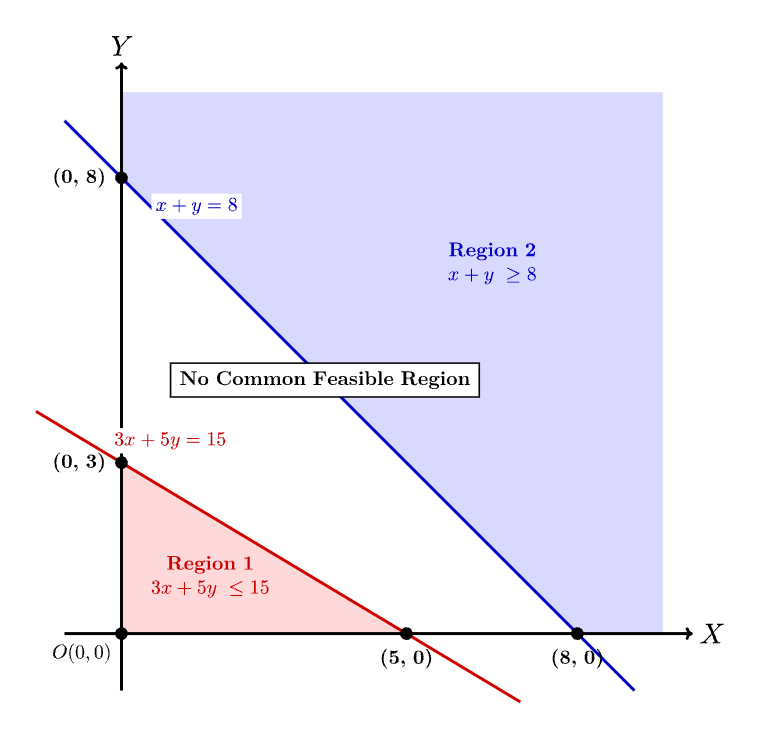
Analyze the spatial relationship between the two defined regions in the first quadrant.
For the constraint 3x+5y\le15, the highest possible x-value is 5 (when y=0) and the highest possible y-value is 3 (when x=0).
Thus, for any point satisfying this constraint, the sum x+y can never be greater than 5.
However, the first constraint strictly requires x+y\ge8.
It is mathematically impossible for a coordinate pair to have a sum less than or equal to 5 while simultaneously having a sum greater than or equal to 8.
Because the two regions do not overlap at any point on the Cartesian plane, there is no common area.
Final Answer: There is no feasible region for this set of constraints, and therefore, no optimal minimum solution exists for Z.
Q8. Consider the following Linear Programming Problem:
Minimise z=x+2y
Subject to
2x+y\ge3
x+2y\ge6
x\ge0, y\ge0
Show graphically that the minimum of Z occurs at more than two points
Solution:
Convert the inequalities to line equations to establish the graphical boundaries.
Line 1: 2x+y = 3.
Intercepts are (1.5, 0) and (0, 3).
The region is above this line.
Line 2: x+2y = 6.
Intercepts are (6, 0) and (0, 3). The region is also above this line.
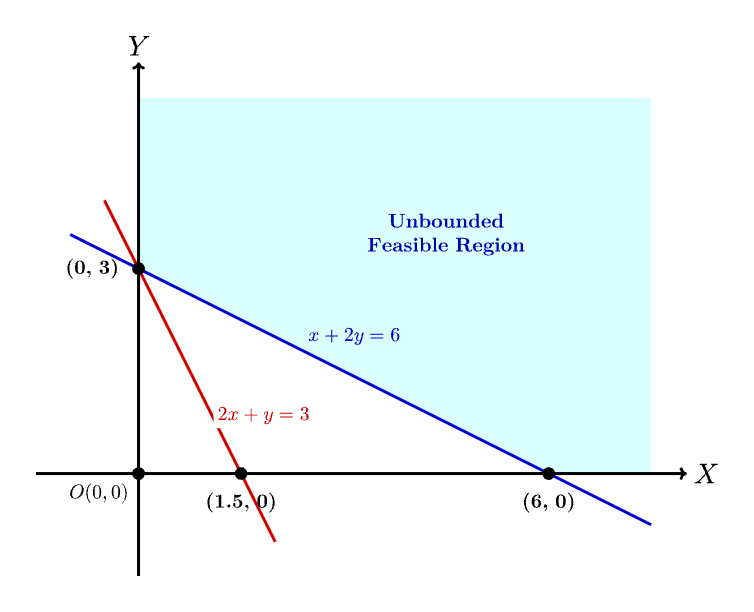
Graphically, the feasible region is unbounded and lies entirely in the first quadrant, bounded from below by the outermost segments of these intersecting lines.
Find the corner points of the feasible region.
The two boundary lines intersect at the y-intercept (0,3).
The outermost x-intercept bounding the region is (6,0).
Thus, the corner points are (0,3) and (6,0).
Evaluate the objective function Z=x+2y at both corner points:
| Corner Point | Value of [/latex] Z=x+2y[/latex] |
| (0, 3) | Z = 0 + 2(3) = 6, m |
| (6, 0) | Z = 6 + 2(0) = 6, m |
Because the feasible region is unbounded, we must theoretically verify that this value is a true minimum by checking the open half-plane x+2y < 6.
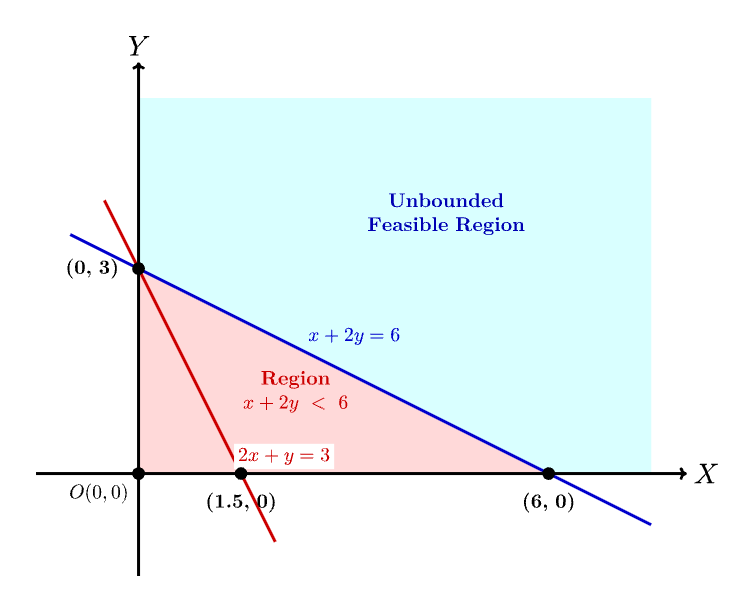
Since the feasible region is rigidly constrained by x+2y \ge 6, the open half-plane shares absolutely no common points with our feasible region.
Therefore, 6 is definitively the minimum value.
The minimum value of Z is identically 6 at two distinct adjacent corner points, (0,3) and (6,0).
According to linear programming principles, if the optimal value occurs at two corner points, it will also occur at every single point on the line segment joining them.
Final Answer: Because the minimum value of 6 is achieved at every coordinate along the line segment between (0,3) and (6,0) on the graph, it is proven that the minimum of Z occurs at infinitely many points between (0, 3) and (6, 0), fulfilling the condition of “more than two points”.
Class 12 Linear Programming Problem Test ⇒