
Q1. In the figure, given below, if XY \parallel QR , PX = 1 cm, QX = 3 cm, YR = 4.5 cm and QR = 9 cm, find PY and XY.
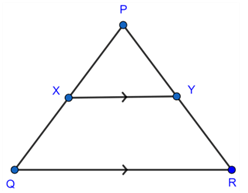
Solution:
Part 1: Finding the length of PY
Since XY \parallel QR,
Using Basic Proportionality Theorem (often called Thales’s Theorem).
This theorem tells us that the parallel line divides the other two sides in the exact same ratio.
\frac{PX}{QX} = \frac{PY}{YR}
Substituting values:
\frac{1}{3} = \frac{PY}{4.5}
PY = \frac{4.5}{3}
\boxed{PY = 1.5 \text{ cm}}
Part 2: Finding the length of XY
Let’s look at the smaller top triangle (\Delta PXY) and compare it to the overall large triangle (\Delta PQR).
Because the lines XY and QR are parallel, their corresponding angles are equal:
\angle PXY = \angle PQR
\angle PYX = \angle PRQ
\angle P is exactly the same for both triangles (it is a common angle).
By the AAA (Angle-Angle-Angle) similarity criterion, we can confidently state that \Delta PXY \sim \Delta PQR.
When two triangles are similar, the ratio of all their corresponding sides is equal:
\frac{PX}{PQ} = \frac{XY}{QR}
PQ = PX + QX = 1 \text{ cm} + 3 \text{ cm} = 4 \text{ cm}.
Now, we can substitute our known values into the similarity ratio:
\frac{1}{4} = \frac{XY}{9}
XY = \frac{9}{4}
\boxed{XY = 2.25 \text{ cm}}
Final Answer: The lengths of the unknown segments are PY = 1.5 \text{ cm} and XY = 2.25 \text{ cm}.
Q2. Find x
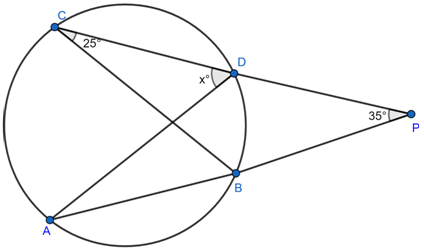
Solution:
Part 1: Finding the interior angles of the cyclic quadrilateral In the given figure,
A, B, D, C form a cyclic quadrilateral on the circle.
The angle bounded by chord BC and CD is given as \angle BCD = 25^\circ.
The external angle of \Delta PBC at vertex B is \angle ABC.
According to the exterior angle theorem, the exterior angle of a triangle is equal to the sum of the two opposite interior angles.
\angle ABC = \angle BCD + \angle P
Substituting the known values:
\angle ABC = 25^\circ + 35^\circ = 60^\circ
Part 2: Finding the value of x
Angles subtended by the same arc at the circumference are equal.
Both \angle ADC and \angle ABC are subtended by the same arc AC.
\angle ADC = \angle ABC
\angle ADC = 60^\circ
In the diagram, x represents the measure of \angle ADC.
Final Answer: \boxed{x = 60^\circ}
Q3. In the figure (i) given below, PR is a diameter of the circle, PQ=7~cm, QR=6 cm and RS=2 cm. Calculate the perimeter of the cyclic quadrilateral PQRS.
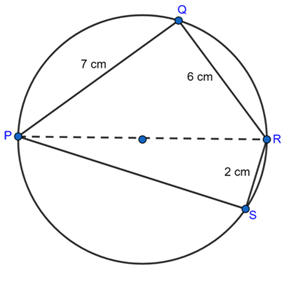
Solution:
Part 1: Finding the length of PR Since PR is the diameter of the circle, the angle in a semicircle is a right angle.
Therefore, \angle PQR = 90^\circ and \angle PSR = 90^\circ.
In the right-angled \Delta PQR, we apply the Pythagorean theorem:
PR^2 = PQ^2 + QR^2
PR^2 = 7^2 + 6^2
PR^2 = 49 + 36
PR^2 = 85
Part 2: Finding the length of PS
In the right-angled \Delta PSR, we apply the Pythagorean theorem again:
PR^2 = PS^2 + RS^2
Substituting the known values:
85 = PS^2 + 2^2
PS^2 = 85 - 4 = 81
PS = \sqrt{81} = 9 \text{ cm}
Part 3: Calculating the perimeter
The perimeter of the cyclic quadrilateral PQRS is the sum of all its sides:
\text{Perimeter} = PQ + QR + RS + PS
\text{Perimeter} = 7 + 6 + 2 + 9
Final Answer: \boxed{\text{Perimeter} = 24 \text{ cm}}
Q4 In figure (ii) given below, quadrilateral ABCD is circumscribed, find x.
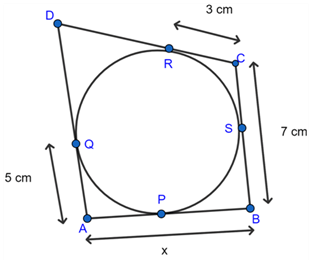
Solution:
Part 1: Applying tangent properties When a quadrilateral circumscribes a circle, the lengths of the two tangents drawn from an external point to the circle are equal.
From point A, the tangents are AQ and AP.
So, AP = AQ = 5 \text{ cm}.
From point C, the tangents are CR and CS.
So, CS = CR = 3 \text{ cm}.
Part 2: Finding the length of PB
We are given the total length of side BC = 7 \text{ cm}.
Since BC = CS + SB, we can find SB:
7 = 3 + SB
SB = 4 \text{ cm}
From point B, the tangents are SB and PB.
So, PB = SB = 4 \text{ cm}.
Part 3: Calculating x (length of AB)
The side AB (which is x) is composed of segments AP and PB.
AB = AP + PB
x = 5 + 4
Final Answer: \boxed{x = 9 \text{ cm}}
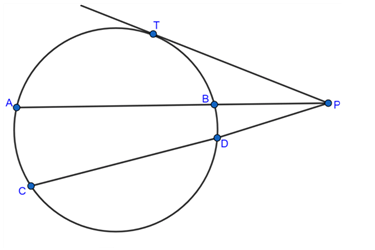
Q5. In the figure (ii) given below, diameter AB and chord CD of a circle meet at P. PT is a tangent to the circle at T. CD=7.8 cm, PD=5 cm, PB=4 cm. Find :
(i) AB
(ii) the length of tangent PT.
Solution:
Part 1: Finding the length of AB
When two secants intersect outside a circle, the product of the secant segment and its external portion is equal for both secants.PA \times PB = PC \times PD
We know PD = 5 \text{ cm} and CD = 7.8 \text{ cm}.
The total length PC = PD + CD = 5 + 7.8 = 12.8 \text{ cm}.
Substituting the known values (PB = 4 \text{ cm}):
PA \times 4 = 12.8 \times 5
4PA = 64
PA = 16 \text{ cm}
Since PA = AB + PB, we can solve for the diameter AB:
16 = AB + 4
AB = 12 \text{ cm}
Part 2: Finding the length of tangent PT
The tangent-secant theorem states that the square of the tangent length equals the product of the secant segment and its external portion.
PT^2 = PA \times PB
PT^2 = 16 \times 4 = 64
PT = \sqrt{64} = 8 \text{ cm}
Final Answer: \boxed{AB = 12 \text{ cm}, PT = 8 \text{ cm}}
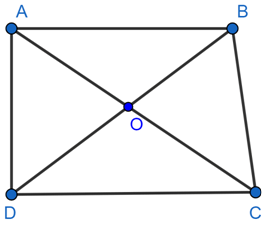
Q6. In the adjoining figure, ABCD is a trapezium in which AB || DC. The diagonals AC and BD intersect at O. Prove that \frac{AO}{OC}=\frac{BO}{OD} .
Using the above result, find the value(s) of x if OA=3x-19, OB=x-4, OC=x-3 and OD=4.
Solution:
Part 1: Proving the ratio
In \Delta AOB and \Delta COD:
\angle AOB = \angle COD … (Vertically opposite angles)
\angle OAB = \angle OCD … (Alternate interior angles, since AB \parallel DC)
\angle OBA = \angle ODC … (Alternate interior angles)
By the AAA (Angle-Angle-Angle) similarity criterion,
\Delta AOB \sim \Delta COD.
When triangles are similar, their corresponding sides are proportional:
\frac{AO}{CO} = \frac{BO}{DO}
Hence proved. \frac{AO}{CO} = \frac{BO}{DO}.
Part 2: Finding the value of x
Substitute the given algebraic expressions into the proven ratio:
\frac{3x-19}{x-3} = \frac{x-4}{4}
4(3x - 19) = (x - 3)(x - 4)
12x - 76 = x^2 - 7x + 12
x^2 - 19x + 88 = 0
x^2 -11x - 8x +88 = 0
x(x-11) - 8(x -11) = 0
(x - 8)(x - 11) = 0
Final Answer: \boxed{x = 8 \text{ or } x = 11}
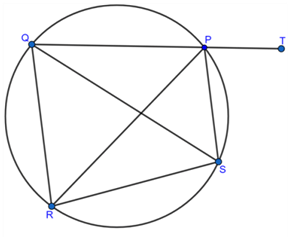
Q7. In the figure given below, SP is the bisector of ZRPT and PQRS is a cyclic quadrilateral. Prove that SQ=RS.
Solution:
#Utilizing the angle bisector
Let the exterior angle be bounded by the straight line extended from QP to T.
Since SP is the angle bisector of \angle RPT, it divides the angle into two equal parts:
Let, \angle RPS = \angle SPT = x
Angles subtended by the same arc at the circumference are equal.
Both \angle SQR and \angle SPR (which is \angle RPS) are subtended by arc SR:
\angle SQR = \angle SPR = x
#Applying cyclic quadrilateral properties
The angle \angle SPQ and exterior angle \angle SPT form a linear pair on the straight line segment QPT:
\angle SPQ = 180^\circ - x
In the cyclic quadrilateral PQRS, the sum of opposite interior angles is 180^\circ:
\angle SRQ + \angle SPQ = 180^\circ
Substituting the value of \angle SPQ:
\angle SRQ + (180^\circ - x) = 180^\circ
\angle SRQ = x
#Proving the sides are equal
In \Delta SQR, we have established that:
\angle SQR = x
and
\angle SRQ = x
Since two angles of the triangle are equal (\angle SQR = \angle SRQ), the sides opposite to those angles must also be equal.
Final Answer: \boxed{SQ = RS}
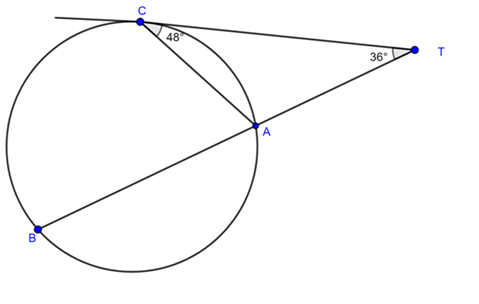
Q8. In the figure given below, A, B and C are three points on a circle. The tangent at C meets BA produced at T. Given that \angle ATC=36^{\circ} and \angle ACT=48^{\circ}, calculate the angle subtended by AB at the centre of the circle.
Solution:
#Finding the angles of triangle ABC
In \Delta ACT, the sum of angles is 180^\circ.
We can find \angle CAT:
\angle CAT = 180^\circ - (36^\circ + 48^\circ) = 180^\circ - 84^\circ = 96^\circ
Since B-A-T forms a straight line, \angle CAB and \angle CAT are supplementary:\angle CAB = 180^\circ - 96^\circ = 84^\circ
According to the Alternate Segment Theorem, the angle between the tangent CT and chord AC is equal to the angle in the alternate segment:
\angle ABC = \angle ACT = 48^\circ
Now, in \Delta ABC, we can find the third angle \angle ACB:
\angle ACB = 180^\circ - (84^\circ + 48^\circ) = 180^\circ - 132^\circ = 48^\circ
#Calculating the angle at the centre
The angle subtended by an arc at the centre is double the angle subtended by it at any remaining part of the circle.
The angle subtended by arc AB at the circumference is \angle ACB = 48^\circ.
\text{Angle at centre} = 2 \times \angle ACB
\text{Angle at centre} = 2 \times 48^\circ
Final Answer: \boxed{96^\circ}
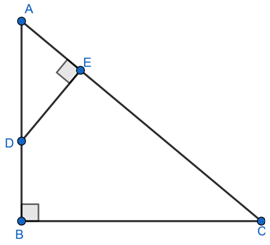
Q9. ABC is a right angled triangle with \angle ABC=90^{\circ} D is any point on AB and DE is perpendicular to AC.
(i) Prove that \triangle ADE\sim\triangle ACB.
(ii) If AC=13~cm, BC=5 cm and AE=4 cm. Find DE and AD.
(iii) Find, area of \triangle ADE: area of quadrilateral BCED.
Solution:
#Proving the triangles are similar
In \Delta ADE and \Delta ACB:
\angle DAE = \angle CAB … (This is a common angle to both triangles)
\angle AED = \angle ABC = 90^\circ … (Given in the problem statement)
By the AA (Angle-Angle) similarity criterion, we can state that: \Delta ADE \sim \Delta ACB
#Finding lengths DE and AD
First, we find the length of AB in the right-angled \Delta ACB using the Pythagorean theorem:
AB = \sqrt{AC^2 - BC^2} = \sqrt{13^2 - 5^2} = \sqrt{169 - 25} = \sqrt{144} = 12 \text{ cm}
Since \Delta ADE \sim \Delta ACB, the ratio of their corresponding sides is equal:
\frac{AD}{AC} = \frac{DE}{BC} = \frac{AE}{AB}
Substituting the known values:
\frac{AD}{13} = \frac{DE}{5} = \frac{4}{12}
\frac{4}{12} = \frac{1}{3},
AD = 13 \times \frac{1}{3} = 4.33 \text{ cm}
DE = 5 \times \frac{1}{3} = 1.67 \text{ cm}
#Finding the ratio of areas
The ratio of the areas of two similar triangles is equal to the square of the ratio of their corresponding sides:
\frac{\text{Area}(\Delta ADE)}{\text{Area}(\Delta ACB)} = \left(\frac{AE}{AB}\right)^2 = \left(\frac{1}{3}\right)^2 = \frac{1}{9}
If the area of \Delta ADE is 1 part, the area of \Delta ACB is 9 parts.
The area of the quadrilateral BCED is the difference between the large and small triangle:
\text{Area}(BCED) = 9 - 1 = 8 \text{ parts}
Final Answer: \boxed{AD = 13/3 \text{ cm}, DE = 5/3 \text{ cm}, \text{ Area Ratio} = 1:8}
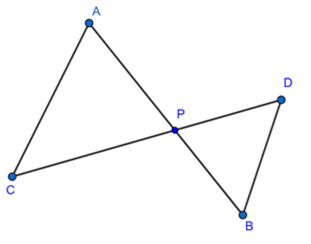
Q10. In the figure (1) given below, AP=2PB and CP=2PD.
(i) Prove that \triangle ACP is similar to \triangle BDP and AC || BD.
(ii) If AC=4.5 cm, calculate the length of BD.
Solution:
(i) Proving similarity and parallel lines
In \Delta ACP and \Delta BDP,
\angle APC = \angle BPD … vertically opposite angles at intersection P
We are given the relationships of the segment lengths:
AP = 2PB \implies \frac{AP}{PB} = 2
CP = 2PD \implies \frac{CP}{PD} = 2
\frac{AP}{PB} = \frac{CP}{PD}
by the SAS (Side-Angle-Side) criterion:
\Delta ACP \sim \Delta BDP Hence Proved
Because the triangles are similar, their corresponding angles are equal:
\angle CAP = \angle DBP
Since these are alternate interior angles and they are equal, the lines forming them must be parallel:
AC \parallel BD Hence Proved
(ii) Calculating the length of BD
Using the similarity ratio we established:
\frac{AC}{BD} = \frac{AP}{PB} = 2
Substituting the given value of AC = 4.5 \text{ cm}:
\frac{4.5}{BD} = 2
BD = \frac{4.5}{2}
Final Answer: \boxed{BD = 2.25 \text{ cm}}