
Class 9 Rectilinear Figures Test ⇒
Q1: If PQRS is a parallelogram, then \angle Q-\angle S is equal to
a) 90^{\circ}
b) 120^{\circ}
c) 0^{\circ}
d) 180^{\circ}
Solution:
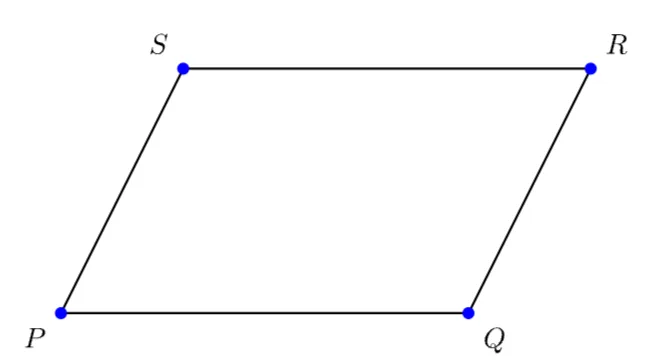
We know, The opposite angles of a parallelogram are always equal in measure.
\angle Q and \angle S are opposite angles.
\angle Q = \angle S
\angle Q - \angle S = 0^{\circ}
Correct option: (c)
Q2. The diagonals AC and BD of a parallelogram ABCD intersect each other at the point O. If \angle DAC=32^{\circ} and \angle AOB=70^{\circ} then \angle DBC is equal to
a) 24^{\circ}
b) 86^{\circ}
c) 38^{\circ}
d) 32^{\circ}
Solution:
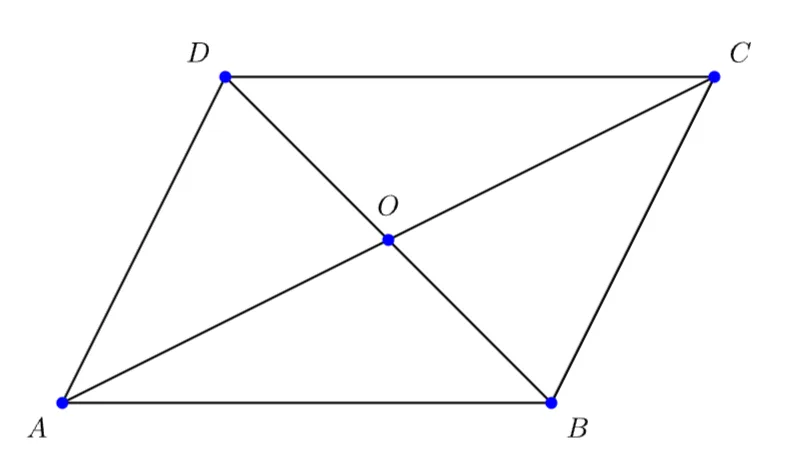
In a parallelogram, opposite sides are parallel.
Since AD || BC, the alternate interior angles formed by the transversal AC are equal.
\angle BCA = \angle DAC = 32^{\circ}
Now, look at \Delta BOC.
The exterior angle of a triangle is always equal to the sum of the two opposite interior angles.
\angle AOB = \angle OBC + \angle OCB
(Note that \angle OBC is the same as \angle DBC, and \angle OCB is \angle BCA)
70^{\circ} = \angle DBC + 32^{\circ}
\angle DBC = 70^{\circ} - 32^{\circ}
\angle DBC = 38^{\circ}
Correct Option: (c)
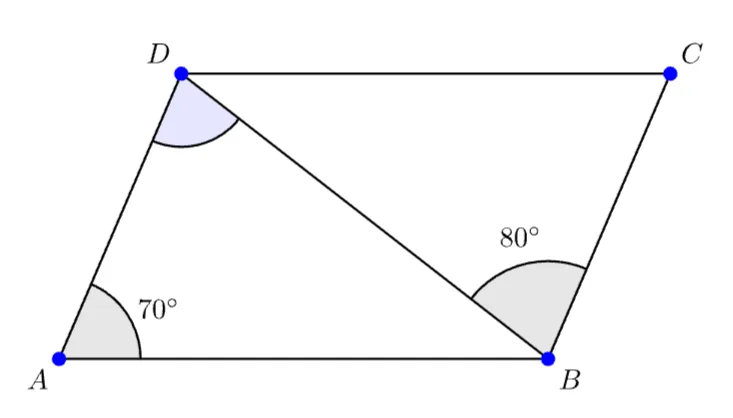
Q3. In the figure given below, ABCD is a parallelogram in which \angle DAB=70^{\circ}, \angle DBC=80^{\circ}. What is the value of angle ADB.
a) 60^{\circ}
b) 70^{\circ}
c) 80^{\circ}
d) 90^{\circ}
Solution:
In a parallelogram, the opposite sides are parallel (AD || BC).
When a transversal line (in this case, the diagonal BD) intersects two parallel lines, the alternate interior angles are equal.
\angle ADB and \angle DBC are alternate interior angles.
Therefore, \angle ADB = \angle DBC.
\angle ADB = 80^{\circ},
Correct Option: (c)
Q4. Which of the following statement is true for a parallelogram?
a) Its diagonals are equal.
b) Its diagonals are perpendicular to each other.
c) The diagonals divide the parallelogram into four congruent triangles.
d) The diagonals bisect each other.
Solution:
Equal diagonals (a) are a property of rectangles and squares, not all parallelograms.
Perpendicular diagonals (b) are a property of rhombuses, squares and kites.
Diagonals dividing the shape into four congruent triangles (c) is a property of a rhombus and square.
However, for every parallelogram, the diagonals cut each other perfectly in half.
Therefore diagonals of a parellelogram bisect each other.
Correct Option: (d)
Q5. ABCD is a square. A is joined to a point P on BC and D is joined to a point Q on AB. If AP=DQ prove that AP and DQ are perpendicular to each other.
Solution:
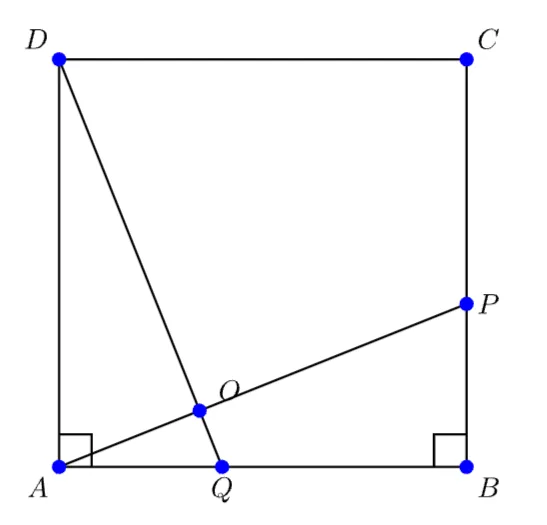
Let the line segments AP and DQ intersect at a point O.
We need to prove that \angle AOQ = 90^{\circ}.
In \Delta ABP and \Delta DAQ:
AB = DA (All sides of a square are equal)
\angle ABP = \angle DAQ = 90^{\circ} (All angles of a square are right angles)
AP = DQ (This is given in the question)
By the RHS (Right angle – Hypotenuse – Side) congruence criterion, \Delta ABP \cong \Delta DAQ.
Because the triangles are congruent, their corresponding angles are equal (CPCTC):
\angle BAP = \angle ADQ
Now, let’s look at the right-angled \Delta DAQ.
The sum of its acute angles must be 90^{\circ}:
\angle ADQ + \angle AQD = 90^{\circ}
Substitute \angle BAP in place of \angle ADQ:
\angle BAP + \angle AQD = 90^{\circ}
Focus on the small \Delta AOQ formed by the intersection.
The sum of its angles is 180^{\circ}:
\angle AOQ = 180 ^{\circ} - (\angle BAP + \angle AQD)
\angle AOQ = 180^{\circ} - 90^{\circ} = 90^{\circ}
Since the angle of intersection is 90^{\circ}, AP and DQ are perpendicular. Hence Proved
Q6. If ABCD is a rectangle in which the diagonal BD bisects \angle B, then show that ABCD is a square.
Solution:
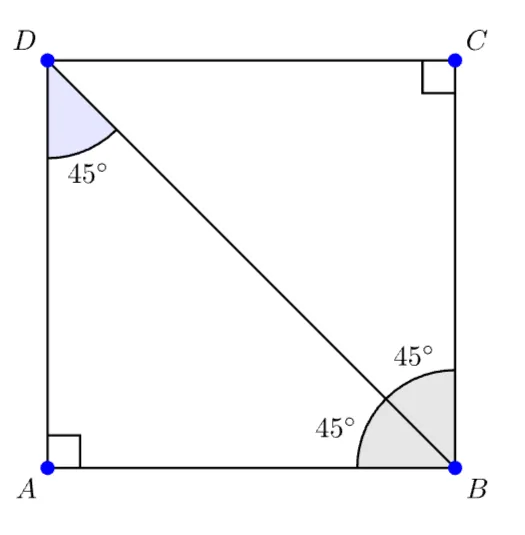
By definition, all angles in a rectangle are 90^{\circ}.
So, \angle B = 90^{\circ}.
Since diagonal BD bisects
\angle ABD = \angle CBD = \frac{90^{\circ}}{2} = 45^{\circ}
In a rectangle, opposite sides are parallel (AD || BC).
The diagonal BD acts as a transversal, meaning the alternate interior angles are equal:
\angle ADB = \angle CBD = 45^{\circ}
Now look at \Delta ABD.
\angle ABD = 45^{\circ} and \angle ADB = 45^{\circ}
AD = AB … (sides opposite to equal angles are equal)
A rectangle that has its adjacent sides equal is a square.
Hence, ABCD is a square. Hence Proved
Q7. In figure given below, ABCD is a kite and diagonals intersect at O. If \angle DAB=112^{\circ} and \angle DCB=64^{\circ}, find \angle ODC and \angle OBA.
Solution:
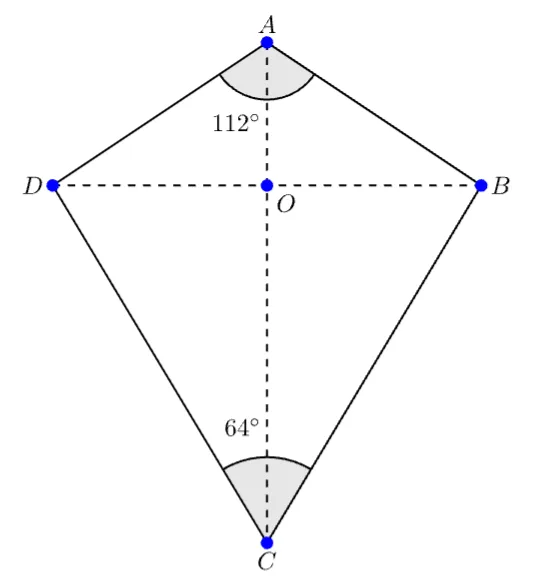
In a kite the adjacent sides are equal
AD = AB
CD = CB
In \Delta ABD
Since AD = AB
Therefore \angle ADB = \angle ABD = x … (Angles opposite to equal sides are equal)
\angle DAB + \angle BDA + \angle DBA = 180^{\circ} … (Angle Sum prop of a Triangle)
112^{\circ} + x + x = 180^{\circ}
112^{\circ} + 2x = 180^{\circ}
2x = 180^{\circ} - 112^{\circ}
2x = 68^{\circ}
x = 34^{\circ}
\angle DBA = \angle OBA = x = 34^{\circ}
In \Delta CBD
Since CD = CB
Therefore \angle BDC = \angle DBC = y … (Angles opposite to equal sides are equal)
\angle DCB + \angle BDC + \angle DBC = 180^{\circ} … (Angle Sum prop of a Triangle)
64^{\circ} + y + y = 180^{\circ}
64^{\circ} + 2y = 180^{\circ}
2y = 180^{\circ} - 64^{\circ}
2y = 116^{\circ}
y = 58^{\circ}
\angle BDC = \angle ODC = y = 58^{\circ}
Final Answer: \boxed{ \angle ODC = 58^{\circ}} and \boxed{\angle OBA = 34^{\circ}}
Q8. Construct a regular hexagon ABCDEF of side 3cm and measure \angle ABC
Q9. In parallelogram ABCD, the bisector of \angle A meets DC in E and AB=2AD. Prove that
(i) BE bisects \angle B
(ii) \angle AEB = a right angle.
Solution:
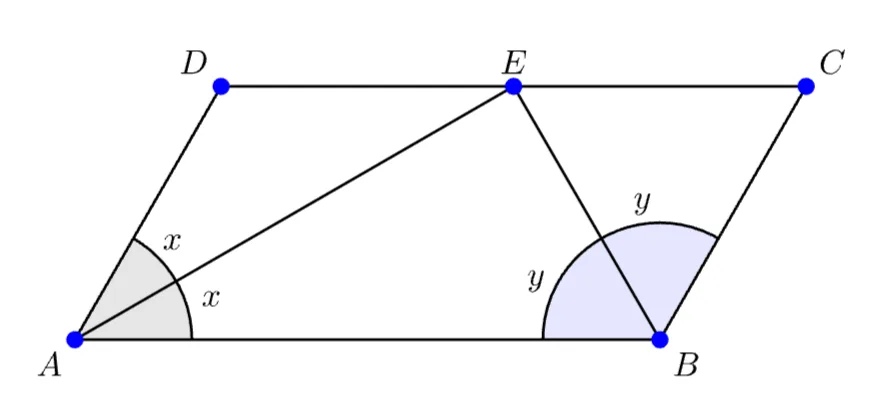
(i) Proving BE bisects \angle B:
Given AE \text{ bisects} \angle DAB
\implies \angle DAE = \angle BAE = x
Since AB \parallel CD
Therefore \angle DEA = \angle BAE = x … (Alternate Interior Angles)
Therefore \angle BAE = \angle DAE = \angle DEA = x
Let’s look at \Delta ADE.
\angle DAE = \angle DEA … (Proved above),
so AD = DE … (Sides opp. to equal angled are equal)
Opposite Sides of a Parellelogram are equal
DC = AB … (1)
DC = DE + EC
DC = AD + EC
AB = 2AD … (Given)
Substituting in (1)
AD + EC = 2AD
EC = AD
Opposite sides of a parallelogram are equal
BC = AD
Therefore
AD = BC = EC
BC = EC
In \Delta BCE,
because sides EC = BC, the opposite angles are equal:
\angle CEB = \angle CBE.
AB || DC, with transversal BE, means
\angle CEB = \angle ABE (Alternate interior angles).
Therefore, \angle CBE = \angle ABE.
This proves BE perfectly bisects \angle B. Hence Proved
(ii) Proving \angle AEB = 90^{\circ}:
The adjacent interior angles of a parallelogram add up to 180^{\circ}.
\angle A + \angle B = 180^{\circ} … (2)
In \Delta ABE, the sum of the angles is 180^{\circ}:
\angle EAB + \angle ABE + \angle AEB = 180^{\circ}
Because AE and BE are bisectors,
\angle EAB is half of \angle A, and
\angle ABE is half of \angle B.
\frac{1}{2} \angle A + \frac{1}{2} \angle B + \angle AEB = 180^{\circ}
\frac{1}{2} (\angle A + \angle B) + \angle AEB = 180^{\circ}
\frac{1}{2} (180^{\circ}) + \angle AEB = 180^{\circ}
90^{\circ} + \angle AEB = 180^{\circ}
\angle AEB = 90^{\circ} (which is a right angle). Hence Proved
Q10. Using ruler and compasses only, construct a parallelogram ABCD with AB=6 cm, altitude =3.5 cm and side BC=4 cm. Measure the acute angles of the parallelogram.
Solution:
Q11. In the figure given below, ABCD is a parallelogram, ADEF and AGHB are two squares. Prove that FG=AC.
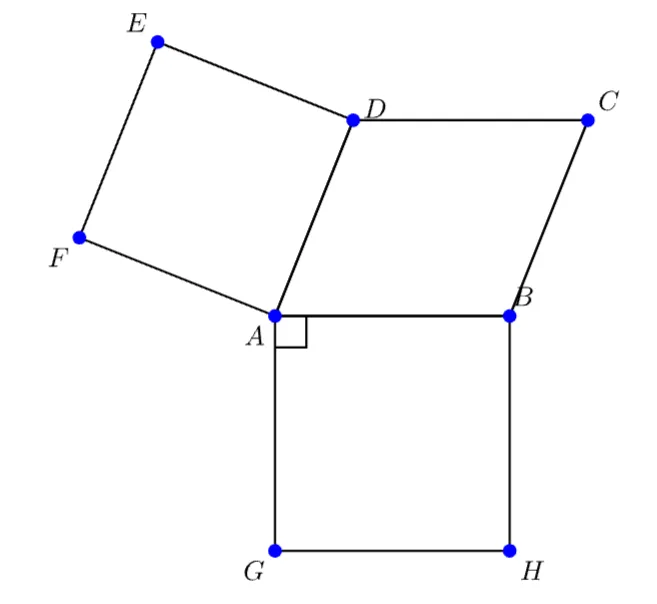
Solution:
We need to prove that \Delta FAG \cong \Delta CBA.
Let’s compare their sides and included angles.
The sides of a square are all equal.
Therefore, AF = AD.
Because ABCD is a parallelogram, opposite sides are equal,
meaning AD = BC.
This logically gives us
AD = AF = BC
or AF = BC
Similarly, looking at the other square, AG = AB.
Now, let’s find the included angles.
The angles around point A form a full circle (360^{\circ}).
\angle FAG + \angle DAB + \angle DAF + \angle GAB = 360^{\circ} … (1)
Because the corners of squares are right angles,
\angle DAF = 90^{\circ} and \angle GAB = 90^{\circ}.
Substituting in (1)
\angle FAG + \angle DAB + 90^{\circ} + 90^{\circ} = 360^{\circ}
\angle FAG + \angle DAB + 90^{\circ} + 90^{\circ} = 360^{\circ}
\angle FAG + \angle DAB = 180^{\circ}
So, \angle FAG = 180^{\circ} - \angle DAB … (2)
Now look at the parallelogram ABCD.
The adjacent interior angles add up to 180^{\circ}.
\angle ABC + \angle DAB = 180^{\circ}
\angle ABC = 180^{\circ} - \angle DAB … (3)
Comparing the two equations (2) and (3), we can conclude that
\angle FAG = \angle ABC.
In \Delta FAG \ \text{and} \ \Delta CBA
With two sides and the included angle proven equal
AF = BC, … (proved above)
\angle FAG = \angle ABC, … (proved above)
AG = AB, … (proved above)
Using SAS (Side-Angle-Side) criterion to state that \Delta FAG \cong \Delta CBA.
Because the triangles are congruent, their corresponding parts are strictly equal (CPCTC).
Therefore, FG = AC. Hence Proved