
Class 12 Application of Integral & Differential Equations Test ⇒
Q1. Find the order and degree of the differential equation
x^{2} \frac{d^2y}{dx^2} = \left\{1+\left( \frac{dy}{dx} \right)^2 \right\}^4
Solution:
Order of the Differential Equation:
The order of a differential equation is defined as the order of the highest derivative occurring in the equation.
Since the highest order derivative is \frac{d^{2}y}{dx^{2}},
the order of this differential equation is 2.
Degree of the Differential Equation:
The degree of a differential equation is the highest power (exponent) of the highest order derivative, provided the differential equation is a polynomial equation in terms of its derivatives.
This means the derivatives cannot be inside fractional powers, radicals, or transcendental functions (like sine, cosine, or logarithms).
Therefore, the degree is 1.
Final Answer: \boxed{ Order = 2 \ \ Degree = 1 }
Q2. Find the area bounded by the curve y=-x+5, above the X-axis and between x=1 and x=4.
Solution:
For this problem, the curve is a straight line y = -x + 5, and the limits are x = 1 to x = 4.
Check for X-axis crossing:
At x=1, y=4 and
at x=4, y=1.
Since y > 0 for all x in the interval the curve lies entirely above the X-axis, so we do not need to split the integral.
Set up and Evaluate the Integral:
\text{Area} = \int_{1}^{4} (-x + 5) dx
\text{Area} = \int (-x + 5) dx
\text{Area} = -\frac{x^{2}}{2} + 5x
Apply the limits from 1 to 4:
\text{Area} = \left[ -\frac{4^2}{2} + 5(4) \right] - \left[ -\frac{1^2}{2} + 5(1) \right]
\text{Area} = \left[ -\frac{16}{2} + 20 \right] - \left[ -\frac{1}{2} + 5 \right]
\text{Area} = [-8 + 20] - \left[ \frac{9}{2} \right]
\text{Area} = 12 - \frac{9}{2}
\text{Area} = \frac{15}{2}
Final Answer: \boxed{ \frac{15}{2} }
Q3. Prove that y=(\sin^{-1}x)^{2} is solution of the differential equation
(1-x^2)\frac{d^{2}y}{dx^{2}}-x\frac{dy}{dx}-2=0.
Solution:
Given y = (\sin^{-1}x)^{2}.
Find the First Derivative:
Differentiating both sides with respect to x using the chain rule:
\frac{dy}{dx} = 2( \sin^{-1}x) \cdot \frac{d}{dx} (\sin^{-1}x)
\frac{dy}{dx} = \frac{2\sin^{-1}x}{\sqrt{1-x^{2}}}
Cross-multiply by \sqrt{1-x^{2}}:
\sqrt{1-x^{2}} \cdot \frac{dy}{dx} = 2\sin^{-1}x
Find the Second Derivative:
Differentiating both sides again with respect to x.
\sqrt{1-x^2} \cdot \frac{d^2 y}{dx^2} + \frac{dy}{dx} \cdot \frac{d}{dx}(\sqrt{1-x^2}) = 2 \cdot \frac{1}{\sqrt{1-x^2}}
\sqrt{1-x^{2}} \cdot \frac{d^{2}y}{dx^{2}} + \frac{dy}{dx} \cdot \left(\frac{-2x}{2\sqrt{1-x^{2}}}\right) = \frac{2}{\sqrt{1-x^{2}}}
\sqrt{1-x^{2}} \cdot \frac{d^{2}y}{dx^{2}} - \frac{x}{\sqrt{1-x^{2}}} \cdot \frac{dy}{dx} = \frac{2}{\sqrt{1-x^{2}}}
Multiply the entire equation by \sqrt{1-x^{2}} to eliminate the denominators:
(1-x^2) \frac{d^{2}y}{dx^{2}} - x\frac{dy}{dx} = 2
This matches the differential equation perfectly. Hence Proved
Q4. Find the particular solution of the differential equation given
\frac{dy}{dx}+2y\tan x=\sin x
When y=0 when x=\frac{\pi}{3}.
Solution:
This is a First-Order Linear Differential Equation in the form
\frac{dy}{dx} + Py = Q.
Here, P = 2\tan x and Q = \sin x.
Find the Integrating Factor: \text{IF} = e^{\int P dx}
\int P dx = \int 2 \tan x dx
\int P dx = 2 \log \sec x dx
Since:
\text{IF} = e^{2\log(\sec x)} = e^{\log(\sec^{2} x)} = \sec^{2} x
The solution is given by y \cdot (\text{IF}) = \int Q \cdot (\text{IF}) dx + C
y \cdot \sec^{2} x = \int (\sin x) \cdot (\sec^2 x) dx + C.
y \cdot \sec^{2} x = \int \frac{\sin x}{\cos^{2} x} dx + C
y \cdot \sec^{2} x = \int (\sec x \cdot \tan x) dx + C
Integrate the RHS:
y \cdot \sec^{2} x = \sec x + C
Multiplying by \cos^{2} x):
y = \cos x + C \cos^{2} x
(This is the general solution)
To Find the Particular Solution:
Apply the given conditions: y=0 when x=\frac{\pi}{3}.
0 = \cos \left( \frac{\pi}{3} \right) + C \cos^{2} \left( \frac{\pi}{3} \right)
0 = \frac{1}{2} + C\left(\frac{1}{2}\right)^{2}
0 = \frac{1}{2} + \frac{C}{4}
\frac{C}{4} = -\frac{1}{2} \implies C = -2
Substitute C = -2 back into the general solution:
y = \cos x - 2\cos^{2} x
Final Answer: \boxed{ y = \cos x - 2\cos^{2} x }
Q5. Solve the differential equation:
xdy-ydx=\sqrt{x^{2}+y^{2}}dx
given that y=0 when x=1.
Solution:
Rearrange the equation:
xdy= ydx + \sqrt{x^{2}+y^{2}}dx
x \frac{dy}{dx} = y + \sqrt{x^{2}+y^{2}}
\frac{dy}{dx} = \frac{y}{x} + \frac{\sqrt{x^{2}+y^{2}}}{x}
\frac{dy}{dx} = \frac{y}{x} + \sqrt{1 + \left(\frac{y}{x} \right)^2} … (1)
This is a Homogeneous Differential Equation.
Substitute y = vx:
Differentiate with respect to x: \frac{dy}{dx} = v + x\frac{dv}{dx}
Substitute y and \frac{dy}{dx} into equation (1):
v + x\frac{dv}{dx} = v + \sqrt{1 + v^2}
x\frac{dv}{dx} = \sqrt{1 + v^{2}}
Separate Variables and Integrate:
\frac{dv}{\sqrt{1 + v^{2}}} = \frac{dx}{x}
Integrate both sides:
\int \frac{1}{\sqrt{1 + v^{2}}} dv = \int \frac{1}{x} dx
\log\left|v + \sqrt{1 + v^{2}}\right| = \log|x| + \log C
\log\left|v + \sqrt{1 + v^{2}}\right| = \log|Cx|
v + \sqrt{1 + v^{2}} = Cx
Substitute back v = \frac{y}{x}:
\frac{y}{x} + \sqrt{1 + \left(\frac{y}{x} \right)^{2}} = Cx
\frac{y}{x} + \frac{\sqrt{x^{2} + y^{2}}}{x} = Cx
y + \sqrt{x^{2} + y^{2}} = Cx^2
(This is the general solution)
To find the Particular Solution:
Apply the given initial conditions: y=0 when x=1.
0 + \sqrt{1^{2} + 0^{2}} = C(1)^2
1 = C
Substitute C = 1 into the general solution:
y + \sqrt{x^{2} + y^{2}} = x^{2}
Final Answer: \boxed{ y + \sqrt{x^{2} + y^{2}} = x^{2} }
Q6. Using integration, find the area of the region in the first quadrant enclosed by the X-axis, the line y=x and the circle x^{2}+y^{2}=32.
Solution:
Identify the intersection point:
Solve the equations y = x and x^{2} + y^{2} = 32
x^{2} + y^{2} = (4 \sqrt{2})^2
Substitute y = x into the circle’s equation:
x^{2}+x^{2}=32
2x^{2} = 32 \implies x^{2} = 16 \implies x = \pm 4
(taking only the positive root for the first quadrant).
When x = 4, y = 4.
The point of intersection is (4, 4)
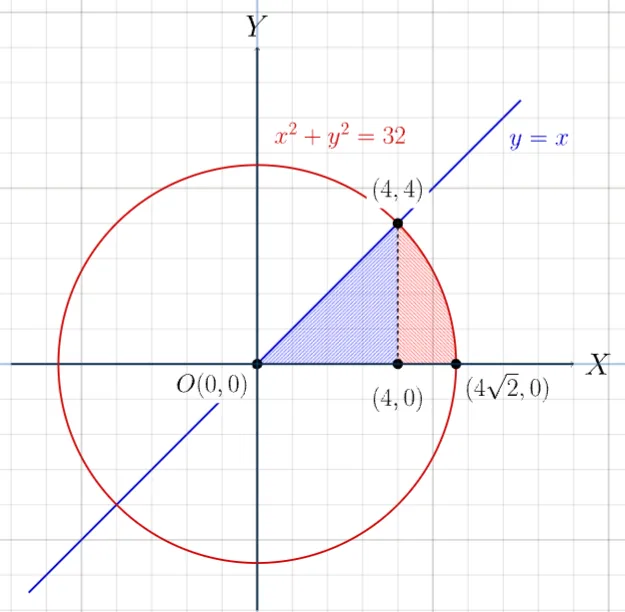
Set up the Integrals: The required area is divided into two regions by a vertical line at x = 4:
- Under the line y = x from x = 0 to x = 4.
- Under the circle y = \sqrt{32 - x^{2}} from x = 4 to the circle’s X-axis intercept at x = \sqrt{32} = 4\sqrt{2}.
\text{Total Area} = \int_{0}^{4} x dx + \int_{4}^{4 \sqrt{2}} \sqrt{32 - x^2} dx … (1)
Evaluating the 1st limit
\int x dx = \left[ \frac{x^2}{2} \right]
Applying limits
\int_{0}^{4} x dx = \left[ \frac{4^2}{2} - 0 \right] = 8
Evaluating the 2nd limit
\int \sqrt{32 - x^2} dx = \int \sqrt{(4 \sqrt{2})^2 - x^2} dx
Use the standard formula \int \sqrt{a^{2}-x^{2}} dx = \frac{x}{2}\sqrt{a^{2}-x^{2}} + \frac{a^{2}}{2}\sin^{-1}\left(\frac{x}{a}\right):
\int \sqrt{(4 \sqrt{2})^2 - x^2} dx = \frac{x}{2}\sqrt{(4 \sqrt{2})^{2}-x^{2}} + \frac{(4 \sqrt{2})^{2}}{2}\sin^{-1}\left(\frac{x}{{4 \sqrt{2}}}\right)
\int \sqrt{32 - x^2} dx = \frac{x}{2}\sqrt{32-x^{2}} + \frac{32}{2}\sin^{-1}\left(\frac{x}{{4 \sqrt{2}}}\right)
Applying Limits
\int_{4}^{4 \sqrt{2}} \sqrt{32 - x^2} dx = \left[ \frac{4 \sqrt{2}}{2}\sqrt{32-32} + \frac{32}{2}\sin^{-1}\left(\frac{4 \sqrt{2}}{{4 \sqrt{2}}}\right) \right] - \left[ \frac{4}{2}\sqrt{32-16} + \frac{32}{2}\sin^{-1}\left(\frac{4}{{4 \sqrt{2}}}\right) \right]
\int_{4}^{4 \sqrt{2}} \sqrt{32 - x^2} dx = \left[ 0 + 16 \sin^{-1} (1) \right] - \left[ 8 + 16\sin^{-1}\left(\frac{1}{\sqrt{2}}\right) \right]
\int_{4}^{4 \sqrt{2}} \sqrt{32 - x^2} dx = \left[ 16 \frac{\pi}{2} \right] - \left[ 8 + 16 \left(\frac{\pi}{4} \right) \right]
\int_{4}^{4 \sqrt{2}} \sqrt{32 - x^2} dx = \left[ 8 \pi \right] - \left[ 8 + 4\pi \right]
\int_{4}^{4 \sqrt{2}} \sqrt{32 - x^2} dx = 4 \pi - 8
Substitute in eq. (1) to calculate total Area
Total Area: 8 + 4 \pi - 8 = 4 \pi
Final Answer: \boxed{ \text{Area} = 4\pi \ \ units}
Q7. Using integration, find the area of the triangle ABC, whose vertices are A(2,5), B(4,7) and C(6,2).
Solution:
Find the equations of the sides of the triangle:
Equation of a line joining (x_1, y_1) \ and (x_2, y_2) is
y - y_1 = \frac{y_2 - y_1}{x_2 - x_1}(x - x_1).
Line AB (joining A(2,5) \ and B(4,7) ):
y - 5 = \frac{7 - 5}{4 - 2}(x - 2)
y - 5 = 1(x - 2)
y = x + 3
Line BC (joining B(4,7) \ and C(6,2) ):
y - 7 = \frac{2 - 7}{6 - 4}(x - 4)
y - 7 = \frac{-5}{2}(x - 4)
y = -\frac{5}{2}x + 10 + 7
y = -\frac{5}{2}x + 17
Line AC (joining A(2,5) \ and C(6,2) ):
y - 5 = \frac{2 - 5}{6 - 2}(x - 2)
y - 5 = \frac{-3}{4}(x - 2)
y = -\frac{3}{4}x + \frac{6}{4} + 5
y = -\frac{3}{4}x + \frac{13}{2}
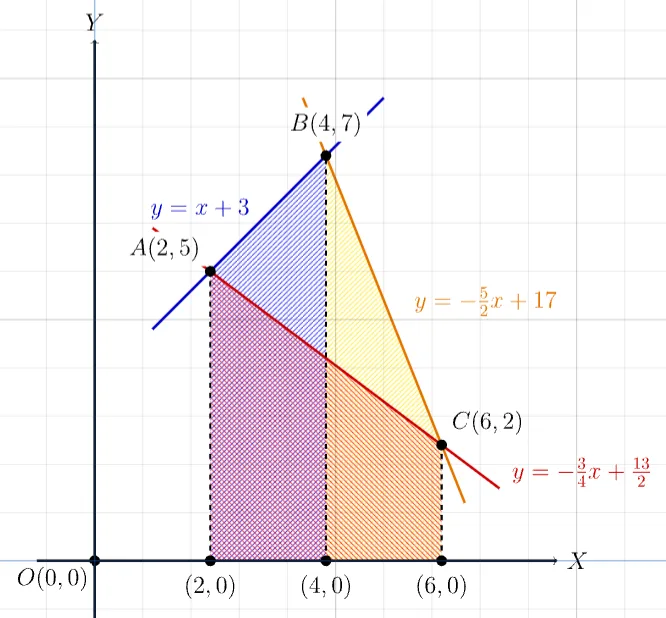
Set up the Area Integral:
The area of the triangle is the area under line AB plus the area under line BC, minus the area under line AC.
\text{Area} = \int_{2}^{4} y_{AB} dx + \int_{4}^{6} y_{BC} dx - \int_{2}^{6} y_{AC} dx
\text{Area} = \int_{2}^{4} (x + 3) dx + \int_{4}^{6} \left(-\frac{5}{2}x + 17\right) dx - \int_{2}^{6} \left(-\frac{3}{4}x + \frac{13}{2}\right) dx
Evaluate the Integrals:
\int (x + 3) dx = \frac{x^2}{2} + 3x
Applying Limits
\int_{2}^{4} (x + 3) dx = \left[\frac{4^2}{2} + 3(4) \right] - \left[\frac{2^2}{2} + 3(2) \right]
\int_{2}^{4} (x + 3) dx = \left[8 + 12 \right] - \left[2 + 6 \right]
\int_{2}^{4} (x + 3) dx = 12
Evaluate the integral
\int \left(-\frac{5}{2}x + 17\right) dx = \left(-\frac{5}{4}x^2 + 17x \right)
Applying Limits
\int_{4}^{6} \left(-\frac{5}{2}x + 17\right) dx = \left[-\frac{5}{4}(6)^2 + 17(6) \right] - \left[-\frac{5}{4}(4)^2 + 17(4) \right]
\int_{4}^{6} \left(-\frac{5}{2}x + 17\right) dx = \left[-45 + 102 \right] - \left[-20 + 68 \right]
\int_{4}^{6} \left(-\frac{5}{2}x + 17\right) dx = \left[-45 + 102 \right] - \left[-20 + 68 \right]
\int_{4}^{6} \left(-\frac{5}{2}x + 17\right) dx = 9
Evaluate the Integral
\int \left(-\frac{3}{4}x + \frac{13}{2}\right) dx = -\frac{3}{8}x^2 + \frac{13}{2}x
Applying Limits
\int_{2}^{6} \left(-\frac{3}{4}x + \frac{13}{2}\right) dx = \left[-\frac{3}{8}(6)^2 + \frac{13}{2}(6) \right] - \left[-\frac{3}{8}(2)^2 + \frac{13}{2}(2) \right]
\int_{2}^{6} \left(-\frac{3}{4}x + \frac{13}{2}\right) dx = \left[-\frac{27}{2} + 39 \right] - \left[-\frac{3}{2} + 13 \right]
\int_{2}^{6} \left(-\frac{3}{4}x + \frac{13}{2}\right) dx = 14
Calculate Total Area: \text{Area} = 12 + 9 - 14 = 7
Final Answer: \boxed{ \text{Area} = 7 \ \ units }
Q8. Find the area of the region \left[ {(x,y): y^{2}\le6ax \text{ and } x^{2}+y^{2}\le16a^{2}} \right] using method of integration.
Solution:
Identify the Curves and Intersections:
The region is bounded by a parabola y^{2} = 6ax and a circle x^{2} + y^{2} = 16a^{2}.
To find point of intersection
Substitute y^{2} from the parabola into the circle’s equation to find intersection
x^{2} + 6ax = 16a^{2}
x^{2} + 6ax - 16a^{2} = 0
(x + 8a)(x - 2a) = 0
Since y^{2} = 6ax strictly requires x \ge 0 (assuming a > 0),
the valid intersection point is at x = 2a.
Because both shapes are symmetrical about the X-axis, the total area will be twice the area in the first quadrant.
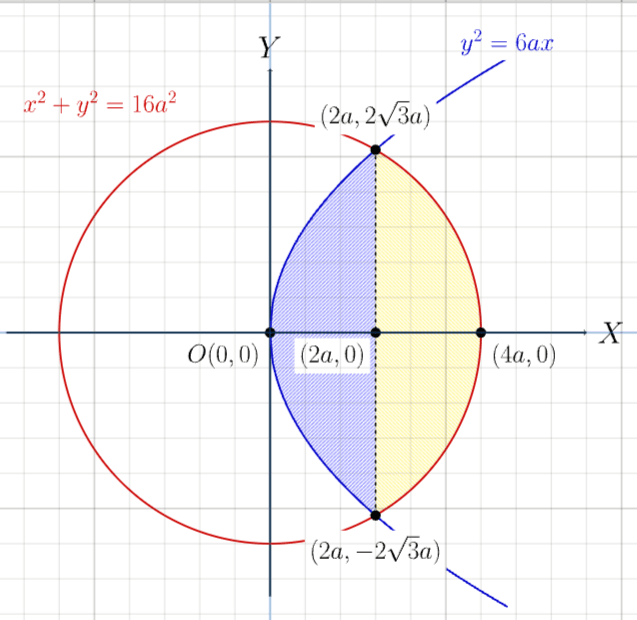
Set up the Integral for the First Quadrant:
In the first quadrant, the area is split by a vertical line at x = 2a:
- Under the parabola from x = 0 to x = 2a
- Under the circle from x = 2a to the circle’s radius boundary x = 4a
\text{Area} \ {1st \ Quadrant} = \int_{0}^{2a} \sqrt{6ax} dx + \int_{2a}^{4a} \sqrt{16a^2 - x^2} dx
Evaluate the First Integral (Parabola):
\int \sqrt{6ax} dx = \frac{2 \sqrt{6a} \ x^{3/2}}{3}
Applying Limits
\int_{0}^{2a} \sqrt{6ax} dx = \left[ \frac{2 \sqrt{6a} \ 2a^{3/2}}{3} \right] - \left[ \frac{2 \sqrt{6a} \ 0^{3/2}}{3} \right]
\int_{0}^{2a} \sqrt{6ax} dx = \left[ \frac{8a^2 \ \sqrt{3}}{3} \right] - 0
\int_{0}^{2a} \sqrt{6ax} dx = \left[ \frac{8a^2 \ \sqrt{3}}{3} \right]
Evaluate the Second Integral (Circle)
\int \sqrt{16a^2 - x^2} dx = \frac{x}{2} \sqrt{16a^2 - x^2} + \frac{16a^2}{2} \sin^{-1} \left(\frac{x}{4a} \right)
Applying Limits
\int_{2a}^{4a} \sqrt{16a^2 - x^2} dx = A_2
A_2 = \left[\frac{4a}{2} \sqrt{16a^2 - 16a^2} + \frac{16a^2}{2} \sin^{-1} \left(\frac{4a}{4a} \right) \right] - \left[\frac{2a}{2} \sqrt{16a^2 - 4a^2} + \frac{16a^2}{2} \sin^{-1} \left(\frac{2a}{4a} \right) \right]
A_2 = \left[ 8a \left( \frac{\pi}{2} \right) \right] - \left[a \sqrt{12a^2 } + 8a^2 \sin^{-1} \left(\frac{1}{2} \right) \right]
A_2 = \left[ 4\pi a^2 \right] - \left[2a^2 \sqrt{3} + 8a^2 \ \frac{\pi}{6} \right]
A_2 = 4\pi a^2 - 2a^2 \sqrt{3} - \frac{4 \pi a^2} {3}
A_2 = \frac{8 \pi a^2} {3} - 2a^2 \sqrt{3}
Calculate Total Area:
Area = \frac{8a^2 \ \sqrt{3}}{3} + \frac{8 \pi a^2} {3} - 2a^2 \sqrt{3}
Area = \frac{8a^2 \ \sqrt{3} - 6a^2 \ \sqrt{3}}{3} + \frac{8 \pi a^2} {3}
Area = \frac{2a^2 \ \sqrt{3}}{3} + \frac{8 \pi a^2} {3}
Since it is symmetric about the X-axis, multiply by 2:
\text{Total Area} = 2 \left( \frac{2\sqrt{3}a^{2}}{3} + \frac{8\pi a^{2}}{3} \right) = \frac{4\sqrt{3}a^{2}}{3} + \frac{16\pi a^{2}}{3}
Final Answer: \boxed{ Area \ = \frac{4a^2}{3} \left( \sqrt{3} + 4\pi \right) }
Class 12 Application of Integral & Differential Equations Test ⇒