
The post provides the complete, step-by-step solution for the Class 11 Test: Straight Lines and Conic Sections
(Maximum Marks: 30 | Duration: 60 mins).
Coordinate geometry is one of the highest-scoring units in Class 11 Mathematics and forms the foundation for Calculus in Class 12.
Work through each step carefully, pay close attention to the standard formulas, and note the exam tips after every solution.
Section A: 1 Mark Questions
Q1. Calculate the slope of a line, which passes through the origin and the mid-point of the segment joining the points P(0, -4) and B(8, 0).
(a) \frac{1}{2}
(b) -\frac{1}{2}
(c) -2
(d) 2
Solution:
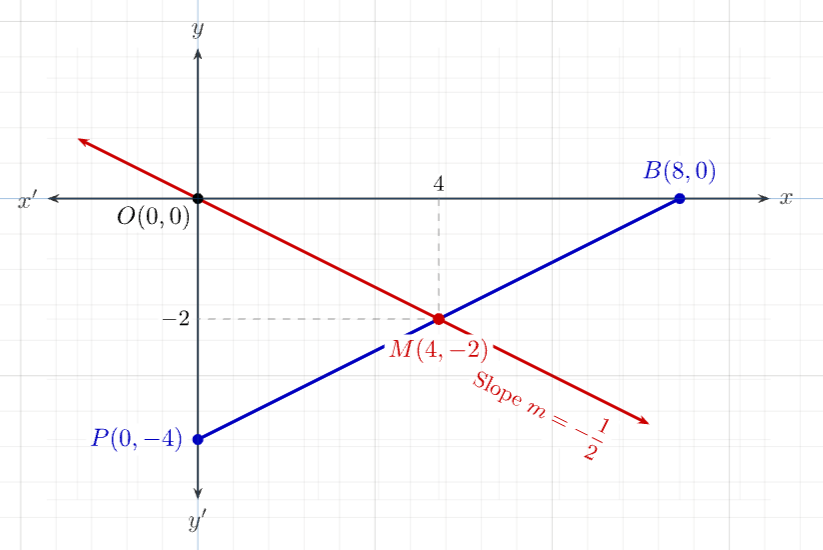
Step 1: Find the mid-point of the line segment PB.
Using the mid-point formula M = \left(\frac{x_1 + x_2}{2}, \frac{y_1 + y_2}{2}\right)
for points P(0, -4) and B(8, 0),
M = \left(\frac{0 + 8}{2}, \frac{-4 + 0}{2}\right) = \left(\frac{8}{2}, \frac{-4}{2}\right) = (4, -2).
Step 2: Calculate the slope of the line passing through the origin O(0, 0) and M(4, -2).
Using the two-point slope formula m = \frac{y_2 - y_1}{x_2 - x_1},
Slope: m = \frac{-2 - 0}{4 - 0} = \frac{-2}{4} = -\frac{1}{2}.
Correct option: (b)
Teacher’s Tip: For any line passing through the origin (0, 0) and another point (x, y), the slope is simply \frac{y}{x}. This saves valuable seconds in 1-mark MCQs!
Q2. Find the distance between the lines 3x + 4y = 9 and 6x + 8y = 15.
(a) \frac{6}{5}
(b) \frac{3}{5}
(c) \frac{3}{10}
(d) \frac{33}{10}
Solution:
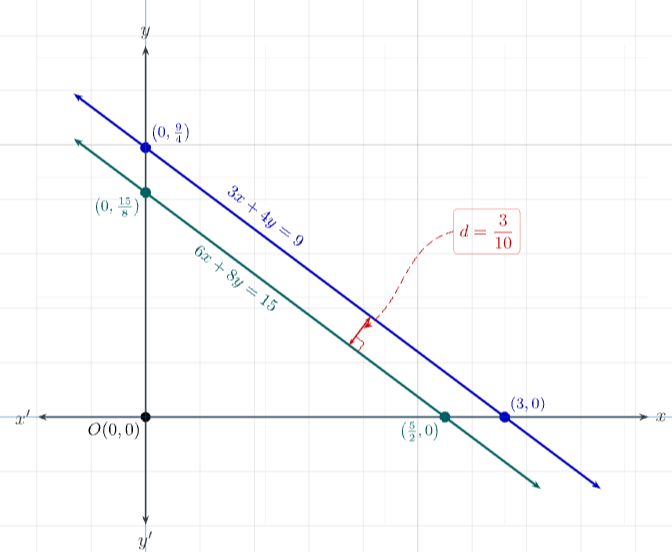
Step 1: Make the coefficients of x and y identical in both equations.
Write both parallel lines in standard form:
Line 1: 3x + 4y - 9 = 0
Line 2: 6x + 8y - 15 = 0
Multiply Line 1 by 2 so both equations have the same A and B values:
Line 1: 6x + 8y - 18 = 0
Line 2: 6x + 8y - 15 = 0
Here, A = 6, B = 8, C_1 = -18, and C_2 = -15.
Step 2: Apply the formula for distance between two parallel lines.
Formula: d = \frac{|C_1 - C_2|}{\sqrt{A^2 + B^2}}
Substitute the values: d = \frac{|-18 - (-15)|}{\sqrt{6^2 + 8^2}}
Simplifying: d = \frac{|-18 + 15|}{\sqrt{36 + 64}} = \frac{|-3|}{\sqrt{100}} = \frac{3}{10}.
Correct option: (c)
Teacher’s Tip: Never plug C_1 and C_2 directly into the parallel-line distance formula without first matching the coefficients of x and y! That is the single most common mistake students make in this question.
Q3. The equation x^2 + y^2 - 12x + 8y - 72 = 0 depicts a circle, find the radius.
(a) 2\sqrt{31}
(b) 124
(c) 2\sqrt{7}
(d) 4\sqrt{13}
Solution:
Step 1: Compare with the general equation of a circle.
The general equation of a circle is: x^2 + y^2 + 2gx + 2fy + c = 0.
Comparing with x^2 + y^2 - 12x + 8y - 72 = 0, we get:
For g: 2g = -12 \implies g = -6
For f: 2f = 8 \implies f = 4
For c: c = -72
Step 2: Calculate the radius using the formula.
Formula: r = \sqrt{g^2 + f^2 - c}
Substitute the values: r = \sqrt{(-6)^2 + (4)^2 - (-72)}
r = \sqrt{36 + 16 + 72} = \sqrt{124}.
r = \sqrt{4 \times 31} = 2\sqrt{31}.
Correct option: (a)
Section B: 2 Marks Questions
Q4. If a circle passes through the points (0, 0), (a, 0), (0, b), then find the coordinates of its centre.
Solution:
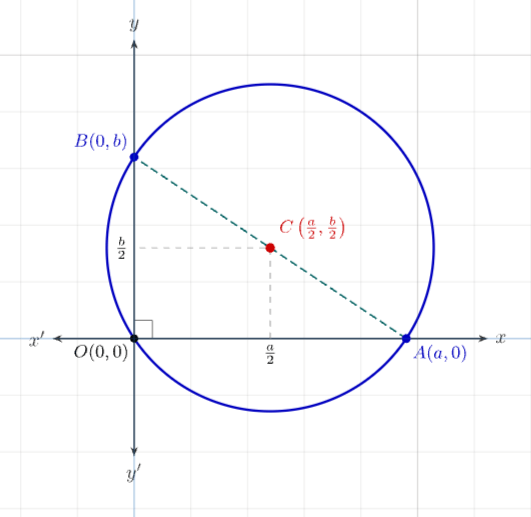
Step 1: Write the standard equation of a circle.
Let the centre of the circle be (h, k) and its radius be r.
The standard equation is: (x - h)^2 + (y - k)^2 = r^2.
Step 2: Substitute the point (0, 0) into the equation.
Since the circle passes through (0, 0): (0 - h)^2 + (0 - k)^2 = r^2.
h^2 + k^2 = r^2 — (Equation 1).
Step 3: Substitute the point (a, 0) into the equation.
We get: (a - h)^2 + (0 - k)^2 = r^2
a^2 - 2ah + h^2 + k^2 = r^2
h^2 + k^2 = r^2 from Equation 1: a^2 - 2ah + r^2 = r^2
a^2 - 2ah = 0 \implies a(a - 2h) = 0
Since the three points are distinct, a \neq 0, which gives:
a - 2h = 0 \implies h = \frac{a}{2}.
Step 4: Substitute the point (0, b) into the equation.
We get: (0 - h)^2 + (b - k)^2 = r^2
h^2 + b^2 - 2bk + k^2 = r^2
Using Equation 1: h^2 + k^2 = r^2
b^2 - 2bk + r^2 = r^2
b^2 - 2bk = 0 \implies b(b - 2k) = 0
Since b \neq 0,
we get: b - 2k = 0 \implies k = \frac{b}{2}.
Final Answer: Coordinates of the centre = \boxed{\left(\frac{a}{2}, \frac{b}{2}\right)}
Teacher’s Tip: Here is a neat geometric way to verify your answer instantly:
the points (a, 0) and (0, b) lie on the x-axis and y-axis, which meet at 90^\circ at the origin (0, 0).
Since the angle in a semicircle is 90^\circ, the segment joining (a, 0) and (0, b) must be the diameter of the circle, making its mid-point \left(\frac{a}{2}, \frac{b}{2}\right) the centre!
Q5. Find the equation for the ellipse that satisfies the given conditions: Ends of major axis (\pm 3, 0), ends of minor axis (0, \pm 2).
Solution:
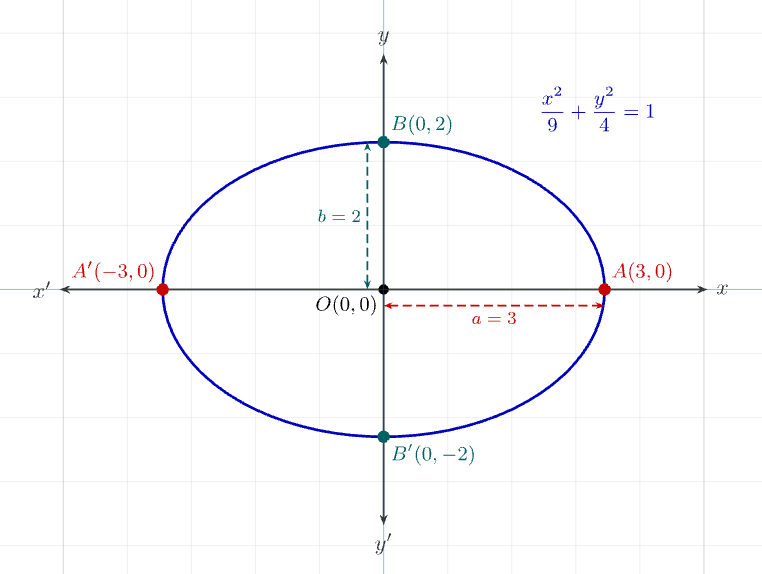
Step 1: Identify the orientation of the ellipse.
The ends of the major axis are (\pm 3, 0), which lie on the x-axis.
Therefore, the major axis is along the x-axis, and the standard equation is:
\frac{x^2}{a^2} + \frac{y^2}{b^2} = 1, where a \gt b.
Step 2: Determine the values of a and b.
Comparing the ends of the major axis (\pm a, 0) with (\pm 3, 0),
we get: a = 3 \implies a^2 = 9.
Comparing the ends of the minor axis (0, \pm b) with (0, \pm 2),
we get: b = 2 \implies b^2 = 4.
Step 3: Substitute a^2 and b^2 into the standard equation.
Thus, the required equation of the ellipse is: \frac{x^2}{9} + \frac{y^2}{4} = 1.
Final Answer: \boxed{\frac{x^2}{9} + \frac{y^2}{4} = 1}
Q6. The perpendicular from the origin to the line y = mx + c meets it at the point (-1, 2). Find the values of m and c.
Solution:
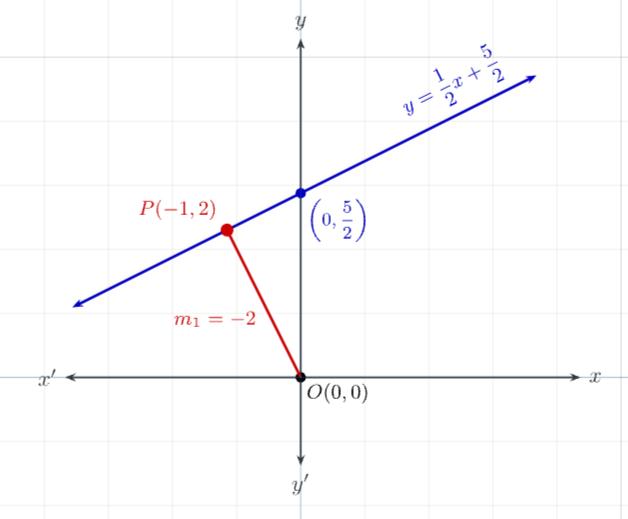
Step 1: Find the slope of the perpendicular segment from the origin.
Let the origin be O(0, 0) and the foot of the perpendicular be P(-1, 2).
Slope of OP: m_1 = \frac{2 - 0}{-1 - 0} = \frac{2}{-1} = -2.
Step 2: Use the perpendicularity condition to find m.
The given line is y = mx + c, whose slope is m.
Since OP is perpendicular to the given line, the product of their slopes is -1:
m_1 \times m = -1
Substitute m_1 = -2:
-2 \times m = -1 \implies m = \frac{1}{2}.
Step 3: Substitute the point (-1, 2) and m = \frac{1}{2} into the line equation to find c.
Since the point P(-1, 2) lies on the line y = mx + c:
We get: 2 = \left(\frac{1}{2}\right)(-1) + c
Simplifying: 2 = -\frac{1}{2} + c
Solving for c: c = 2 + \frac{1}{2} = \frac{5}{2}.
Final Answer: \boxed{m = \frac{1}{2}, \quad c = \frac{5}{2}}
Q7. If p is the length of perpendicular from origin to the line which makes intercepts a, b on the axes, prove that: \frac{1}{p^2} = \frac{1}{a^2} + \frac{1}{b^2}.
Solution:
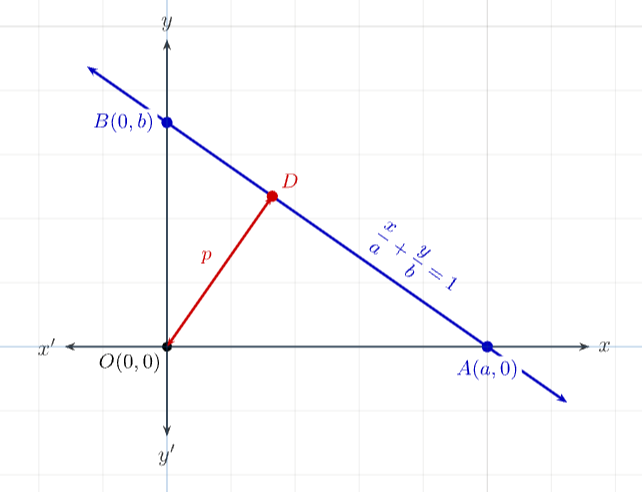
Step 1: Write the equation of the line in intercept form.
A line making intercepts a and b on the x-axis and y-axis respectively has the equation:
\frac{x}{a} + \frac{y}{b} = 1.
Rewrite this in general form (Ax + By + C = 0):
\left(\frac{1}{a}\right)x + \left(\frac{1}{b}\right)y - 1 = 0.
Here, A = \frac{1}{a}, B = \frac{1}{b}, and C = -1.
Step 2: Find the perpendicular distance p from the origin (0, 0) to this line.
Using the distance formula p = \frac{|Ax_1 + By_1 + C|}{\sqrt{A^2 + B^2}} with (x_1, y_1) = (0, 0):
p = \frac{\left|\frac{1}{a}(0) + \frac{1}{b}(0) - 1\right|}{\sqrt{\left(\frac{1}{a}\right)^2 + \left(\frac{1}{b}\right)^2}}
p = \frac{|-1|}{\sqrt{\frac{1}{a^2} + \frac{1}{b^2}}} = \frac{1}{\sqrt{\frac{1}{a^2} + \frac{1}{b^2}}}.
Step 3: Square both sides and take reciprocals.
Squaring both sides gives: p^2 = \frac{1}{\frac{1}{a^2} + \frac{1}{b^2}}.
\frac{1}{p^2} = \frac{1}{a^2} + \frac{1}{b^2}.
Final Answer: \boxed{\frac{1}{p^2} = \frac{1}{a^2} + \frac{1}{b^2}}. Hence proved.
Section C: 3 Marks Questions
Q8. Let P and P' be the foci of the ellipse 16x^2 + 25y^2 = 1600. Find the area of the triangle formed by the foci P and P' with the point Q(4\sqrt{4}, 5).
Solution:
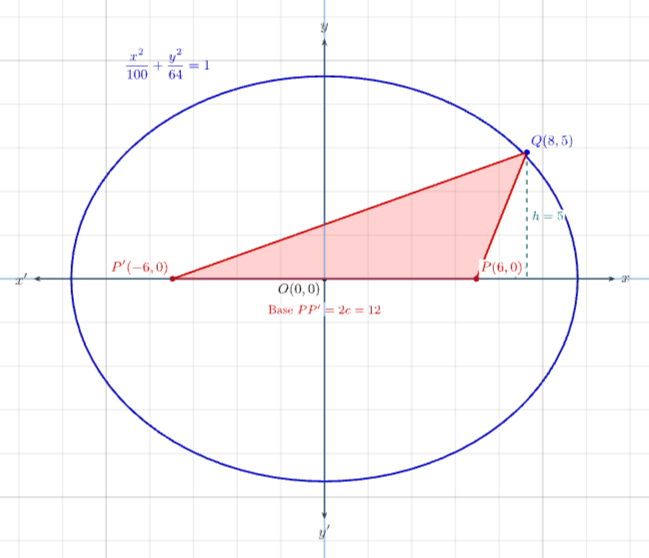
Step 1: Convert the ellipse equation into standard form.
Divide both sides of 16x^2 + 25y^2 = 1600 by 1600:
\frac{16x^2}{1600} + \frac{25y^2}{1600} = 1
\frac{x^2}{100} + \frac{y^2}{64} = 1
100 \gt 64, the major axis is along the x-axis.
Comparing with \frac{x^2}{a^2} + \frac{y^2}{b^2} = 1:
Value of a: a^2 = 100 \implies a = 10
Value of b: b^2 = 64 \implies b = 8
Step 2: Find the coordinates of the foci P and P'.
For an ellipse, c = \sqrt{a^2 - b^2}:
So, c = \sqrt{100 - 64} = \sqrt{36} = 6.
Therefore, the foci are P(6, 0) and P'(-6, 0).
Step 3: Find the area of \triangle PP'Q.
Note that 4\sqrt{4} = 4 \times 2 = 8, so the third vertex is Q(8, 5).
Using the coordinate formula for the area of a triangle with vertices P(6, 0), P'(-6, 0), and Q(8, 5):
Formula: \text{Area} = \frac{1}{2} \left| x_1(y_2 - y_3) + x_2(y_3 - y_1) + x_3(y_1 - y_2) \right|
Substitute the coordinates: \text{Area} = \frac{1}{2} \left| 6(0 - 5) + (-6)(5 - 0) + 8(0 - 0) \right|
\text{Area} = \frac{1}{2} \left| -30 - 30 + 0 \right| = \frac{1}{2} \left| -60 \right| = 30 \text{ sq. units}.
Final Answer: \boxed{30 \text{ sq. units}}
Teacher’s Tip: Notice something clever here! Because both foci P(6, 0) and P'(-6, 0) lie directly on the x-axis, the base of the triangle is simply PP' = 2c = 12, and the perpendicular height is just the y-coordinate of the third point (5). So \text{Area} = \frac{1}{2} \times 12 \times 5 = 30—the x-coordinate of the third point doesn’t even affect the area!
Q9. Find the equation of the circle with centre (3, 3) and touching the line 5x - 12y - 20 = 0.
Solution:
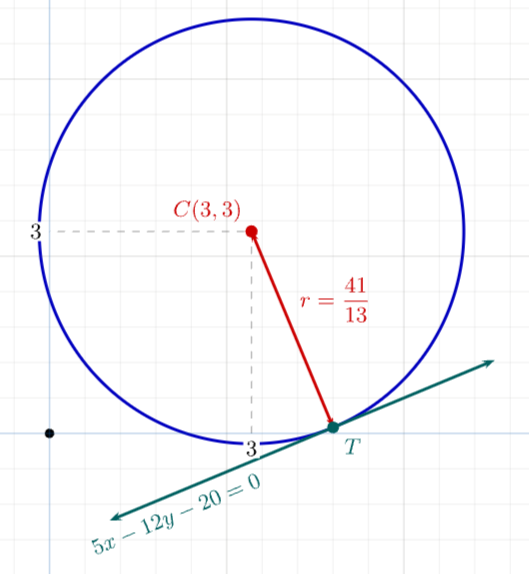
Step 1: Relate the radius to the given tangent line.
Since the circle touches the line 5x - 12y - 20 = 0, the line is tangent to the circle.
Therefore, the radius r equals the perpendicular distance from the centre (3, 3) to the line 5x - 12y - 20 = 0.
Step 2: Calculate the radius r.
Using r = \frac{|Ax_1 + By_1 + C|}{\sqrt{A^2 + B^2}} with A = 5, B = -12, C = -20, and (x_1, y_1) = (3, 3):
Substitute the values: r = \frac{|5(3) - 12(3) - 20|}{\sqrt{5^2 + (-12)^2}}
r = \frac{|15 - 36 - 20|}{\sqrt{25 + 144}} = \frac{|-41|}{\sqrt{169}} = \frac{41}{13}.
Step 3: Write the equation of the circle.
Using the standard form (x - h)^2 + (y - k)^2 = r^2 with (h, k) = (3, 3) and r = \frac{41}{13}:
We get: (x - 3)^2 + (y - 3)^2 = \left(\frac{41}{13}\right)^2
(x - 3)^2 + (y - 3)^2 = \frac{1681}{169}.
Step 4: Expand into general form.
x^2 - 6x + 9 + y^2 - 6y + 9 = \frac{1681}{169}
x^2 + y^2 - 6x - 6y + 18 = \frac{1681}{169}
169x^2 + 169y^2 - 1014x - 1014y + 3042 = 1681
169x^2 + 169y^2 - 1014x - 1014y + 1361 = 0.
Final Answer: \boxed{(x - 3)^2 + (y - 3)^2 = \frac{1681}{169}} or \boxed{169x^2 + 169y^2 - 1014x - 1014y + 1361 = 0}
Q10. Determine the axis lengths, vertices coordinates, foci, the eccentricity, and length of the latus rectum for the hyperbola 25x^2 - 9y^2 = 225.
Solution:
Step 1: Write the hyperbola in standard form.
Divide both sides of 25x^2 - 9y^2 = 225 by 225:
We get: \frac{25x^2}{225} - \frac{9y^2}{225} = 1
\frac{x^2}{9} - \frac{y^2}{25} = 1
Since the x^2 term is positive, the transverse axis lies along the x-axis.
Comparing with \frac{x^2}{a^2} - \frac{y^2}{b^2} = 1:
Value of a: a^2 = 9 \implies a = 3
Value of b: b^2 = 25 \implies b = 5
Step 2: Calculate c (distance from centre to each focus).
For a hyperbola, c^2 = a^2 + b^2:
So, c = \sqrt{9 + 25} = \sqrt{34}.
Step 3: Compute all required parameters.
Length of transverse axis: 2a = 2(3) = 6
Length of conjugate axis: 2b = 2(5) = 10
Coordinates of vertices: (\pm a, 0) = (\pm 3, 0)
Coordinates of foci: (\pm c, 0) = (\pm \sqrt{34}, 0)
Eccentricity (e): e = \frac{c}{a} = \frac{\sqrt{34}}{3}
Length of latus rectum: \frac{2b^2}{a} = \frac{2(25)}{3} = \frac{50}{3}
Final Answer:
Transverse axis = \boxed{6}, Conjugate axis = \boxed{10}
Vertices = \boxed{(\pm 3, 0)}
Foci = \boxed{(\pm \sqrt{34}, 0)}
Eccentricity = \boxed{\frac{\sqrt{34}}{3}}
Length of latus rectum = \boxed{\frac{50}{3}}
Q11. The foci of a hyperbola coincide with the foci of the ellipse \frac{x^2}{25} + \frac{y^2}{9} = 1. Find the equation of the hyperbola if its eccentricity is 2.
Solution:
Step 1: Find the foci of the given ellipse.
The ellipse is \frac{x^2}{25} + \frac{y^2}{9} = 1.
25 \gt 9, so the major axis is along the x-axis with a_1^2 = 25 and b_1^2 = 9.
Using c = \sqrt{a_1^2 - b_1^2},
we get: c = \sqrt{25 - 9} = \sqrt{16} = 4.
So the foci of the ellipse are (\pm 4, 0).
Step 2: Set up the parameters for the hyperbola.
Since the foci of the hyperbola coincide with (\pm 4, 0), its transverse axis also lies along the x-axis, its standard equation is
\frac{x^2}{a^2} - \frac{y^2}{b^2} = 1, and c = 4.
We are also given the eccentricity of the hyperbola: e = 2.
Step 3: Find a^2 and b^2 for the hyperbola.
Using the eccentricity formula e = \frac{c}{a}:
Substitute values: 2 = \frac{4}{a} \implies a = \frac{4}{2} = 2 \implies a^2 = 4.
Now use c^2 = a^2 + b^2:
4^2 = 2^2 + b^2
16 = 4 + b^2 \implies b^2 = 12.
Step 4: Write the equation of the hyperbola.
Substitute a^2 = 4 and b^2 = 12 into \frac{x^2}{a^2} - \frac{y^2}{b^2} = 1:
Required equation: \frac{x^2}{4} - \frac{y^2}{12} = 1.
Final Answer: \boxed{\frac{x^2}{4} - \frac{y^2}{12} = 1} (or \boxed{3x^2 - y^2 = 12})
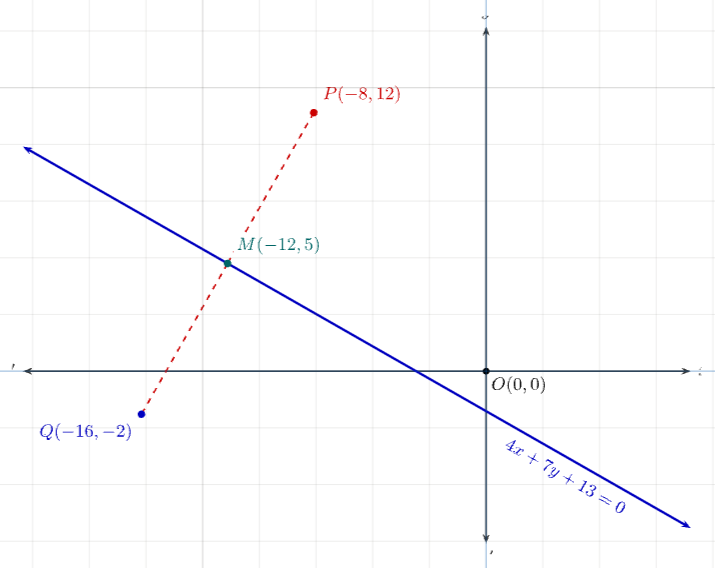
Q12. Find the image of the point P(-8, 12) with respect to the line mirror 4x + 7y + 13 = 0.
Solution:
Step 1: Define the image point and use the mid-point condition.
Let Q(\alpha, \beta) be the image of P(-8, 12) in the line mirror 4x + 7y + 13 = 0.
By the property of reflection, the line mirror is the perpendicular bisector of segment PQ.
The mid-point M of PQ is: M = \left(\frac{\alpha - 8}{2}, \frac{\beta + 12}{2}\right).
Since M lies on the line 4x + 7y + 13 = 0, we substitute its coordinates:
4\left(\frac{\alpha - 8}{2}\right) + 7\left(\frac{\beta + 12}{2}\right) + 13 = 0
2: 4(\alpha - 8) + 7(\beta + 12) + 26 = 0
4\alpha - 32 + 7\beta + 84 + 26 = 0
4\alpha + 7\beta + 78 = 0 — (Equation 1).
Step 2: Use the perpendicularity condition.
Slope of the mirror line 4x + 7y + 13 = 0 is m_1 = -\frac{4}{7}.
Slope of the segment PQ is m_2 = \frac{\beta - 12}{\alpha - (-8)} = \frac{\beta - 12}{\alpha + 8}.
Since PQ is perpendicular to the mirror line (m_1 \cdot m_2 = -1):
\left(-\frac{4}{7}\right)\left(\frac{\beta - 12}{\alpha + 8}\right) = -1
\frac{\beta - 12}{\alpha + 8} = \frac{7}{4}
4(\beta - 12) = 7(\alpha + 8)
4\beta - 48 = 7\alpha + 56
7\alpha - 4\beta + 104 = 0 — (Equation 2).
Step 3: Solve Equations 1 and 2 simultaneously.
From Equation 1: 4\alpha + 7\beta = -78
From Equation 2: 7\alpha - 4\beta = -104
Multiply Equation 1 by 4 and Equation 2 by 7 to eliminate \beta:
Equation 1 becomes: 16\alpha + 28\beta = -312
Equation 2 becomes: 49\alpha - 28\beta = -728
Adding both equations: 65\alpha = -1040 \implies \alpha = \frac{-1040}{65} = -16.
Substitute \alpha = -16 into Equation 1:
4(-16) + 7\beta = -78
-64 + 7\beta = -78
\beta: 7\beta = -78 + 64 = -14 \implies \beta = -2.
Final Answer: The image of the point is \boxed{(-16, -2)}
Teacher’s Tip: In CBSE subjective papers, always show the full mid-point and perpendicularity steps above for 3 marks. To double-check your final answer in 15 seconds, use the direct image formula: \frac{\alpha - x_1}{A} = \frac{\beta - y_1}{B} = \frac{-2(Ax_1 + By_1 + C)}{A^2 + B^2}. Here, \frac{-2(4(-8) + 7(12) + 13)}{4^2 + 7^2} = \frac{-2(65)}{65} = -2, which immediately confirms \alpha = -8 + 4(-2) = -16 and \beta = 12 + 7(-2) = -2!
Section D: Case Study (4 Marks)
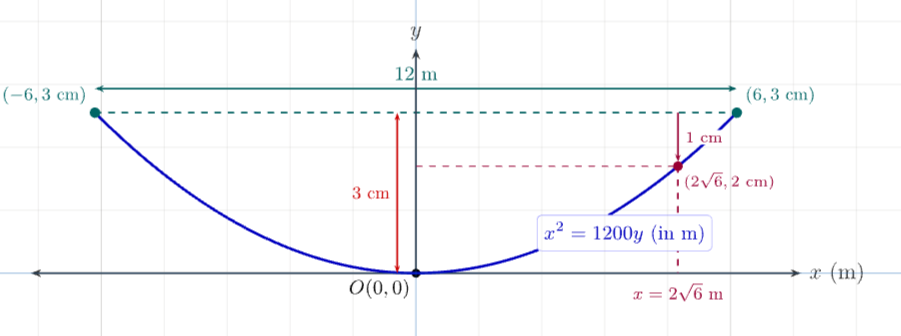
Q13. A beam is supported at its ends by supports which are 12\text{ m} apart. Since the load is concentrated at its centre, there is a deflection of 3\text{ cm} at the centre and the deflected beam is in the shape of a parabola. Considering the centre of the beam is at the origin as shown in the figure, answer the following
(i) Write the form of the equation of parabola.
(ii) Find the focus of parabola.
(iii) Find the length of latus rectum of parabola.
(iv) How far from the centre is the deflection 1\text{ cm}?
Solution:
(i) — Form of the equation of the parabola.
Step 1:
From the figure, the vertex of the parabola is at the origin O(0, 0) and it opens upwards along the positive y-axis.
Therefore, the standard form of the equation of the parabola is: x^2 = 4ay.
Step 2: Find the parameter a using consistent units (metres).
Convert all measurements into metres so the units match:
Total distance between the supports = 12\text{ m}, so each end is at horizontal distance x = \pm 6\text{ m} from the centre
Deflection at the centre = 3\text{ cm} = \frac{3}{100}\text{ m}
Therefore, the right-hand support lies on the parabola at the point \left(6, \frac{3}{100}\right).
Substitute x = 6 and y = \frac{3}{100} into x^2 = 4ay:
6^2 = 4a\left(\frac{3}{100}\right)
36 = \frac{12a}{100}
a = \frac{36 \times 100}{12} = 300\text{ m}.
Thus, the exact equation of the parabola (in metres) is: x^2 = 1200y.
(ii) — Focus of the parabola.
For an upward parabola x^2 = 4ay, the focus is at (0, a).
Since a = 300\text{ m}, the focus is: (0, 300) (in metres).
(iii) — Length of latus rectum.
The length of the latus rectum is 4a:
So, 4a = 4 \times 300 = 1200\text{ m}.
(iv) — Distance from the centre where deflection is 1\text{ cm}.
The supports are at height y = 3\text{ cm} above the origin O, and deflection is measured downward from the horizontal line joining the supports.
So, when the deflection is 1\text{ cm}, the height y above the x-axis is: y = 3\text{ cm} - 1\text{ cm} = 2\text{ cm} = \frac{2}{100}\text{ m}.
Substitute y = \frac{2}{100} into the parabola equation x^2 = 1200y:
x^2 = 1200 \times \frac{2}{100}
x^2 = 24
Taking the positive square root: x = \sqrt{24} = 2\sqrt{6}\text{ m} \approx 4.9\text{ m}.
Final Answer:
(i) Form of equation: \boxed{x^2 = 4ay} (specifically x^2 = 1200y in metres)
(ii) Focus: \boxed{(0, 300)} (in metres)
(iii) Length of latus rectum: \boxed{1200\text{ m}}
(iv) Distance from centre: \boxed{2\sqrt{6}\text{ m}} (or approximately 4.9\text{ m})