
Table of Contents
The CBSE has changed the Maths Syllabus of class 9 for the Academic Year 2026-27. The NCERT has come out with a new maths book (Ganita Manjiri) as per the new syllabus. The new book does not have an answer key for the exercises as was present in the previous NCERT books.
So I have solved the book and posted the answer keys for the complete book in page. Feel free to refer it as you solve the book and share it with friends, students and teachers. Happy Practicing Maths 🙂
EXERCISE SET 1.1
1. (i) The door is 8 units (feet) away from the left wall (y-axis).
Since the door is on the line OA (x-axis), it is 0 units from the x-axis.
(ii) The coordinates of D_1 are (8, 0).
(iii) The width of the door = 3.5 ft.
Yes, this is a very comfortable width. Standard room doors are usually about 3 feet wide. A 3.5 ft door (42 inches) is wider than standard requirements, making it very easy for a wheelchair user to enter.
(iv) The width of the bathroom door is 2.5 ft.
The bathroom door is narrower than the room door.
EXERCISE SET 1.2
1. (i) The fourth foot is at (8, 7).
(ii) Yes! Looking at the floor plan, placing it between x=8 to 11 and y=7 to 9 tucks it nicely into the top right area of the room, keeping the central walking space clear.
(iii) Length = 11 - 8 = 3 ft. Width = 9 - 7 = 2 ft.
Because we are strictly looking at a 2D floor plan (xy-plane), we cannot determine the height of the table.
2. The door will not hit the wardrobe.
If the door is made wider (e.g., 3.5 ft), its swing would reach x = 3.5, which means it would hit the wardrobe.
Suggestion: Slide the wardrobe further to the right or have the door open outwards into the bathroom.
3.(i) Coordinates of the four corners O, F, R, and P:
The coordinates are O(0, 0), F(0, 10), R(-6, 10), and P(-6, 0).
(ii) It is a square/rectangle.
The coordinates are S(-6, 5), H(-2, 5), W(-2, 10), and R(-6, 10).
(iii) Washbasin (3 \text{ ft} \times 2 \text{ ft} in the bottom corner): (-6, 0), (-3, 0), (-3, 2), (-6, 2).
Toilet (2 \text{ ft} \times 3 \text{ ft} above the basin): (-6, 2), (-4, 2), (-4, 5), (-6, 5).
4. Other rooms in the house (Dining Room):
(i) The room spans 18 ft from P to A.
If P is (-6, 0) and A is (12, 0), the length is 12 - (-6) = 18 ft.
If it has a width of 15 ft extending downwards, the coordinates of the corners are (-6, 0), (12, 0), (12, -15), and (-6, -15).
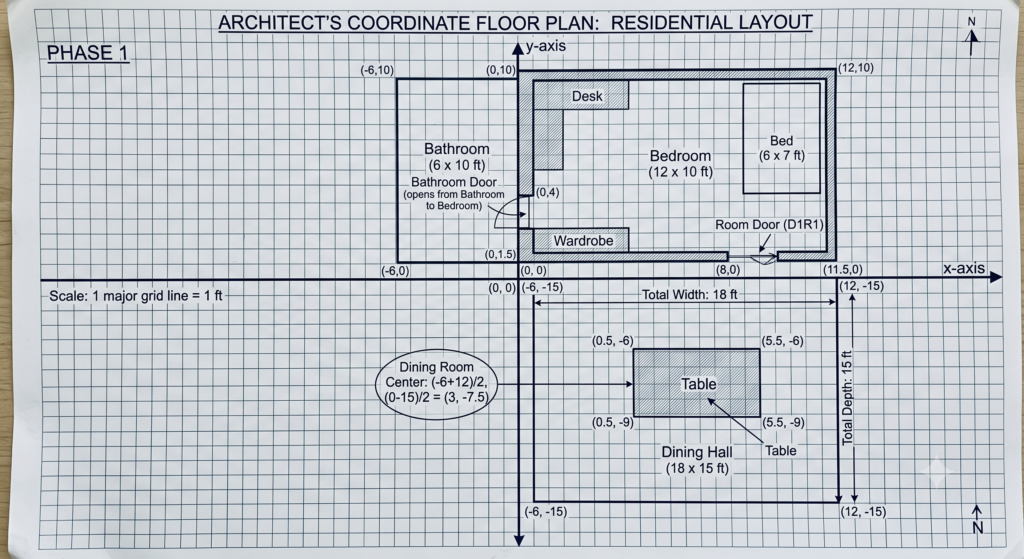
(ii) Table placed perfectly in the center, its corners (feet) will be (0.5, -6), (5.5, -6), (5.5, -9), and (0.5, -9).
END OF CHAPTER 1 Exercise
1. The coordinates are (0, 0).
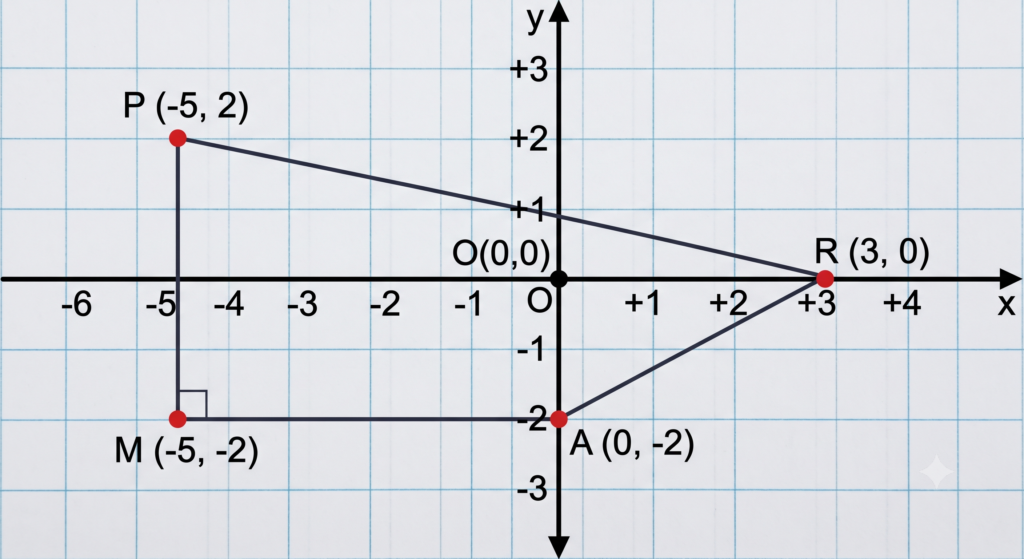
2. Point H will have coordinates (-5, y).
H can lie in Quadrant II or Quadrant III.
3. (i) Sides perpendicular to each other: Line segments AM and MP.
(ii) Parallel to axes: AM is parallel to the x-axis, and MP is parallel to the y-axis.
(iii) Mirror images: Points M(-5, -2) and P(-5, 2) are mirror images of each other across the x-axis.
4.
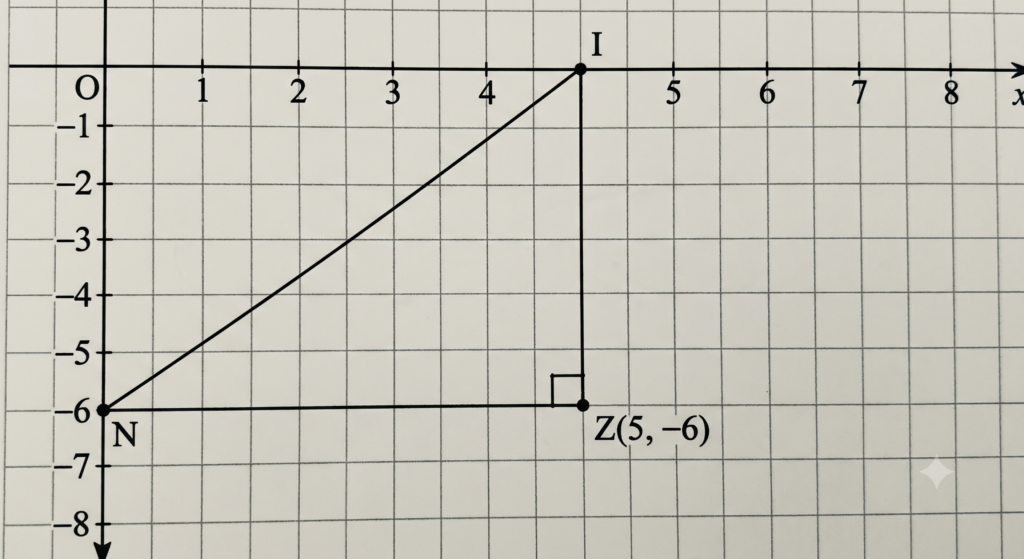
Lengths of sides:
IZ = 6 units
ZN = 5 units
IN = \sqrt{61} units.
(note: Answer may differ from person to person)
5. If we didn’t have negative numbers, our coordinate system would be limited to only the first quadrant.
We would not be able to locate all points in a 2-D plane, making concepts like a four-quadrant Cartesian plane impossible.
6. Yes.
You can check this mathematically without plotting by comparing the distance MG and the sum of distances MA and AG
7. No R, B and C are not collinear.
8. Plotting vertices using the origin (0,0):
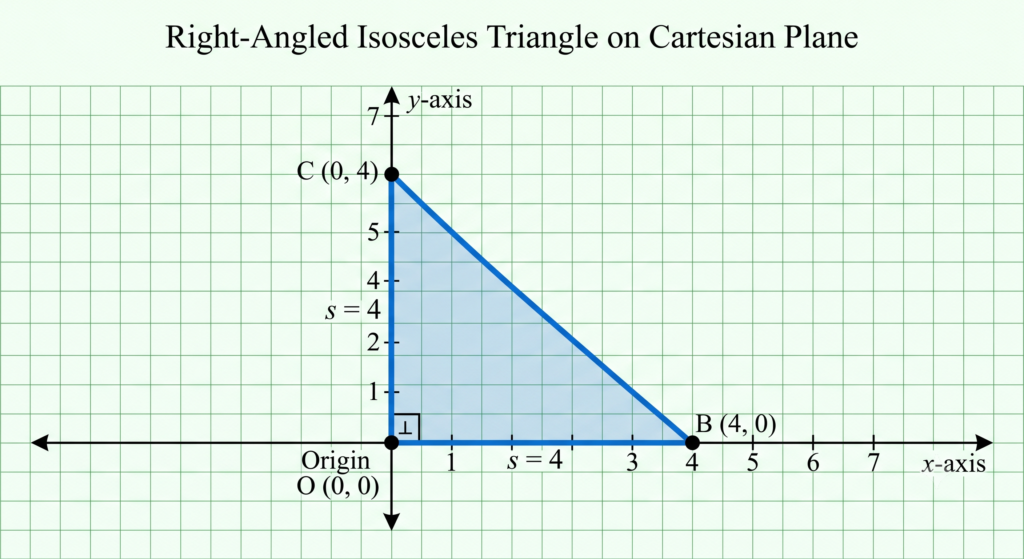
- (i) Right-angled isosceles triangle: (0, 0), (a, 0), and (0, a).
- (ii) Isosceles triangle with vertices in Q3 and Q4: (0, 0), (-a, -b), and (a, -b).
9. Formula Check: Midpoint = \left( \frac{x_1 + x_2}{2}, \frac{y_1 + y_2}{2} \right)
| S | M | T | Is M the midpoint? | Reason |
| (-3, 0) | (0, 0) | (3, 0) | Yes | \frac{-3+3}{2} = 0, \frac{0+0}{2} = 0 |
| (2, 3) | (3, 4) | (4, 5) | Yes | \frac{2+4}{2} = 3, \frac{3+5}{2} = 4 |
| (0, 0) | (0, 5) | (0, -10) | No | \frac{0-10}{2} = -5, not 5 |
| (-8, 7) | (0, -2) | (6, -3) | No | \frac{-8+6}{2} = -1, not 0 |
10. Coordinates of B are (-17, 6).
11. Points of Trisection: P(8, 4), Q(12, 1)
12. (i) Radius R = \sqrt{65}.
(ii)OD = \sqrt{61}.
D lies inside the circle.
OE = 9.
E lies outside the circle.
13. A(1, 7), B(-1, -1), and C(11, 3).
14. City Map intersections:
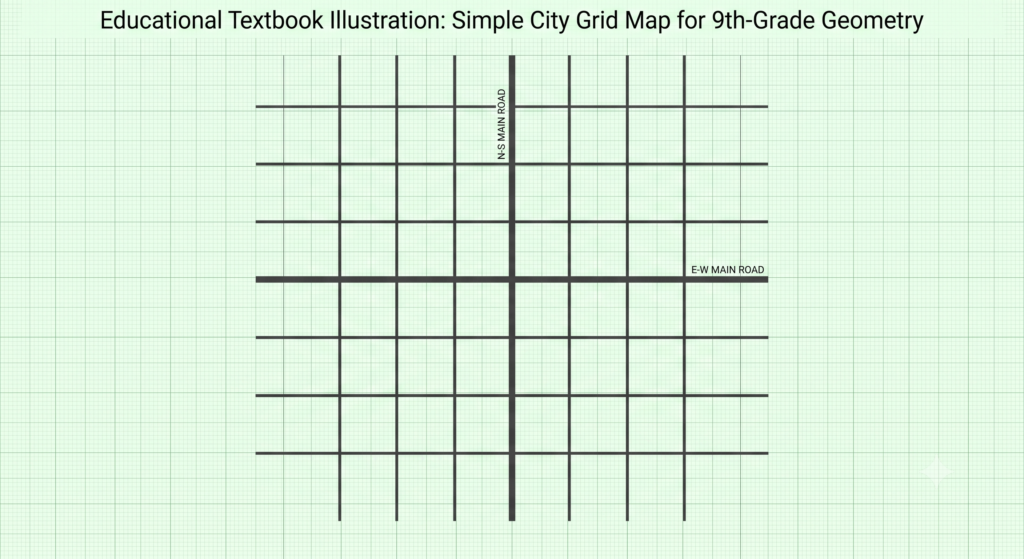
- (a) There is exactly 1 street intersection referred to as (4, 3).
- (b) There is exactly 1 street intersection referred to as (3, 4).
15. (i) No part lies outside.
(ii) Distance between centers A and B: AB = 170 \text{ pixels}
The sum of their radii is 80 + 100 = 180 pixels.
Since the distance between centers (170) is less than the sum of the radii (180), the two circles intersect.
16. Yes, ABCD is a square.
Area = \text{10 square units}.
EXERCISE SET 2.1
1. (i) The degree is 2.
(ii) The degree is 3.
(iii) The degree is 0.
(iv) The degree is 1.
2. (Answers may vary. Here are standard examples)
- Degree 1 (Linear): 5x + 2
- Degree 2 (Quadratic): 3y^2 - 4y + 7
- Degree 3 (Cubic): 2z^3 + z^2 - 8
3. The term with x^2 is 6x^2. Its coefficient is 6.
The term with x^3 is -3x^3. Its coefficient is -3.
4. The coefficient of z is 0.
5. The constant term is -10.
EXERCISE SET 2.2
1. The value of the linear polynomial 5x - 3 is:
(i) -3
(ii) -8
(iii) 7
2. Find the value of the quadratic polynomial 7s^2 - 4s + 6 is:
(i) 6
(ii) 81
(iii) 102
3. Salil’s present age is 15 years, and his mother’s present age is 45 years.
4. The two integers are 42 and 105.
5. Ruby has 8 coins of ₹5, and 24 coins of ₹2.
6. The shorter piece is 60 feet and the longer piece is 240 feet.
7. The dimensions of the rectangle are Length = 9 cm and Width = 3 cm.
EXERCISE SET 2.3
1. Amount at the end of every month from the 2nd month onwards:
- End of Month 1: 500 + 150 = \text{₹650}
- End of Month 2: 650 + 150 = \text{₹800}
- End of Month 3: 800 + 150 = \text{₹950}
Linear Expression: \text{Amount in } n^{\text{th}} \text{ month} = 500 + 150n
2. Members remaining after 1, 2, 3 hours:
- After 1 hour: 120 - 9 = 111 members
- After 2 hours: 111 - 9 = 102 members
- After 3 hours: 102 - 9 = 93 members
\text{Members at the end of } n^{\text{th}} \text{ hour} = 120 - 9n
3. Area
(i) Area = 156 \text{ cm}^2
(ii) Area = 130 \text{ cm}^2
(iii) Area = 104 \text{ cm}^2
The linear pattern representing the area is: \text{Area} = 13b
4. Volume
(i) Volume = 385 \text{ cm}^3
(ii) Volume = 693 \text{ cm}^3
(iii) Volume = 1001 \text{ cm}^3
The linear pattern representing the volume is: \text{Volume} = 77h
5. Pages left after 15 days = 200
Because the pages remaining decrease every day, this is a linear decay pattern.
\text{Pages left after } n \text{ days} = 500 - 20n
EXERCISE SET 2.4
1. (i) The height after 7 months: = 5.25 \text{ feet}
(ii) Table of values for t varying from 0 to 10 months:
| Month (t) | 0 | 1 | 2 | 3 | 4 | 5 | 6 | 7 | 8 | 9 | 10 |
| Height, h (ft) | 1.75 | 2.25 | 2.75 | 3.25 | 3.75 | 4.25 | 4.75 | 5.25 | 5.75 | 6.25 | 6.75 |
(iii) Expression h(t) = 1.75 + 0.5t
This represents linear growth because the height increases by a constant amount (0.5 feet) over equal intervals (every month).
2. (i) The value of the phone after 3 years: = \text{₹7600}
(ii) Table of values for t varying from 0 to 8 years:
| Year (t) | 0 | 1 | 2 | 3 | 4 | 5 | 6 | 7 | 8 |
| Value, v (₹) | 10000 | 9200 | 8400 | 7600 | 6800 | 6000 | 5200 | 4400 | 3600 |
(iii) Expression: v(t) = 10000 - 800t
This represents linear decay because the value decreases by a fixed, constant amount (₹800) over equal intervals (every year).
3. (i) The population after 6 years: 1050 \text{ people}
(ii) Table of values for t varying from 0 to 10 years:
| Year (t) | 0 | 1 | 2 | 3 | 4 | 5 | 6 | 7 | 8 | 9 | 10 |
| Population, P | 750 | 800 | 850 | 900 | 950 | 1000 | 1050 | 1100 | 1150 | 1200 | 1250 |
(iii) Expression: P(t) = 750 + 50t
This represents linear growth because the population increases by a constant amount (50 people) each year.
4. (i) Equation: b(x) = 600 - 15x
This is linear decay because the balance is reduced by a constant amount (₹15) every single day.
(ii) The balance runs out after 40 \text{ days}
(iii) Table of values for x varying from 1 to 10 days:
| Day (x) | 1 | 2 | 3 | 4 | 5 | 6 | 7 | 8 | 9 | 10 |
| Balance, b(x) | 585 | 570 | 555 | 540 | 525 | 510 | 495 | 480 | 465 | 450 |
EXERCISE SET 2.5
1. a = 25, b = 150. (The linear relation is y = 25x + 150).
2. a = 60, b = 200. (The linear relation is y = 60x + 200).
3. a = \frac{5}{9}, b = -\frac{160}{9}. (The relation is C = \frac{5}{9}F - \frac{160}{9}).
EXERCISE SET 2.6
1. (i)
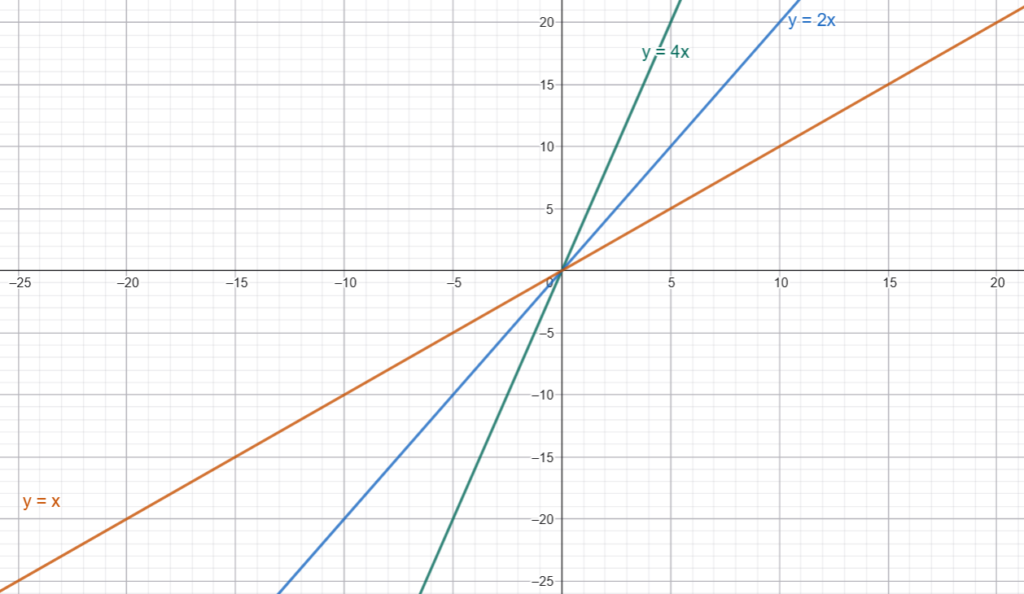
The changing value of a (4, 2, 1) changes the steepness of the lines.
The larger the a, the steeper the graph.
The value of b is 0 for all, so they all pass exactly through the origin (0,0).
(ii)
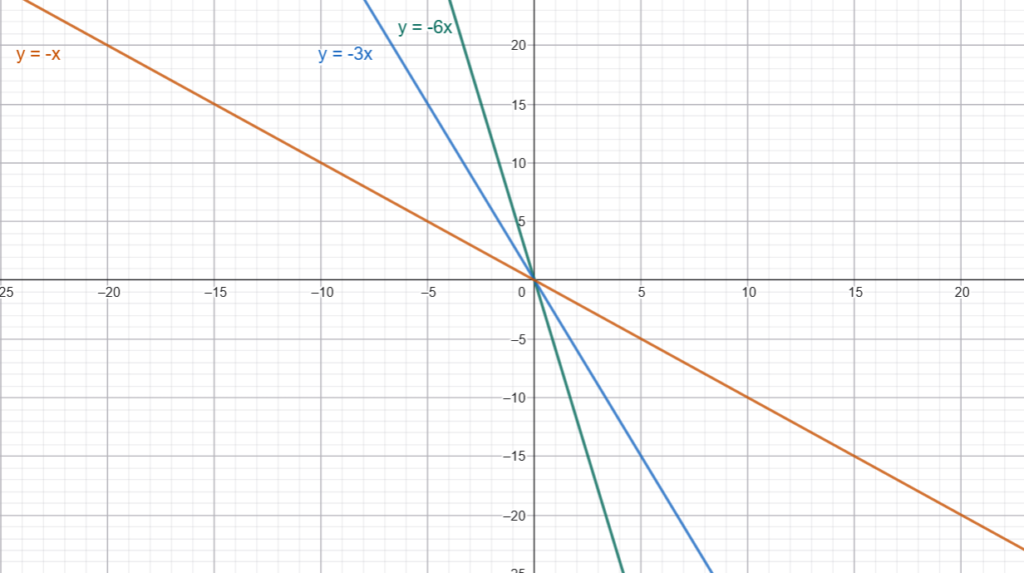
The value of a are (-1, -3, -6).
A negative slope represents that the lines goes down as x increases/
The larger the a, in magnitude the steeper the graph.
The value of b is 0 for all, so they all pass exactly through the origin (0,0).
(iii)
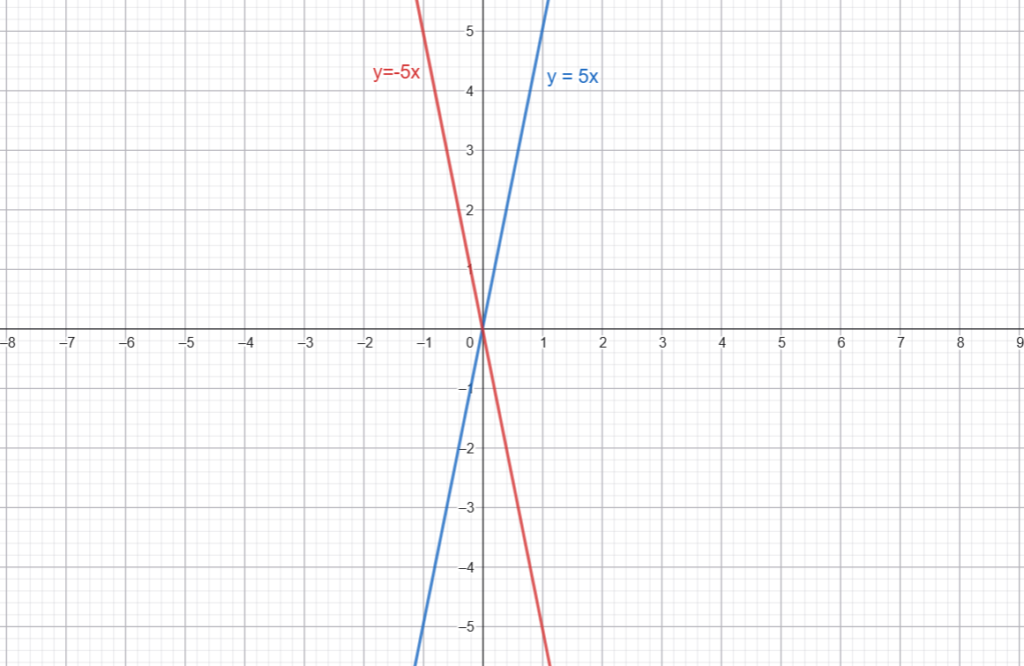
The number for the slope is the same, but the signs are opposite.
y = 5x slopes upwards (linear growth), while y = -5x slopes downwards (linear decay) at the exact same steepness.
The value of b is 0 for all, so they all pass exactly through the origin (0,0).
(iv)
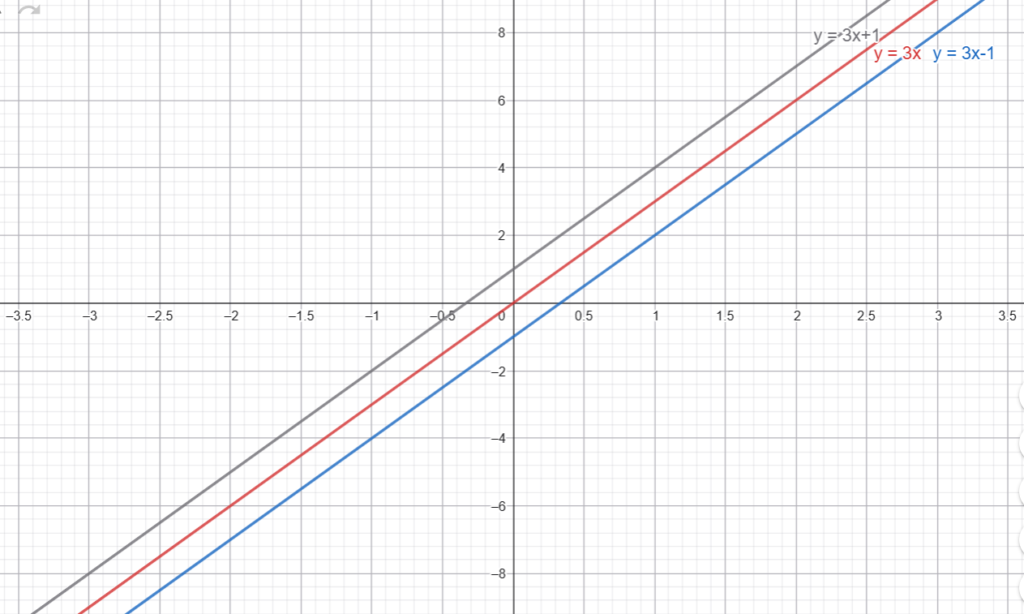
The value of a (slope) is 3 for all of them.
Since the slopes are identical, these three lines are perfectly parallel.
The value of b is the y intercept i.e. where they cross the y-axis
([/latex] b = -1, 0, \text{ and } 1[/latex]).
(v)
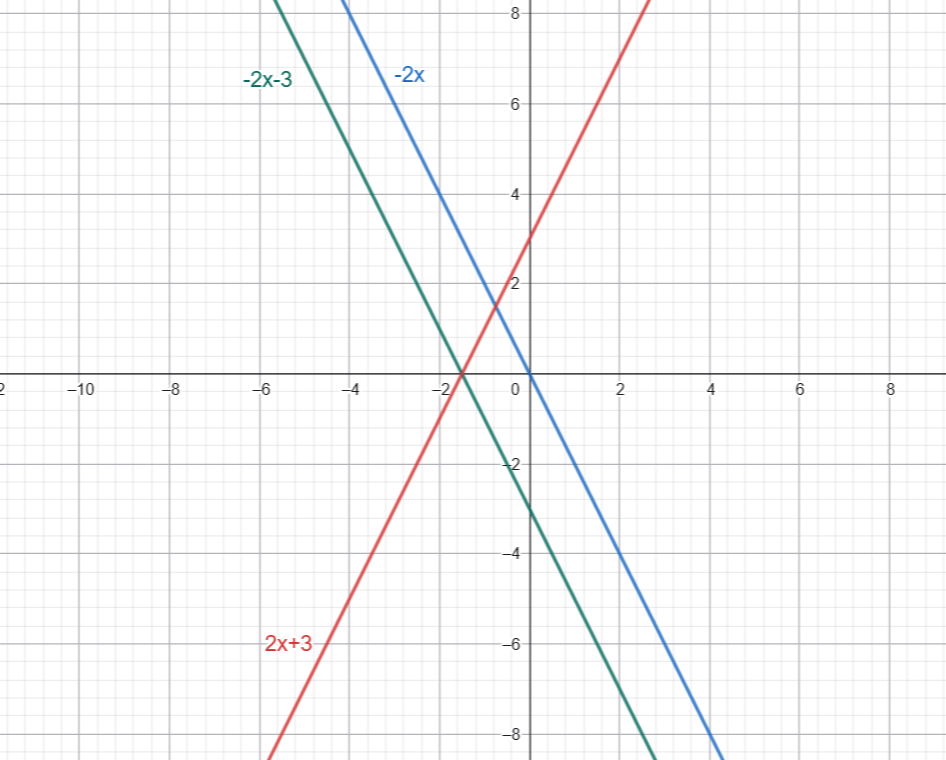
The value of a (slope) for two lines is -2 so they are parallel.
Also since the slope is negative the lines slopes downwards.
While the slope of the third line is 2 hence it slopes upwards with the exact steepness of the other two lines
The value of b for the line (y = -2x) is 0, therefore it passes through the origin.
The value of b for the other two lines are 3 and -3, which is their y intercept.
END-OF-CHAPTER 2 EXERCISE
1. x^3 - 7x^2 + 5x + 2
(Any cubic equation works as long as the x^2 term is -7x^2.)
2. (i) 9
(ii) 4a^3 - a^2 + 6
3. The number is -\frac{1}{2}.
4. The numbers are 7 and 35.
5. (i) After 6 months, amount = \text{₹2300}
(ii) After 2 years (24 months), amount = \text{₹6800}
Linear pattern: Amount = 800 + 250n
(where n is months)
6. The numbers are 85 or 58.
7. Identify slopes, y-intercepts, and see if parallel:
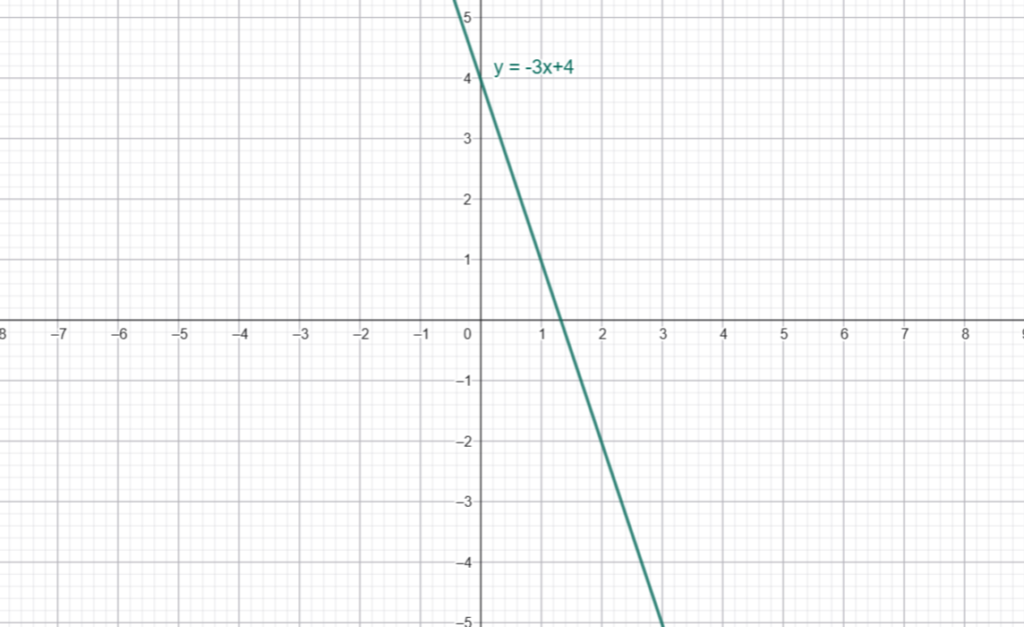
(i) y = -3x + 4:
Slope = -3, cuts y-axis at (0, 4).
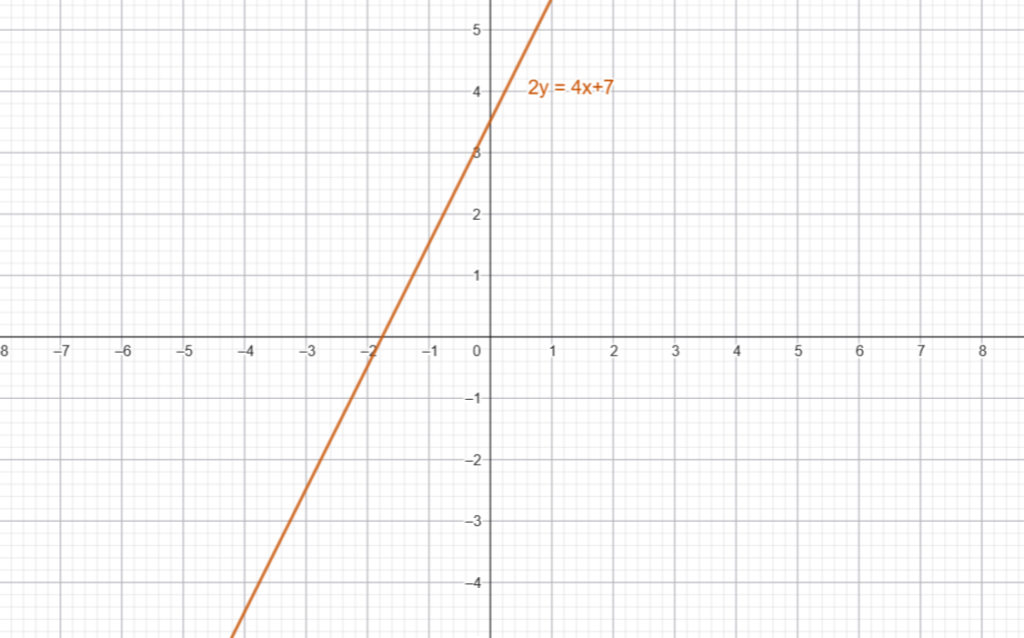
(ii) 2y = 4x + 7 \implies y = 2x + 3.5:
Slope = 2, cuts y-axis at (0, 3.5).
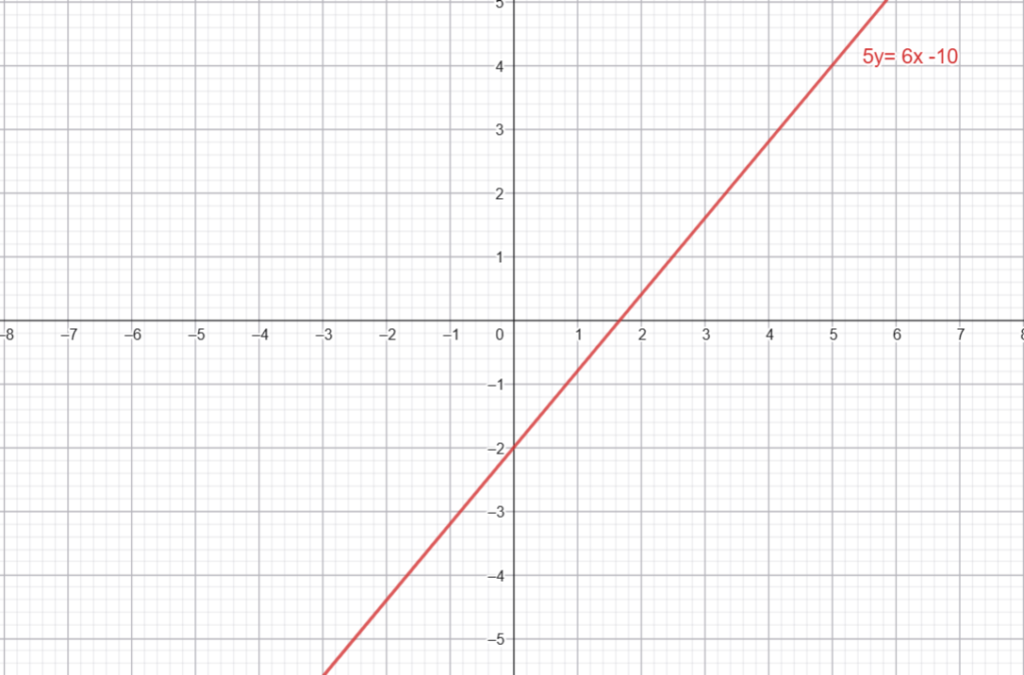
(iii) 5y = 6x - 10 \implies y = 1.2x - 2:
Slope = 1.2, cuts y-axis at (0, -2).
(iv) 3y = 6x - 11 \implies y = 2x - \frac{11}{3}:
Slope = 2, cuts y-axis at (0, -\frac{11}{3}).
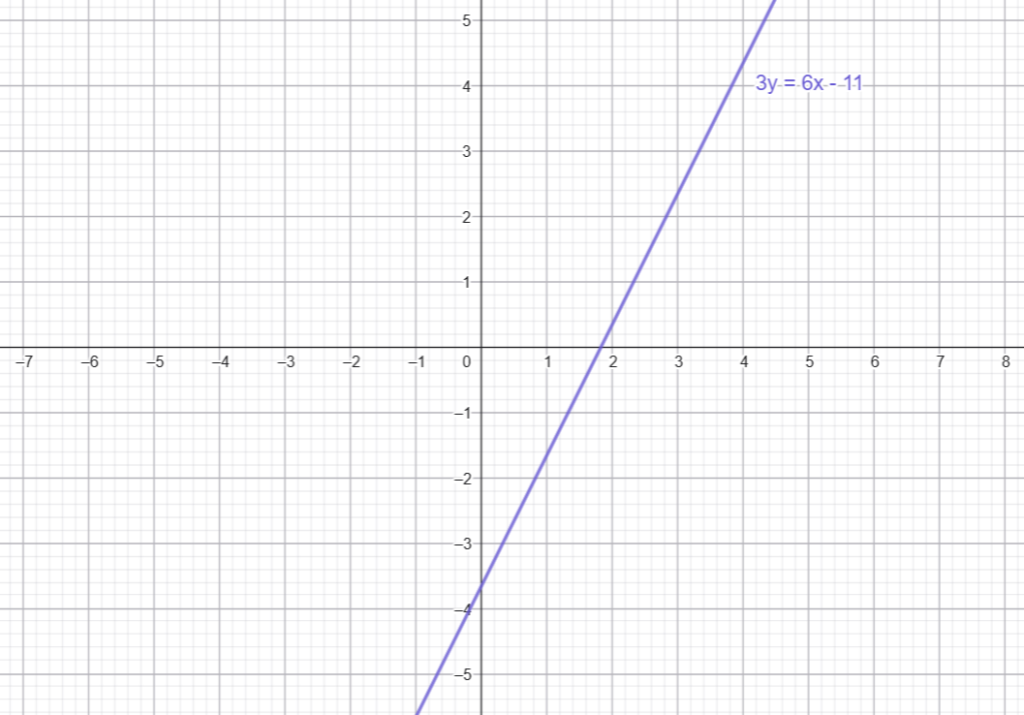
Answer: Yes, lines (ii) and (iv) are parallel because they both have the exact same slope of 2.
8. (i) 104^\circ\text{F}
(ii) 343\text{ K}
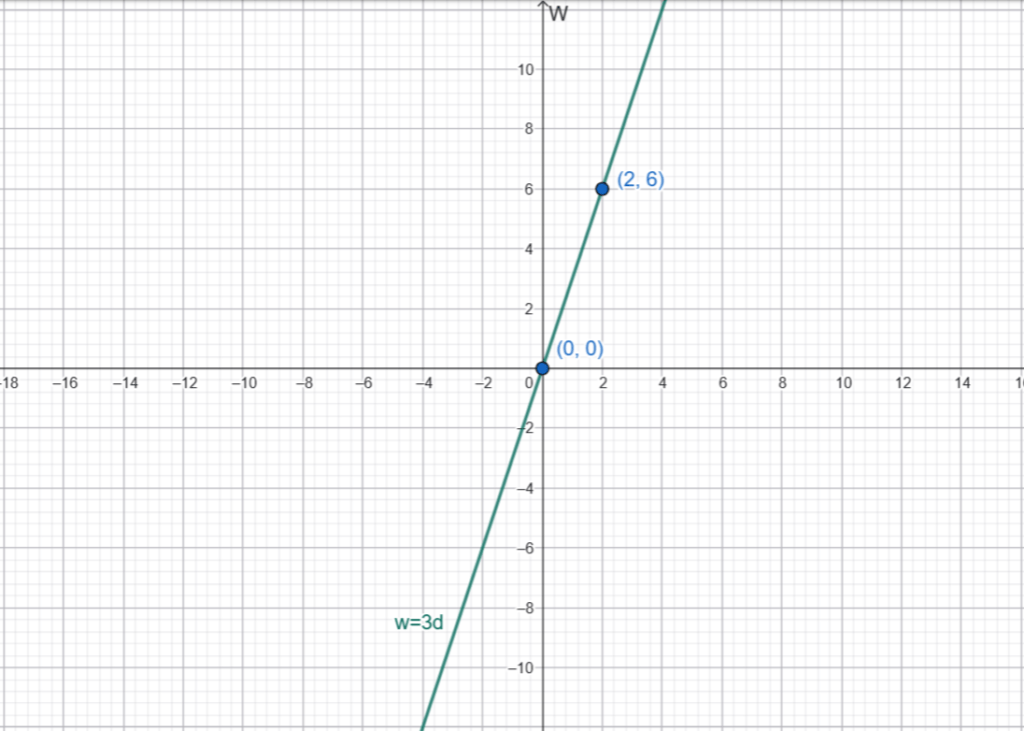
9. Work w and distance d with constant force = 3.
Formula: w = F \times d \implies w = 3d
If d = 2 units, w = 3(2) = 6 \text{ units}.
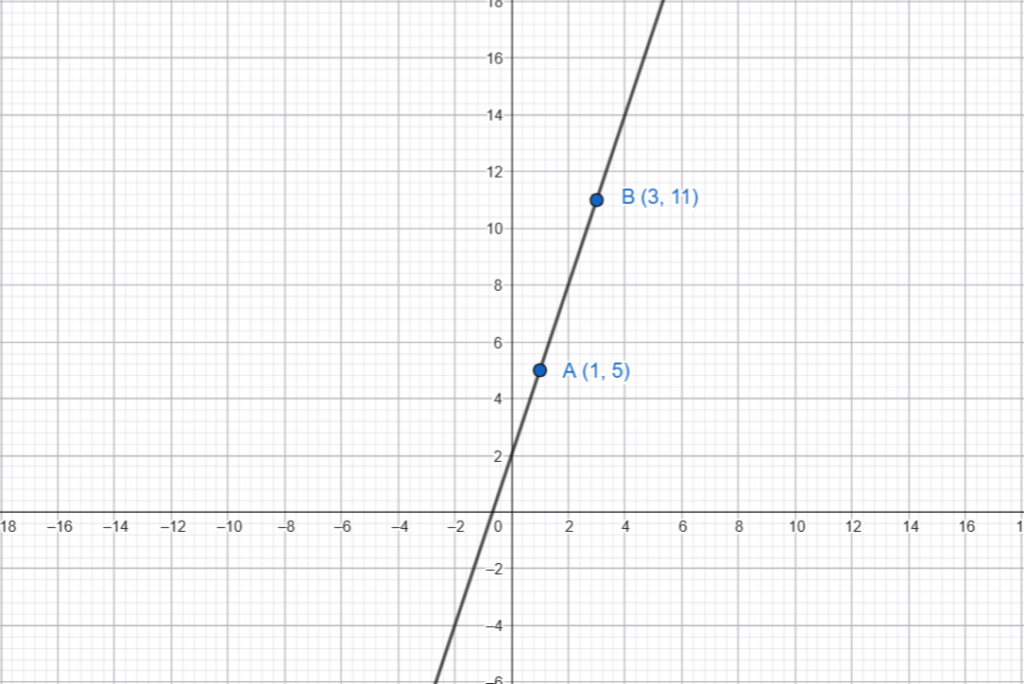
10. (i) p(x) = 3x + 2
(ii) Cuts y-axis at (0, 2)
Cuts x-axis at (-\frac{2}{3}, 0)
(iii)
11. p(x) = 2x + 5 and q(x) = 4x - 1
12. Growing pattern of hexagons.
(i) Next two stages:
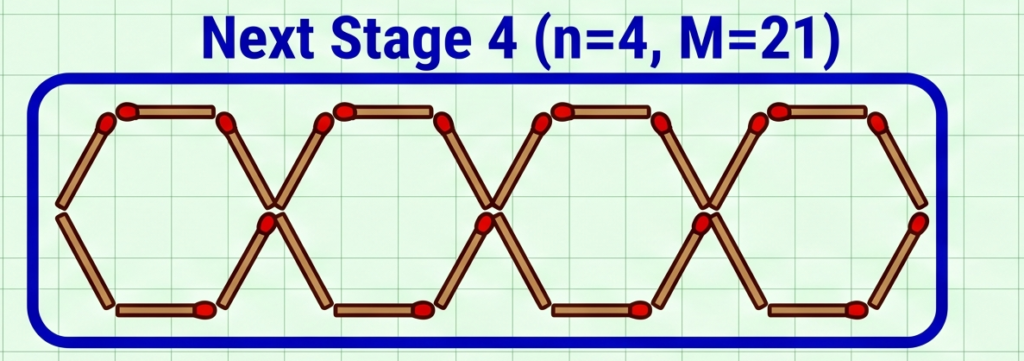
Stage 4 will have 16 + 5 = 21 matchsticks.
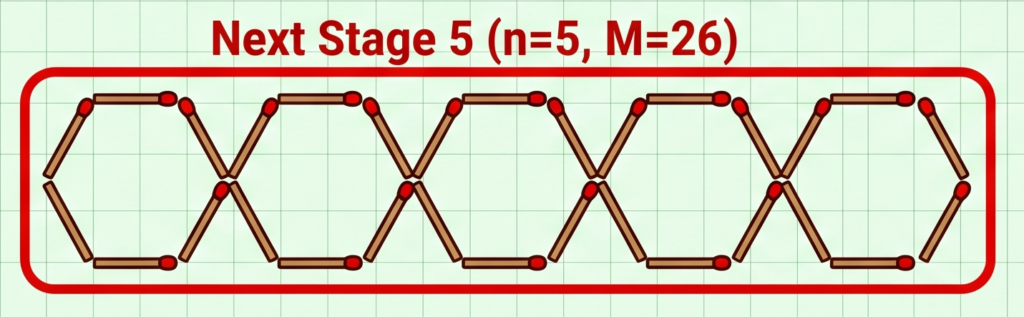
Stage 5 will have 21 + 5 = 26 matchsticks.
(ii)
| Stage Number | 1 | 2 | 3 | 4 | 5 | … | n |
| Number of Matchsticks | 6 | 11 | 16 | 21 | 26 | … | 5n+1 |
(iii) Rule for n^{\text{th}} stage: 5n + 1
(iv) Matchsticks for 15th stage: 5(15) + 1 = 75 + 1 = 76
(v) No. Since n must be a whole number (you can’t have a fraction of a stage), 200 matchsticks will not form a complete stage.
13. p(x) = 2x - 1
q(x) = 2x - 9.
Coordinates where they meet the x-axis:
For p(x): (\frac{1}{2}, 0)
For q(x): (\frac{9}{2}, 0)
14. The linear functions all represent straight lines passing through the exact same point: (-1, 0) on the x-axis.
EXERCISE SET 3.1
1. The merchant will leave with 90 copper ingots.
2. The next three prime numbers following 19 are 23, 29, and 31.
3. No, Natural Numbers are not closed under subtraction.
Example: If we take two natural numbers, say 5 and 8, and subtract them: 5 - 8 = -3.
Since -3 is an integer but not a natural number, the closure property fails for subtraction.
4. Using the thumb to point to each joint allows you to count to 4 \times 3 = 12 on a single hand.
Relation: This simple anatomical fact is exactly why ancient cultures developed base-12 (dozenal) counting systems. Measuring in dozens and grosses is a direct result of counting finger joints!
EXERCISE SET 3.2
1. The midnight temperature is -11^\circ\text{C}.
2. Equation: Debt is negative, profit is positive, and loss is negative. -850 + 1200 + (-450)
The final standing is -100, which means the trader has a net debt of ₹100.
3. (i) The product of a debt and a fortune is a debt. Answer: -60
(ii) The product of two debts is a fortune. Answer: 56
(iii) Subtracting a debt is equivalent to adding a fortune. Answer: 14
(iv) Dividing a debt by a fortune yields a debt. Answer: -5
4. Imagine you have ₹10 in your pocket, but you also owe your friend ₹5. That ₹5 you owe is a debt, represented as -5. If your friend suddenly forgives your debt and takes it away (subtracts the -5), your financial standing improves! Removing a ₹5 debt makes you ₹5 richer. Therefore, taking away a debt of 5 is exactly the same as gaining a fortune of 5: 10 - (-5) = 15.
EXERCISE SET 3.3
1. (i) \frac{2}{3} and \frac{4}{6}
2 \times 6 = 12 and 3 \times 4 = 12.
Since 12 = 12, they are equal.
(ii) \frac{5}{4} and \frac{10}{8}
5 \times 8 = 40 and 4 \times 10 = 40.
Since 40 = 40, they are equal.
(iii) -\frac{3}{5} and -\frac{6}{10}
-3 \times 10 = -30 and 5 \times (-6) = -30.
Since -30 = -30, they are equal.
(iv) \frac{9}{3} and 3
9 \times 1 = 9 and 3 \times (3) = 9.
Since 9 = 9, they are equal.
2. (i) \frac{7}{10}
(ii) \frac{29}{24}
(iii) -\frac{5}{14}
3. (i) \frac{7}{12}
(ii) \frac{5}{8}
(iii) -\frac{1}{9}
4. (i) \frac{1}{5}
(ii) \frac{35}{88}
(iii) -\frac{10}{49}
5. (i) \frac{20}{9}
(ii) \frac{56}{55}
(iii) -\frac{8}{5}
6. Show that: \left(\frac{1}{2} + \frac{3}{4}\right) \times \frac{8}{3} = \frac{1}{2} \times \frac{8}{3} + \frac{3}{4} \times \frac{8}{3}
LHS (Left Hand Side):
First solve the bracket.
\left(\frac{2}{4} + \frac{3}{4}\right) \times \frac{8}{3} = \frac{5}{4} \times \frac{8}{3} = \frac{40}{12} = \frac{10}{3}
RHS (Right Hand Side):
Solve multiplications first.
\left( \frac{8}{6} \right) + \left( \frac{24}{12} \right) = \frac{4}{3} + \frac{6}{3} = \frac{10}{3}
Conclusion: LHS = RHS, Hence Proved
7. \frac{1}{12}
8. x can be ANY rational number.
Every rational number will satisfy this equation because it perfectly demonstrates the distributive property.
EXERCISE SET 3.4
Step by step solution of Exercise Set 3.4
1.
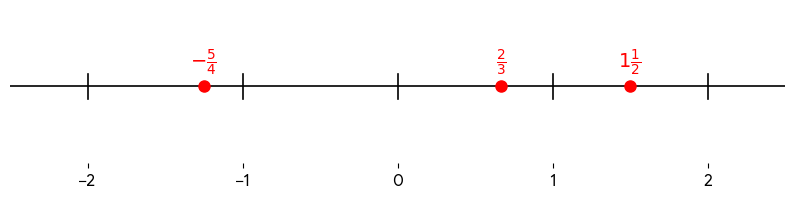
2. -\frac{9}{32}, -\frac{10}{32}, -\frac{11}{32} (Answers may vary).
3. \frac{1}{6}.
4. He can make exactly 7 kurtas.
5. 3.14151, 3.14152, 3.14155 (Answers may vary).
6. Yes! In addition to the “mean” or “average” method (\frac{a+b}{2}),
you can convert the rational numbers to decimals and pick a terminating decimal between them (as we did in Q5).
You can also make their denominators very large (equivalent fractions) and pick integer numerators in between (as we did in Q2).
EXERCISE SET 3.5
Step by step solution of Exercise Set 3.5
1. \frac{7}{20}: terminating.
\frac{4}{15}: non-terminating repeating.
\frac{13}{250}: terminating.
2. \frac{1}{13} = 0.076923076923... = 0.\overline{076923}. The repeating block is 076923.
\frac{2}{13} = 0.\overline{153846}.
\frac{3}{13} = 0.\overline{230769}.
Notice that unlike \frac{1}{7}, the digits for \frac{1}{13} and \frac{2}{13} are NOT part of the same cyclic circle.
13 produces two separate cyclic groups of 6 digits!
3. (i) \sqrt{81}: Rational
(ii) \sqrt{12}: Irrational
(iii) 0.33333…: Rational
(iv) 0.123451234512345: Rational
(v) 1.01001000100001…: Irrational
(vi) 23.560185612239874790120: Rational
4. Let x = 0.9999... … (1)
Multiply by 10 (since 1 digit repeats): 10x = 9.9999... … (2)
Subtract the first equation from the second:
10x - x = 9.9999... - 0.9999...
9x = 9
x = 1
Conclusion: Therefore, 0.\overline{9} is mathematically identical to 1.
5. Other numbers whose reciprocals produce cyclic numbers include 17, 19, 23, and 29.
END-OF-CHAPTER 3 EXERCISE
Step by Step Solution of End of Chapter 3 Exercise
1. (i) \frac{3}{50}: Terminating. 3 \div 50 = 0.06.
(ii) \frac{2}{9}: Non-terminating repeating. 2 \div 9 = 0.222... = 0.\overline{2}.
2. Prove that \sqrt{5} is an irrational number.
Step 1 (Assumption):
Assume \sqrt{5} is rational.
So, \sqrt{5} = \frac{p}{q}, where p and q are co-prime integers and q \neq 0.
Step 2: Square both sides:
5 = \frac{p^2}{q^2} \implies p^2 = 5q^2.
Step 3: This means p^2 is a multiple of 5.
Therefore, p must also be a multiple of 5.
Let p = 5k.
Step 4: Substitute p back in: p^2 = 5q^2
(5k)^2 = 5q^2
25k^2 = 5q^2
5k^2 = q^2.
q^2 = 5k^2.
Step 5: This means q^2 is a multiple of 5, so q must also be a multiple of 5.
Conclusion: If both p and q are multiples of 5, they share a common factor of 5. This contradicts our assumption that they are co-prime.
This contradiction arises because of our wrong assumption and
Therefore, \sqrt{5} must be irrational.
3. (i) 12.6 = \frac{63}{5}
(ii) 0.0120 = \frac{3}{250}
(iii) 3.0\overline{52} = \frac{1511}{495}
(iv) 1.235 = \frac{247}{200}
(v) 0.\overline{23} = \frac{23}{99}
5. \frac{22}{7}, \frac{23}{7}, \frac{24}{7}, \frac{25}{7}, \frac{26}{7}, \frac{27}{7}. Answers may be different
6. \frac{13}{30}, \frac{14}{30}, \frac{15}{30}, \frac{16}{30}, \frac{17}{30}. Answers may be different
7. \frac{6}{30}, \frac{7}{30}, \frac{8}{30}, \frac{9}{30}, \frac{10}{30}. Answers may be different
8. 2
9. The product ab must be negative.
10. Yes, it is absolutely necessary.
11. Terminating.
It will terminate after 3 decimal places.
12. Because the denominator can be expressed as 10^3, the decimal expansion will have exactly 3 decimal places.
13. \frac{22}{36}, \frac{23}{36}, \frac{24}{36}, \frac{25}{36}, \frac{26}{36}
Explanation of the rule: If you need to fit exactly n integers between two endpoints (k_1 and k_2), the “gap” or difference between those endpoints must be at least n + 1. For example, to fit 5 integers between two numbers, the difference must be at least 6. The condition k_2 - k_1 > n (or \ge n + 1) ensures there is enough mathematical “space” to pull out n unique integer numerators!
16. \sqrt{2}, \sqrt{3}, \sqrt{4}, \sqrt{5}, \sqrt{6}, \sqrt{7}, \sqrt{8}, \sqrt{9}, \sqrt{10}, \sqrt{11}, \sqrt{12}, \text{and } \sqrt{13}
Chapter 4: Exploring Algebraic Identities
EXERCISE SET 4.1
1. (i) = 49x^2 + 56xy + 16y^2
(ii) = \frac{49}{25}x^2 + \frac{21}{5}xy + \frac{9}{4}y^2
(iii) = 6.25p^2 + 7.5pq + 2.25q^2
(iv) = \frac{9}{16}s^2 + 12st + 64t^2
(v) = x^2 + \frac{x}{y} + \frac{1}{4y^2}
(vi) = \frac{1}{x^2} + \frac{2}{xy} + \frac{1}{y^2}
2. (i) = 4096
(ii) = 11025
(iii) = 42025
EXERCISE SET 4.2
1. (i) = (3x + 4y)^2
(ii) = (2s + 5t)^2
(iii) = (7x + 2y)^2
(iv) = \left(8p + \frac{2}{3}q\right)^2
(v) = 3\left(a + \frac{2}{3}b\right)^2
(vi) = \frac{1}{5}(3s + 5v)^2
2. (i) = 6241
(ii) = 37249
(iii) = 89401
EXERCISE SET 4.3
1. (i) 13689
(ii) 6084
(iii) 39204
(iv) 45796
(v) 1218816
(vi) 1254400
2. (i) (4y - 3)^2
(ii) \left(\frac{3}{2}s + 2t\right)^2
(iii) \left(\frac{m}{3} + \frac{k}{2} + 3n\right)^2
(iv) \left(\frac{p}{4} - \frac{4}{p}\right)^2
(v) (3a - 2b + c)^2
3. (i) p^2 + 9q^2 + 49r^2 + 6pq + 42qr + 14pr
(ii) 9x^2 + 4y^2 + 16z^2 - 12xy - 16yz + 24xz
4. No, this is not an identity.
EXERCISE SET 4.4
1. (i) (s - 8)(s - 3)
(ii) (3x - 7)
(iii) (2x - 3)(5x + 2)
(iv) (3x + 2)(2x + 1)
2. (i) 1681
(ii) 729
(iii) 391
(iv) 18225
(v) 9409
(vi) 522
(vii) 1462
(viii) 42025
3. (i) (3a-b+2c)^2 = (b-3a-2c)^2
(ii) (4s-5t)^2
(iii) (r-7)(r+6)
(iv) (6g+h)^2
(v) (11v-8u+2w)^2 = (8u-11v-2w)^2
EXERCISE SET 4.5
1. (i) \frac{3(p-3q)(p+2q)}{(p+5q)(p-2q)}
(ii) \frac{(n - m)^3}{5(n - m)^2} = \frac{n - m}{5}
(iii) \frac{w^2 + v^2 + x^2 + wv + vx - wx}{w - v + x}
(iv) \frac{5z - 2y}{5z + 2y}
(v) 1
(vi) \frac{(p + 2)(p^2 + 4)}{p - 2}
END-OF-CHAPTER 4 EXERCISE
1. (i) 9x^2 - 24x + 16
(ii) 4s^2 - 49
(iii) p^4 - \frac{1}{4}
(iv) 4n^2 - 49
(v) s^3 - 8t^3
(vi) \frac{1}{4r^2} - 4 + 16r^2
(vii) 9m^2 + 16k^2 + l^2 - 24mk + 6ml - 8kl
(viii) x^3 - x^2y + \frac{1}{3}xy^2 - \frac{1}{27}y^3
(ix) \frac{343}{8}k^3 - \frac{49}{2}k^2m + \frac{14}{3}km^2 - \frac{8}{27}m^3
2. (i) 357
(ii) 9984
(iii) 384
(iv) 3176523
(v) 7880599
(vi) 2048383
(vii) -1225043
(viii) -26730899
3. (i) (2y + \frac{1}{4y})^2
(ii) (3m - \frac{1}{5n})(3m + \frac{1}{5n})
(iii) (3b - \frac{1}{4b})(9b^2 + \frac{3}{4} + \frac{1}{16b^2})
(iv) (x + \frac{1}{2})(x + \frac{1}{3})
(v) (3u - \frac{1}{5})^3
(vi) (4y + \frac{1}{5}z)(16y^2 - \frac{4}{5}yz + \frac{1}{25}z^2)
(vii) (p + 3q + r)(p^2 + 9q^2 + r^2 - 3pq - 3qr - rp)
(viii) \frac{1}{3}(3x - 2y + z)(9x^2 + 4y^2 + z^2 + 6xy + 2yz - 3xz)
(ix) (3m - 2)^2
(x) (2x + 3y + 6z)^2
(xi) (3u - \frac{1}{6})^3
4. (i) \frac{2x + 1}{2x - 1}
(ii) \frac{3(a^2 + 2ab + 4b^2)}{a + 2b}
(iii) \frac{s^2 - 5st + 25t^2}{s - 7t}
5. (i) Length = 5a - 3b, Breadth = 5a - 3b
(ii) Length = 6s + 7t, Breadth = 6s - 7t
6. (i) Dimensions: 6, (a - 2b), and (a + 2b).
(ii) Dimensions: 3p, (s - 1), and (s - 4).
7. 4s^2 + 160s square metres.
8. The number is 3 or \frac{1}{3}.
9. Length = x + 3.
12. Factorise: n^3 - n = n(n^2 - 1) = (n - 1)n(n + 1).
These are three consecutive natural numbers.
Reason: In any three consecutive numbers, at least one is even (divisible by 2) and exactly one is a multiple of 3.
Therefore, their product is always divisible by 2 \times 3 = 6.
13. (i) The value is 0.
(ii) The value is 0.
EXERCISE SET 5.1
1.
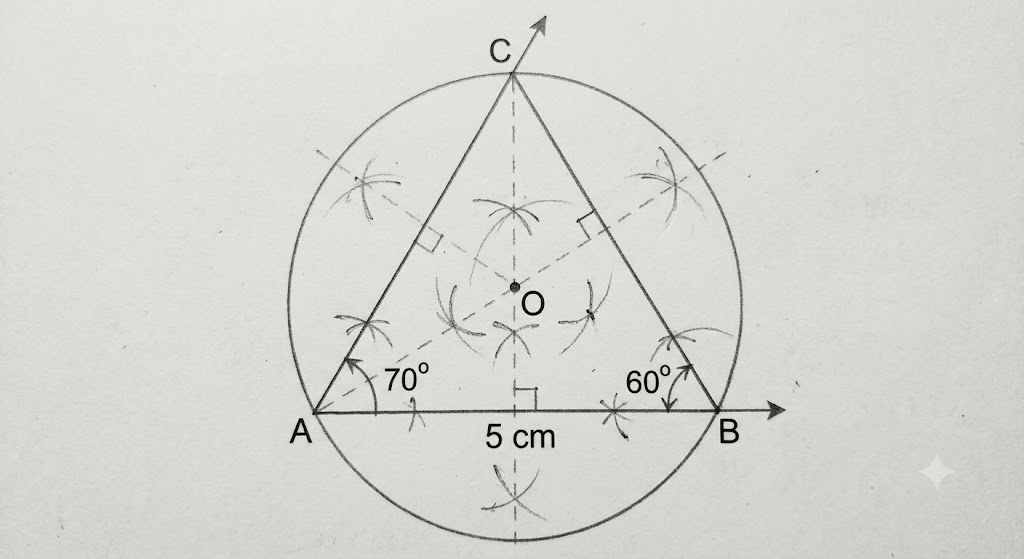
For an acute-angled triangle, the circumcentre lies inside the triangle.
2. For an obtuse-angled triangle, the circumcentre lies outside the triangle.
3. Because A, B, and C all lie on the boundary of the same circle, the distances from the centre O to each of these points represent the radii of the circumcircle. Therefore, when you measure them, you will find that OA = OB = OC.
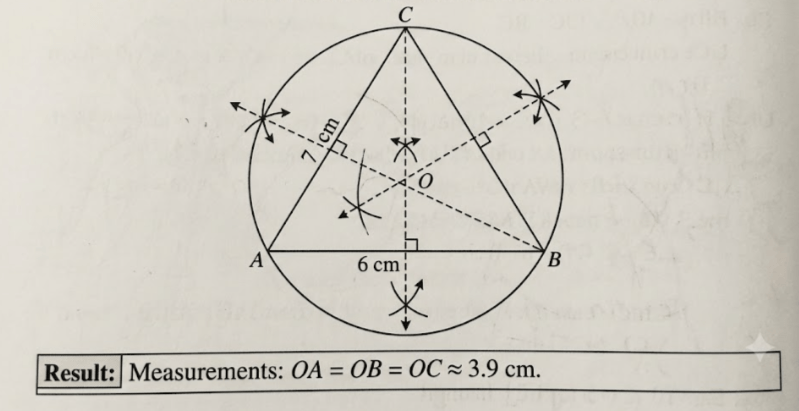
4. \frac{AB}{2}.
EXERCISE SET 5.3
3. The distance between the midpoints of the chords is 7 cm.
EXERCISE SET 5.5
1. 2\sqrt{13} cm.
3. No, we cannot conclude that CD = 2AB.
Reason: The relationship between the length of a chord and its distance from the centre is not linear; it is governed by squares and square roots in the Pythagorean theorem.
If d_{AB} = 2d_{CD}, the lengths will be AB = 2\sqrt{r^2 - 4d_{CD}^2} and CD = 2\sqrt{r^2 - d_{CD}^2}.
These are clearly not multiples of 2 of each other!
EXERCISE SET 5.6
1. AB = 12 cm.
2. (i) No. Angles subtended by an arc at any point on the remaining part of the circle (the same segment) are always equal.
(ii) Yes. If the angles are equal and not right angles, they must lie in the same major or minor segment, and thus on the same side of the chord AB.
(iii) Yes. By Theorem 10, if a line segment subtends equal angles at two points on the same side, all four points are concyclic.
3. 80^\circ.
END-OF-CHAPTER 5 EXERCISE
1. 24 cm.
2. 35^\circ .
3. 5 cm.
4. 24 cm.
6. Measure: 90^\circ.
Reasoning: The angle subtended by a diameter at any point on the circle is 90^\circ (angle in a semicircle).
7. \angle C = 105^\circ.
\angle D = 70^\circ.
8. x = 38.
P = 86^\circ
R = 94^\circ.
9. r = 10 cm.
10. Area = 60 square units.
11. Check the angles of the triangles formed by the diagonals. If any three vertices form an obtuse-angled triangle, the circumcentre will fall outside the triangle (and potentially outside the quadrilateral). For an acute-angled triangle, it lies inside.
16. Thus, the shape formed is a smaller concentric circle.
18. The radius of the circle is 13 cm.
19. The distance of each side from the centre is \frac{\sqrt{3}}{2}r.
20. Explanation: The angle subtended by a diameter at any point on the circle is 90^{\circ}. Because MN is the diameter, it subtends angles at the remaining vertices O and P on the circumference.
Answer: Therefore, both \angle MON = 90^{\circ} and \angle MPN = 90^{\circ}.
22. Explanation: Let the distance from the centre to a chord be d, and the radius be r. The length of any chord is 2\sqrt{r^2 - d^2}.
Conclusion: To maximize this length, we must subtract the smallest possible value for d^2. Since distance squared cannot be negative, its minimum value is d = 0.
When d = 0, the chord passes through the centre and its length becomes 2\sqrt{r^2} = 2r, which is the diameter. Any chord where d > 0 will strictly be less than 2r.
Chapter 6: Measuring Space: Perimeter and Area
EXERCISE SET 6.1
1. The radius is 7 cm.
2. (i) 44. cm
(ii) \frac{440}{7} \approx 62.9 cm.
(iii) \frac{528}{7} \approx 75.4 cm.
3. (i) \frac{22}{6} \approx 3.67 cm.
(ii) \frac{66}{5} = 13.2 m.
4. \frac{139}{3} 46.33 cm.
5. (i) 348 \frac{4}{7} cm.
(ii) 35 \frac{3}{7} cm.
(iii) 62 \frac{6}{7} cm.
(iv) 56 \frac{4}{7} cm.
(v) 176 cm.
(vi) 88 cm.
(vii) 50 \frac{2}{7} cm.
(vii) 50 \frac{2}{7} cm.
(ix) 62 \frac{6}{7} cm.
6. (i) Distance for one revolution = Circumference = 176 cm
(ii) Revolutions = \frac{1,000,000}{176} \approx 5681.8 revolutions.
7. (i) 88 cm.
(ii) 528 cm.
8. The ratio of their radii is 5:4.
EXERCISE SET 6.2
1. Area = 40 sq cm.
2. Area = 720 sq cm.
3. Area = 8\sqrt{30} sq cm.
4. Area = 1500\sqrt{3} sq m.
5. Shorter Diagonal = 8\sqrt{2} cm.
6. 1:1
10. 1:1
EXERCISE SET 6.3
1. \frac{154}{6} sq cm.
2. \frac{154}{4} sq cm.
3. \frac{154}{6} sq cm.
4. (i) Minor Sector Area = \frac{157}{2} = 78.5 sq cm.
(ii) Major Sector Area = 235.5 sq cm.
5. (i) Minor Segment Area = 20.44 sq cm.
(ii) Major Segment Area = 686.06 sq cm.
6. 1642 \frac{2}{3} sq cm
END-OF-CHAPTER 6 EXERCISE
2. 50\sqrt{2} sq cm.
3. 13 cm.
4. 36 cm.
5. \frac{75 \sqrt{15}}{4} sq cm.
6. 84 sq cm.
7. 188 \frac{4}{7} sq cm.
8. 86.625 sq cm.
9. 1.78 m, 568 turns
10. Yes.
16. (i) 1:2
(ii) 1:4
17. (i) \frac{11}{14}
(ii) \frac{11}{14}
19. \frac{18 \sqrt{10}}{5} cm
22. \frac{88}{7} cm
\frac{16}{7} sq cm
25. r^2 \left( \frac{2 \pi}{3} - \frac{\sqrt{3}}{2} \right) sq. unit
Chapter 7: The Mathematics of Maybe
EXERCISE SET 7.1
1. (i) It will snow in Mumbai in July.
- Ranking: 0
- Label: Impossible
- Reason: Mumbai has a tropical climate, and July is the middle of the monsoon season (heavy rain). Temperatures never drop to freezing, making snow geographically and meteorologically impossible.
(ii) The next Monday will come after Sunday.
- Ranking: 1
- Label: Certain
- Reason: Our calendar system is rigidly fixed. Monday always follows Sunday without exception.
(iii) You will greet at least one friend at school tomorrow.
- Ranking: Close to 1 (e.g., 0.9)
- Label: More likely
- Reason: Assuming tomorrow is a standard school day, it is highly probable you will see and greet a friend. However, it is not “Certain” (1) because you or your friends might fall sick and stay home.
(iv) An elephant will walk through your classroom today.
- Ranking: 0
- Label: Impossible
- Reason: Unless your school is in a wildlife sanctuary with gigantic doors, an elephant cannot physically fit into a standard classroom, nor are they roaming around school corridors!
EXERCISE SET 7.2
1. (i) \frac{4}{15}
(ii) 140 sweets.
2. (i) \frac{11}{40}
(ii) 180 students.
5. \frac{3}{6} = \frac{1}{2}.
6. (i) Experimental Prob = \frac{1}{4}
(ii) Theoretical Prob = \frac{1}{6}
(iii) Reason: They are different because 12 is a very small number of trials.
Random chance causes short-term fluctuations.
Expectation: According to the Law of Large Numbers, as you increase the number of rolls to 60, 600, or 6000, your experimental probability will get closer and closer to the theoretical probability of \frac{1}{6}.
EXERCISE SET 7.3
1. There are 6 possible outcomes.
2. (i) S = {(1,H), (1,T), (2,H), (2,T), (3,H), (3,T), (4,H), (4,T), (5,H), (5,T), (6,H), (6,T)}
(ii) S = {-4, -3, -2, -1, 0, 1, 2, 3, 4}
(iii) S = {\text{Green}, \text{Red}}
3. (i) S = {(\text{Samosa, Chai}), (\text{Samosa, Lassi}), (\text{Pakora, Chai}), (\text{Pakora, Lassi}), (\text{Bhaji, Chai}), (\text{Bhaji, Lassi})}
(ii) E = {(\text{Samosa, Chai}), (\text{Samosa, Lassi})}
EXERCISE SET 7.4
1. (ii) List the sample space.
S = {(\text{Apple, Banana}), (\text{Apple, Mango}), (\text{Orange, Banana}), (\text{Orange, Mango})}
(iii) \frac{1}{6}.
2. (i) What are the possible outcomes of the pen colours?
The possible colours for each draw are Red (R), Black (B), or Green (G).
(ii) Can you use the tree diagram to guess the probability that both you and your friend pick pens of the same colour?
Total Probability = \frac{29}{81} .
END-OF-CHAPTER 7 EXERCISE
1. (i) 0.
(ii) sample space.
(iii) 1.
(iv) \frac{1}{2}
2. relative frequency
\frac{15}{50} or 0.3.
3. (i) Yes. A fair coin is unbiased, so Heads and Tails both have a \frac{1}{2} chance.
(ii) No. Under normal conditions, a working car is highly likely to start, so the chances are not 50/50.
(iii) Yes. Each face (1 to 6) has an identical \frac{1}{6} chance of landing face up.
(iv) No. Since there are more blue marbles (7) than red (3), picking a blue marble is more likely.
(v) Yes. Generally, the biological probability of a baby being born male or female is considered to be equally likely (approx. 50/50).
4. (i) Sample Space S = {HH, HT, TH, TT}.
Probability = \frac{3}{4}.
(ii) Sample Space S = {1, 2, 3, 4, 5, 6, 7, 8, 9, 10}.
Probability = \frac{5}{10} = \frac{1}{2}.
(iii) Sample Space S = {1, 2, 3, 4, 5, 6}.
Probability = \frac{2}{6} = \frac{1}{3}.
(iv) Probability = \frac{3}{6} = \frac{1}{2}.
(v) S = {HHH, HHT, HTH, HTT, THH, THT, TTH, TTT}
Probability = \frac{3}{8}.
5. \frac{1}{3}.
6.
| Combinations | Red | Blue |
| Jeans | (Red, Jeans) | (Blue, Jeans) |
| Khakis | (Red, Khakis) | (Blue, Khakis) |
| Shorts | (Red, Shorts) | (Blue, Shorts) |
7. (i) \frac{20}{1000} = 0.02.
(ii) \frac{535}{1000} = 0.535.
(iii) \frac{445}{1000} = 0.445.
8. (i) \frac{4}{5}.
(ii) \frac{3}{5}.
9. (i) \frac{1}{8}.
(ii)\frac{4}{8} = \frac{1}{2}.
(iii) \frac{6}{8} = \frac{3}{4}.
(iv) \frac{8}{8} = 1 (Certain).
(v) \frac{2}{8} = \frac{1}{4}.
10. (i) \frac{5}{18}.
(ii) \frac{5}{18}.
11. Probability of 0 (Impossible): Getting a sum of 13. (The maximum possible sum is 6 + 6 = 12).
Probability of 1 (Certain): Getting a sum that is between 2 and 12 (inclusive).
12. (i) Probability = \frac{8}{36} = \frac{2}{9}.
(ii) P(Different Colours) = 1 - \frac{20}{72} = \frac{52}{72} = \frac{13}{18}.
(iii) Probability = \frac{2}{8} = \frac{1}{4}.
(iv) Probability = \frac{12}{24} = \frac{1}{2}.
(v) Probability = 3 \times \frac{3}{64} = \frac{9}{64}.
13. (i) Sample size = 16 .
(ii)Sample size = 12 .
14. S = {(H,1), (H,2), (H,3), (H,4), (H,5), (H,6), (T,1), (T,2), (T,3), (T,4), (T,5), (T,6)}.
15. The correct sample space must be {0, 1, 2, 3}.
Reason: The experiment specifically asks to record the number of heads, not the sequence of coins (like HHT or TTH). Any list that provides sequences instead of numerical totals fails to qualify because it does not match the recorded data of the experiment.
16. Probability = \frac{\pi}{24} .
EXERCISE SET 8.1
1. (i) -1, 2, 5, 8, 11
(ii) -3, -8, -13, -18, -23
(iii) 2, 3, 6, 11, 18
2. t_{10} = 47.
t_{15} = 72.
3. Yes, 97 is the 20th term.
Yes, 172 is the 35th term.
4. 122^{nd} term.
5. First five terms: -5, -2, 1, 4, 7
Yes, 52 is the 20^{th} term.
6. 7, 13, 24, 44, 81
EXERCISE SET 8.2
1. 48, 128.
2. -81 is the 35th term.
Yes, 0 is the 8th term.
3. t_n = 11 + (n-1)(-3) = 14 - 3n.
Recursive rule: t_1 = 11, t_n = t_{n-1} - 3 for n \ge 2.
4. t_{29} = 64.
5. There are 30 numbers.
Sum = 1665 .
6. His salary reached ₹7,00,000 in his 11^{th} year of work (which means after 10 years of increments).
7. 325 marbles.
EXERCISE SET 8.3
1. t_{12} = 3072 .
2. t_{10} = 5^{10} (or 9,765,625).
t_n = 5^n.
3. 7^{th} term.
4. The 8th term
Explicit formula: t_n = 2 \times 3^{n-1}.
Recursive formula: t_1 = 2, t_n = 3t_{n-1} for n \ge 2 .
5. (i) h_5 = 6.144 metres.
(ii) D = 301.184 metres.
6. It is the 13th term.
7. (i) Stage 0: 1.
Stage 1: 8.
Stage 2: 64.
Stage 3: 512.
(ii) Stage 4: 4096.
Stage 5: 32768.
(iii) Explicit: t_n = 8^n (where n is the stage number).
Recursive: t_0 = 1, t_n = 8t_{n-1} for n \ge 1.
(iv) Stages 1: \frac{8}{9},
Stage 2: \left(\frac{8}{9}\right)^2,
Stage 3: \left(\frac{8}{9}\right)^3,
Stage 4: \left(\frac{8}{9}\right)^4,
Stage 5: \left(\frac{8}{9}\right)^5.
Explicit: A_n = \left(\frac{8}{9}\right)^n.
Recursive: A_0 = 1, A_n = \frac{8}{9}A_{n-1}.
As n increases, the area decreases and gets closer and closer to 0.
END-OF-CHAPTER 8 EXERCISE
1. 178 .
2. The AP is: 4, 10, 16, 22, 28...
3. 128 .
4. n = 60 .
5. GP is -4, 8, -16...
6. Sequence: 18+19+20+21+22 = 100.
Sequence: 9+10+11+12+13+14+15+16 = 100.
There are exactly two ways.
7. End of 2nd hour: 30 \times 2^2 = 120.
End of 4th hour: 30 \times 2^4 = 480.
End of n^{th} hour: 30 \times 2^n
(Note: formula is ar^n because the original 30 is at n=0).
8. First three terms: -13, -8, -3.
9. The smallest n is 45.
10. The 9th term.
Explicit: t_n = 2 \times 4^{n-1}.
Recursive: t_1 = 2, t_n = 4t_{n-1} for n \ge 2.
11. Common ratio r = -\frac{3}{4} or r = -\frac{4}{3}.
In either case, the terms are: \frac{4}{3}, -1, \frac{3}{4}.
13. Terms are: 2, 6, 18 (or 18, 6, 2).
14. P_1 = 1, P_2 = 2, P_3= 4, P_4 = 8, P_5 = 16, P_6 = 32, P_7 = 64, P_8 = 128.
Simpler recursive: Notice each term is double the previous term.
P_n = 2P_{n-1} for n \ge 3.
Explicit: P_n = 2^{n-1} for n \ge 2, and P_1=1.
15. W_1=1, W_2=2, W_3 = 3, W_4 = 5, W_5 = 8, W_6 = 13, W_7 = 21, W_8 = 34.
Sequence is: 1, 2, 3, 5, 8, 13, 21, 34.
This is the famous Virahānka-Fibonacci sequence, where each term is the sum of the two preceding terms!