
Q1. Convert the following rational numbers in the form of a terminating decimal or non-terminating and repeating decimal, whichever the case may be, by the process of long division:
Solution:
(i) \frac{3}{50}:
3 \div 50 = 0.06.
Terminating.
(ii) \frac{2}{9}:
2 \div 9 = 0.222... = 0.\overline{2}.
Non-terminating repeating.
Q2. Prove that \sqrt{5} is an irrational number.
Solution:
Step 1 (Assumption): Assume \sqrt{5} is rational.
So, \sqrt{5} = \frac{p}{q}, where p and q are co-prime integers and q \neq 0.
Step 2: Square both sides: 5 = \frac{p^2}{q^2} \implies p^2 = 5q^2. … (1)
Step 3: This means p^2 is a multiple of 5.
Therefore, p must also be a multiple of 5.
Let p = 5k.
Step 4: Substitute p back in (1).
(5k)^2 = 5q^2 \implies 25k^2 = 5q^2 \implies q^2 = 5k^2.
Step 5: This means q^2 is a multiple of 5, so q must also be a multiple of 5.
Conclusion: If both p and q are multiples of 5, they share a common factor of 5. p and q are not coprimes.
This contradicts arises because of our wrong assumption.
Therefore, \sqrt{5} must be irrational.
Q3. Convert the decimal numbers into the form \frac{p}{q}:
Solution:
(i) 12.6 = \frac{126}{10} = \frac{63}{5}
(ii) 0.0120 = \frac{120}{10000} = \frac{12}{1000} = \frac{3}{250}
(iii) 3.0\overline{52}
Let x = 3.05252... … (1)
Multiplying eq. (1) by 10
10x = 30.5252... … (2)
Multiplying eq. (2) by 100
1000x = 3052.52... … (3)
Subtracting (2) from (3)
990x = 3022
x = \frac{3022}{990}
x = \frac{1511}{495}
Final Answer: \boxed {3.0\overline{52} = \frac{1511}{495}}
(iv) 1.235 = \frac{1235}{1000} = \frac{247}{200}
(v) 0.\overline{23}
Let x = 0.2323... … (1)
Multiply Equation by 100
100x = 23.2323... … (2)
Subtracting (1) from (2)
99x = 23
x = \frac{23}{99}
Final Answer: \boxed{ 0.\overline{23} = \frac{23}{99}}
(vi) 2.0 \overline{5}
Let x = 2.0555... … (1)
Multiplying Equation by 10
10x = 20.555... … (2)
Multiply Equation by 10
100x = 205.555... … (3)
Subtracting (2) from (3)
90x = 185
x = \frac{185}{90}
x = \frac{37}{18}
Final Answer: \boxed{ 2.0 \overline{5} = \frac{37}{18}}
(vii) 2.12 \overline{5}
Let x = 2.12555... … (1)
Multiplying Equation by 100
100x = 212.555... … (2)
Multiply Equation by 10
1000x = 2125.555... … (3)
Subtracting (2) from (3)
900x = 1913
x = \frac{1913}{900}
Final Answer: \boxed{ 2.12 \overline{5} = \frac{1913}{900}}
(viii) 3.12 \overline{5}
Let x = 3.12555... … (1)
Multiplying Equation by 100
100x = 312.555... … (2)
Multiply Equation by 10
1000x = 3125.555... … (3)
Subtracting (2) from (3)
900x = 2813
x = \frac{2813}{900}
Final Answer: \boxed{ 2.12 \overline{5} = \frac{1913}{900}}
(ix) 2. \overline{1625}
Let x = 2.162516251625... … (1)
Multiplying Equation by 10,000
10000x = 21625.162516251625... … (2)
Subtracting (1) from (2)
9999x = 21623
x = \frac{21623}{9999}
Final Answer: \boxed{ 2. \overline{1625} = \frac{21623}{9999}}
Q5. Find 6 rational numbers between 3 and 4.
Solution:
3 = \frac{3}{1}, \ \ 4 = \frac{4}{1}
Since we want 6 numbers, 6+1=7). We will multiply numerator and denominator of both numbers by 7
\frac{3 \times 7}{1 \times 7} = \frac{21}{7}, \ \ \frac{4 \times 7}{1 \times 7} = \frac{28}{7}
Now we can write 6 numbers between \frac{21}{7} and \frac{28}{7}.
Final Answer: \frac{22}{7}, \frac{23}{7}, \frac{24}{7}, \frac{25}{7}, \frac{26}{7}, \frac{27}{7}.
Q6. Find 5 rational numbers between \frac{2}{5} and \frac{3}{5}.
Solution:
Since we need 5 rational numbers, we can multiply the numerator and denominator of both fractions by 5 + 1 = 6 to create a large enough gap between them.
Find the equivalent fractions:
\frac{2 \times 6}{5 \times 6} = \frac{12}{30}
\frac{3 \times 6}{5 \times 6} = \frac{18}{30}
Now, pick 5 integer numerators between \frac{12}{30} and \frac{18}{30}.
Final Answer: \frac{13}{30}, \frac{14}{30}, \frac{15}{30}, \frac{16}{30}, \frac{17}{30}.
Q7. Find 5 rational numbers between \frac{1}{6} and \frac{2}{5}.
Solution:
First, make their denominators the same by finding the LCM of 6 and 5, which is 30.
\frac{1 \times 5}{6 \times 5} = \frac{5}{30}
\frac{2 \times 6}{5 \times 6} = \frac{12}{30}
Now, pick 5 integer numerators between \frac{5}{30} and \frac{12}{30}.
Final Answer: \frac{6}{30}, \frac{7}{30}, \frac{8}{30}, \frac{9}{30}, \frac{10}{30}
Q8. If \frac{x}{3} + \frac{x}{5} = \frac{16}{15}, find the rational number x.
Solution:
Find LCM of 3 and 5, which is 15.
\frac{5x}{15} + \frac{3x}{15} = \frac{16}{15}
\frac{8x}{15} = \frac{16}{15}
Multiply both sides by 15:
8x = 16 .
x = 2
Final Answer: \boxed {x = 2}
Q9. Let a and b be two non-zero rational numbers such that a + \frac{1}{b} = 0. Determine whether ab is positive or negative.
Solution:
a + \frac{1}{b} = 0 \implies a = -\frac{1}{b} \implies ab = -1.
This means that a and b must have opposite signs.
If a is positive, b is negative, and vice versa.
The product of a positive number and a negative number is always negative.
Final Answer: The product ab must be negative.
Q10. A rational number has a terminating decimal expansion whose last non-zero digit occurs in the 4th decimal place. Show that such a number can be written in the form \frac{p}{10^4} where p is an integer not divisible by 10. Is it necessary that the denominator of this rational number, when written in the lowest form, is divisible by 2^4 or 5^4? Give reasons.
- Part 1: Let the terminating decimal be x = d.a b c f, where f is the 4th decimal place and f \neq 0. We can remove the decimal point by dividing by 10^4. Thus, x = \frac{p}{10^4} where p is the integer dabcf. If p were divisible by 10, it would end in a zero, meaning the last non-zero digit would not be in the 4th decimal place. Therefore, p cannot be divisible by 10.
- Part 2: The denominator is 10^4 = 2^4 \times 5^4. Because p is not divisible by 10, p cannot be a multiple of both 2 and 5 simultaneously.
- Conclusion: When we simplify \frac{p}{2^4 \times 5^4} to its lowest form, p might cancel out some 2s OR some 5s, but it can never cancel out both. Therefore, at least one of the prime factors (2^4 or 5^4) will remain completely intact in the denominator. Yes, it is absolutely necessary.
Q11. Without performing division, determine whether the decimal expansion of \frac{18}{125} is terminating or non-terminating.
Solution:
The denominator is 125, which is 5 \times 5 \times 5 = 5^3.
Because the prime factorization of the denominator contains ONLY 5s, the decimal expansion will be terminating.
Number of decimal places is determined by the highest power of 2 or 5 in the denominator.
Here, the highest power is 3, so it will terminate after 3 decimal places.
Q12. A rational number in its lowest form has denominator 2^3 \times 5. How many decimal places will its decimal expansion have? Explain your answer.
Solution:
Explanation: A rational number’s decimal expansion terminates after n places if its denominator (in lowest form) can be multiplied to become 10^n.
Our denominator is 2^3 \times 5^1.
To make it a perfect power of 10, we must pair every 2 with a 5.
Since we have three 2s but only one 5, we need to multiply the numerator and the denominator by 5^2.
The new denominator becomes 2^3 \times 5^3 = (2 \times 5)^3 = 10^3.
Final Answer: Because the denominator can be expressed as 10^3, the decimal expansion will have exactly 3 decimal places.
Q13. Let a = \frac{7}{12} and b = \frac{5}{6}. Express both in the form \frac{k_1}{m} and \frac{k_2}{m} where k_2 - k_1 > 6. Using the same denominator, write exactly five distinct rational numbers between them… Explain why the condition k_2 - k_1 > n + 1 is necessary to find n rational numbers.
Solution:
Find equivalent fractions for a and b.
Let’s try m = 36.
a = \frac{7 \times 3}{12 \times 3} = \frac{21}{36} (so k_1 = 21)
b = \frac{5 \times 6}{6 \times 6} = \frac{30}{36} (so k_2 = 30)
Check the condition: 30 - 21 = 9. Since 9 > 6, the condition is met!
Five distinct numbers between them: \frac{22}{36}, \frac{23}{36}, \frac{24}{36}, \frac{25}{36}, \frac{26}{36}.
Explanation of the rule: If you need to fit exactly n integers between two endpoints (k_1 and k_2), the “gap” or difference between those endpoints must be at least n + 1.
For example, to fit 5 integers between two numbers, the difference must be at least 6.
The condition k_2 - k_1 > n (or \ge n + 1) ensures there is enough mathematical “space” to pull out n unique integer numerators!
Q14. Three rational numbers x, y, z satisfy x+y+z=0 and xy+yz+zx=0. Show that all the rational numbers x, y, z must be simultaneously zero.
Solution:
We use the algebraic identity:
(x+y+z)^2 = x^2 + y^2 + z^2 + 2(xy + yz +zx)
Substitute: x+y+z=0 and xy+yz+zx=0
(0)^2 = x^2 + y^2 + z^2 + 2(0)
x^2 + y^2 + z^2 = 0
The square of any rational number is always non-negative (zero or positive).
The only way three non-negative numbers can add up to exactly 0 is if every single one of them is 0.
Conclusion: Therefore, x = 0, y = 0, \text{and } z = 0 simultaneously.
Q15. Show that the rational number \frac{a+b}{2} lies between the rational numbers a and b.
Solution:
Let’s assume a < b.
Add a to both sides of the inequality:
a + a < a + b
2a < a + b
a < \frac{a + b}{2}
Now, take the original assumption a < b and add b to both sides:
a + b < b + b
a + b < 2b
\frac{a + b}{2} < b
Conclusion: By combining the two results, we get a < \frac{a+b}{2} < b. This proves the average of two numbers always sits squarely between them!
Q16. Find the lengths of the hypotenuses of all the right triangles in Figure which is referred to as the square root spiral.
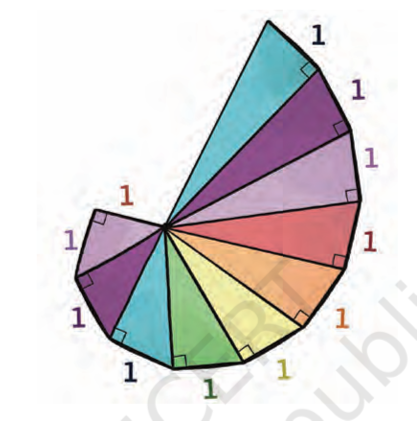
Explanation: The square root spiral is built using the Pythagorean theorem (a^2 + b^2 = c^2), where the base of each new triangle is the hypotenuse of the previous one, and the perpendicular height is always 1.
Triangle 1: Base = 1, Height = 1. Hypotenuse = \sqrt{1^2 + 1^2} = \sqrt{2}
Triangle 2: Base = \sqrt{2}, Height = 1. Hypotenuse = \sqrt{(\sqrt{2})^2 + 1^2} = \sqrt{2 + 1} = \sqrt{3}
Triangle 3: Base = \sqrt{3}, Height = 1. Hypotenuse = \sqrt{(\sqrt{3})^2 + 1^2} = \sqrt{3 + 1} = \sqrt{4} = 2
Conclusion: As you follow the spiral around, each new hypotenuse is the square root of the next consecutive natural number.
Counting the 12 triangles shown in the textbook diagram, the lengths of the hypotenuses are: \sqrt{2}, \sqrt{3}, \sqrt{4}, \sqrt{5}, \sqrt{6}, \sqrt{7}, \sqrt{8}, \sqrt{9}, \sqrt{10}, \sqrt{11}, \sqrt{12}, \text{and } \sqrt{13}.