
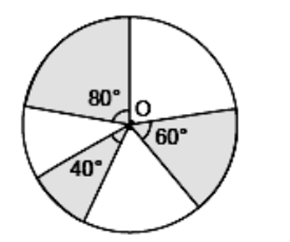
Q1: In the given figure, three sectors of a circle of radius 7 cm, making angles of 60^\circ, 80^\circ and 40^\circ at the centre are shaded. The area of the shaded region (in cm^2) is [Use \pi=\frac{22}{7}]:
(A) 77 \text{ cm}^2
(B) 154 \text{ cm}^2
(C) 44 \text{ cm}^2
(D) 22 \text{ cm}^2
Solution:
The radius of the circle, r, is 7 \text{ cm}.
The angles of the three shaded sectors at the centre are 60^\circ, 80^\circ, and 40^\circ.
The general formula for the area of a sector is \frac{\theta}{360^\circ} \times \pi r^2.
\text{Area of 1st sector:} = \frac{60^\circ}{360^\circ} \times \frac{22}{7} \times (7)^2
\text{Area of 2nd sector:} = \frac{80^\circ}{360^\circ} \times \frac{22}{7} \times (7)^2
\text{Area of 3rd sector:} = \frac{40^\circ}{360^\circ} \times \frac{22}{7} \times (7)^2
Total combined area of the shaded region = Area of 1st sector + Area of 2nd sector + Area of 3rd sector
\text{Total Shaded Area} = \left[ \frac{60^\circ}{360^\circ} \times \frac{22}{7} \times (7)^2 \right] + \left[ \frac{80^\circ}{360^\circ} \times \frac{22}{7} \times (7)^2 \right] + \left[ \frac{40^\circ}{360^\circ} \times \frac{22}{7} \times (7)^2 \right]
\text{Total Shaded Area} = \left[ \frac{60^\circ+ 80^\circ + 40^\circ }{360^\circ} \right] \times \frac{22}{7} \times (7)^2
\text{Total Shaded Area} = \frac{180^\circ}{360^\circ} \times \frac{22}{7} \times (7)^2
\text{Total Shaded Area} = \frac{1}{2} \times \frac{22}{7} \times 49
\text{Total Shaded Area} = \frac{1}{2} \times 22 \times 7
\text{Total Shaded Area} = 11 \times 7 = 77 \text{ cm}^2
The total area of the shaded region is 77 \text{ cm}^2.
Correct option: (A)
Q2: If the perimeter of a circle is equal to that of a square, then the ratio of the area of circle to the area of the square is
(A) 14:11
(B) 12:13
(C) 11:14
(D) 13:12
Solution:
Let the radius of the circle be r and the side of the square be a.
The perimeter (circumference) of the circle is 2\pi r.
The perimeter of the square is 4a.
Given that the perimeters are equal:
2\pi r = 4a
a = \frac{2\pi r}{4} = \frac{\pi r}{2}
Now, we need the ratio of the Area of the circle to the Area of the square:
\text{Ratio} = \frac{\text{Area of Circle}}{\text{Area of Square}} = \frac{\pi r^2}{a^2}
Substitute the value of a into the ratio:
\text{Ratio} = \frac{\pi r^2}{\left(\frac{\pi r}{2}\right)^2}
\text{Ratio} = \frac{\pi r^2}{\frac{\pi^2 r^2}{4}}
\text{Ratio} = \frac{4\pi r^2}{\pi^2 r^2} = \frac{4}{\pi}
Substitute \pi = \frac{22}{7}:
\text{Ratio} = \frac{4}{\frac{22}{7}} = \frac{4 \times 7}{22} = \frac{28}{22} = \frac{14}{11}
Correct option: (A)
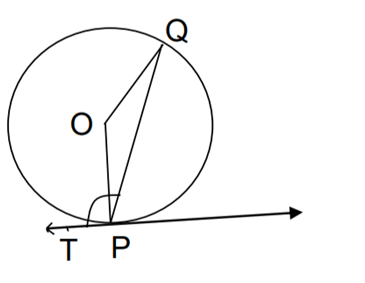
Q3: In the given figure, a tangent has been drawn at a point P on the circle centred at O. If \angle TPQ=110^\circ then \angle PQO is equal to
(A) 110^\circ
(B) 70^\circ
(C) 140^\circ
(D) 55^\circ
Solution:
A tangent to a circle is perpendicular to the radius through the point of contact.
Therefore, the angle between the tangent line and the radius OP is 90^\circ (\angle OPT = 90^\circ).
Given \angle TPQ = 110^\circ.
\angle OPQ + \angle OPT = 110^\circ
\angle OPQ = 110^\circ - \angle OPT
\angle OPQ = 110^\circ - 90^\circ = 20^\circ
In \triangle POQ,
OP = OQ ... (radii of the same circle)
Angles opposite to equal sides of a triangle are equal.
Therefore, \angle PQO = \angle OPQ.
\angle PQO = 20^\circ
Correct option: (C)
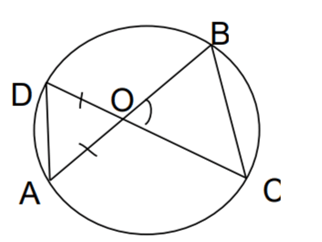
Q4: O is the point of intersection of two chords AB and CD of a circle. If \angle BOC=80^\circ and OA=OD, then \triangle ODA and \triangle OBC are
(A) equilateral and similar
(B) isosceles and similar
(C) isosceles but not similar
(D) not similar
Solution:
\angle BOC = \angle AOD ... (vertically opposite angles).
\angle AOD = \angle BOC = 80^\circ
In \triangle AOD,
we are given OA = OD.
so \angle OAD = \angle ODA ... (Angles opposite to equal sides are equal).
Using the angle sum property of a triangle:
\angle OAD + \angle ODA + \angle AOD = 180^\circ
2\angle ODA + 80^\circ = 180^\circ \implies \angle ODA = 50^\circ
So, the angles of \triangle AOD are 80^\circ, 50^\circ, 50^\circ.
In \triangle OBC, OB = OC because they are radii of the same circle.
This makes \triangle OBC an isosceles triangle.
Similarly, \angle OBC = \angle OCB.
2\angle OBC + 80^\circ = 180^\circ \implies \angle OBC = 50^\circ
So, the angles of \triangle OBC are 80^\circ, 50^\circ, 50^\circ.
Since both triangles are isosceles and all their corresponding angles are equal, they are similar by AAA similarity criterion.
Correct option: (B)
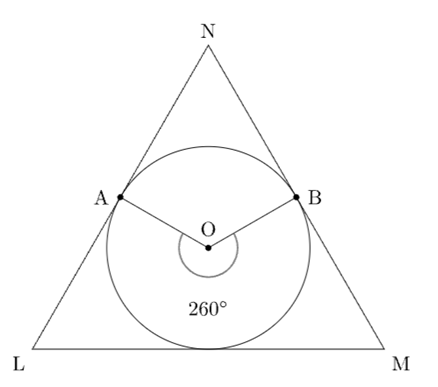
Q5: In the figure given below, a circle with centre O is inscribed inside \triangle LMN. A and B are the points on the tangents. Find \angle ANB. Show your steps.
Solution:
Given \angle AOB = 260^\circ.
At the centre O:
\text{Interior } \angle AOB = 360^\circ - 260^\circ = 100^\circ
The lines NA and NB are tangents to the circle at points A and B.
The radius is perpendicular to the tangent at the point of contact.
Therefore, \angle OAN = 90^\circ and \angle OBN = 90^\circ.
In the quadrilateral AOBN, the sum of all interior angles is 360^\circ:
\angle ANB + \angle OAN + \angle OBN + \text{Interior } \angle AOB = 360^\circ
\angle ANB + 90^\circ + 90^\circ + 100^\circ = 360^\circ
\angle ANB + 280^\circ = 360^\circ
\angle ANB = 360^\circ - 280^\circ = 80^\circ
Final Answer: \boxed{ \angle ANB = 80^\circ }
Q6: The minute hand of a clock is \sqrt{21} cm long. Find the area described by the minute hand on the face of the clock between 7.00 am and 7.05 am. [Use \pi=\frac{22}{7}]
Solution:
The radius of the circle formed by the minute hand, r, is \sqrt{21} \text{ cm}.
The time duration is from 7:00 am to 7:05 am, which is exactly 5 \text{ minutes}.
The minute hand completes a full 360^\circ circle in 60 \text{ minutes}.
Angle swept by the minute hand in 1 \text{ minute} = \frac{360^\circ}{60} = 6^\circ.
Angle swept in 5 \text{ minutes} (\theta) = 5 \times 6^\circ = 30^\circ.
The area described is the area of a sector with \theta = 30^\circ and r = \sqrt{21}.
\text{Area} = \frac{\theta}{360^\circ} \times \pi r^2
\text{Area} = \frac{30^\circ}{360^\circ} \times \frac{22}{7} \times (\sqrt{21})^2
\text{Area} = \frac{1}{12} \times \frac{22}{7} \times 21
\text{Area} = \frac{1}{12} \times 66 = 5.5 \text{ cm}^2
Final Answer: The area described is \boxed {5.5 \text{ cm}^2}.
Q7: Find the perimeter of the shaded region in figure, if ABCD is a square of side 14 cm and APB and CPD are semicircles. [Use \pi=\frac{22}{7}]
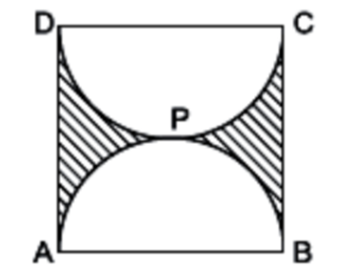
Solution:
The side of the square is 14 \text{ cm}.
This means lengths AD = 14 \text{ cm} and BC = 14 \text{ cm}.
The diameter of both semicircles (APB and CPD) is equal to the side of the square, which is 14 \text{ cm}.
Therefore, the radius r = \frac{14}{2} = 7 \text{ cm}.
The perimeter of the shaded region consists of the straight lengths AD and BC, plus the arc lengths of the two semicircles APB and CPD.
\text{Length of arc } APB = \pi r = \frac{22}{7} \times 7 = 22 \text{ cm}
\text{Length of arc } CPD = \pi r = \frac{22}{7} \times 7 = 22 \text{ cm}
\text{Total Perimeter} = AD + BC + \text{arc } APB + \text{arc } CPD
\text{Total Perimeter} = 14 + 14 + 22 + 22
\text{Total Perimeter} = 72 \text{ cm}
Final Answer: The perimeter of the shaded region is \boxed{ 72 \text{ cm}}.
Q8: ABCD is a square. CD is a tangent to the circle with centre O as shown in the figure below... If OD=CE, what is the ratio of the area of the circle and the area of the square?
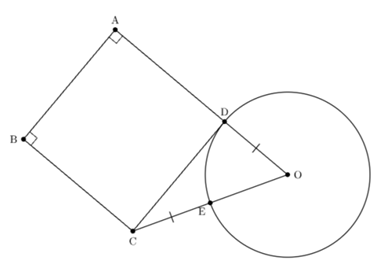
Solution:
Let the radius of the circle be r.
Let the side of the square ABCD be a.
Since D is a point on the circle and CD is a tangent to the circle, the radius OD is perpendicular to the tangent CD.
\angle ODC = 90^\circ
We are given OD = CE.
Since OD is the radius r, CE = r.
The line segment OC intersects the circle at E, making OE a radius (r).
Therefore, the total length of the hypotenuse OC is:
OC = OE + CE = r + r = 2r
In the right-angled \triangle ODC, we apply the Pythagorean theorem:
OD^2 + DC^2 = OC^2
r^2 + a^2 = (2r)^2
r^2 + a^2 = 4r^2
a^2 = 3r^2
We need the ratio of the Area of the circle (\pi r^2) to the Area of the square (a^2):
\text{Ratio} = \frac{\pi r^2}{a^2} = \frac{\pi r^2}{3r^2} = \frac{\pi}{3}
Final Answer: The ratio is \boxed{ \pi : 3 }.
Q9: In the given figure, two circles touch each other at the point C. Prove that the common tangent to the circles at C, bisects the common tangent at P and Q.
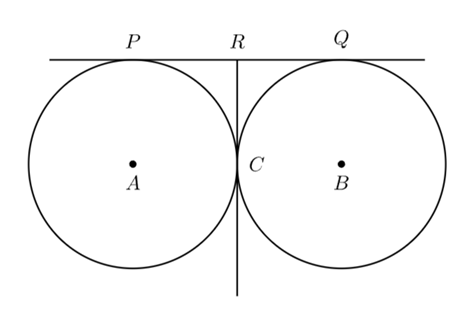
Solution:
Let the common tangent at C intersect the common tangent PQ at a point R.
We know that the lengths of two tangents drawn from an external point to a circle are equal.
For the circle with centre A:
From the external point R, tangents RP and RC are drawn to the circle.
RP = RC ... (1)
For the circle with centre B:
From the external point R, tangents RQ and RC are drawn to the circle.
RQ = RC ... (2)
From Equation 1 and Equation 2, we can conclude:
RP = RC = RQ
RP = RQ
R is the midpoint of PQ.
Therefore, the common tangent at C bisects the common tangent PQ.
(Hence Proved)
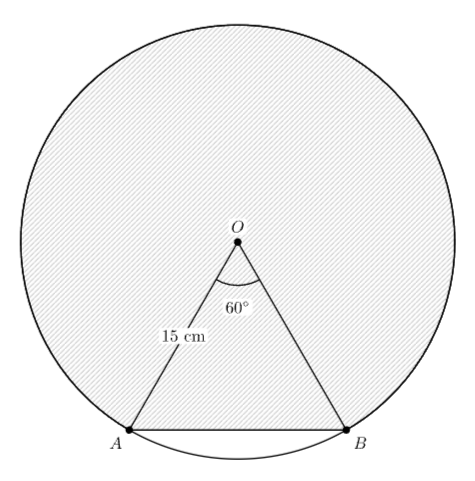
Q10: A chord of a circle of radius 15 cm subtends an angle of 60^\circ at the centre. Find the areas of the corresponding minor and major segments of the circle. (Use \pi=3.14 and \sqrt{3}= 1.73)
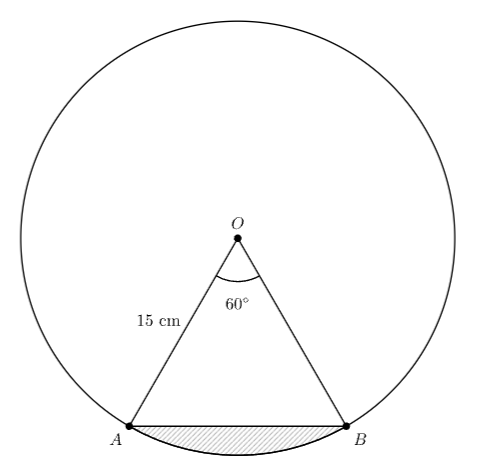
Solution:
Given:
Radius r = 15 \text{ cm}, Central angle \theta = 60^\circ.
The triangle formed by the two radii and the chord is an isosceles triangle with a 60^\circ vertex angle.
This forces the other two angles to be \frac{180^\circ - 60^\circ}{2} = 60^\circ, making it an equilateral triangle.
Area of the Minor Segment:
\text{Area of Minor Segment} = \text{Area of Sector} - \text{Area of Equilateral Triangle}
\text{Area} = \left(\frac{\theta}{360^\circ} \times \pi r^2\right) - \left(\frac{\sqrt{3}}{4} \times (\text{side})^2\right)
\text{Area} = \left(\frac{60^\circ}{360^\circ} \times 3.14 \times (15)^2\right) - \left(\frac{1.73}{4} \times (15)^2\right)
\text{Area} = \left(\frac{1}{6} \times 3.14 \times 225\right) - \left(0.4325 \times 225\right)
\text{Area} = 117.75 - 97.3125 = 20.4375 \text{ cm}^2
Area of the Major Segment:
\text{Area of Major Segment} = \text{Area of Entire Circle} - \text{Area of Minor Segment}
\text{Area} = (\pi r^2) - 20.4375
\text{Area} = (3.14 \times 225) - 20.4375
\text{Area} = 706.5 - 20.4375 = 686.0625 \text{ cm}^2
Final Answer: Minor segment area is \boxed{ 20.4375 \text{ cm}^2 } and Major segment area is \boxed{ 686.0625 \text{ cm}^2 } .
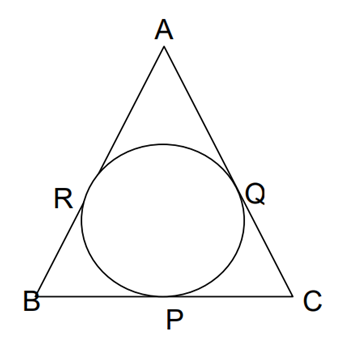
Q11: Prove that the lengths of tangents drawn from an external point to a circle are equal. Using above result, find the length BC of \Delta ABC. Given that, a circle is inscribed in \Delta ABC touching the sides AB, BC and CA at R, P and Q respectively and AB=10 cm, AQ=7 cm, CQ=5 cm.
Solution:
To Prove: Prove that the lengths of tangents drawn from an external point to a circle are equal.
AR = AQ
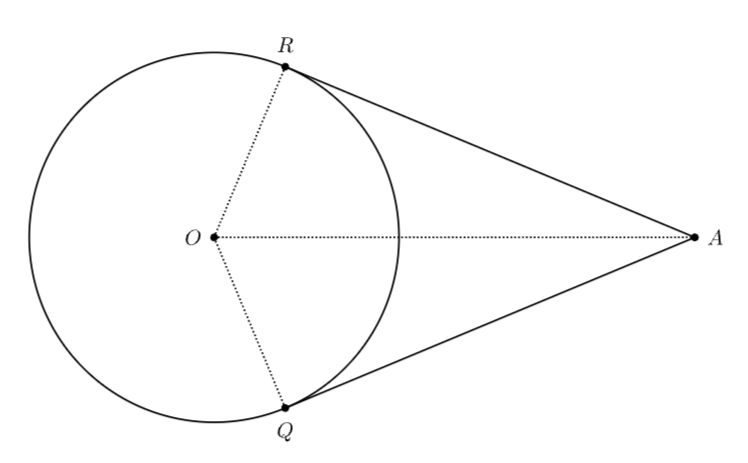
In \triangle ARO \text{and} \triangle AQO
\angle ARO = \angle AQO = 90^\circ ... (Radius meets the tangent at 90^\circ )
AO = AO ... (Common)
OR = OQ ... (Radii of the same Circle)
\triangle ARO \cong \triangle AQO using \text{RHS} criteria
Therefore, AR = AQ ... (by, c.p.c.t.)
Hence Proved
Using the theorem that tangents from an external point are equal:
From point A:
AR = AQ.
Since AQ = 7 \text{ cm}, AR = 7 \text{ cm}.
From point C:
CP = CQ.
Since CQ = 5 \text{ cm}, CP = 5 \text{ cm}.
We are given the total length of AB = 10 \text{ cm}.
Since AB = AR + RB, we can find RB:
10 = 7 + RB \implies RB = 3 \text{ cm}
From point B:
BP = RB.
Therefore, BP = 3 \text{ cm}.
The total length of side BC is the sum of BP and CP:
BC = BP + CP = 3 \text{ cm} + 5 \text{ cm} = 8 \text{ cm}
Final Answer: The length of \boxed{ BC = 8 \text{ cm} }.
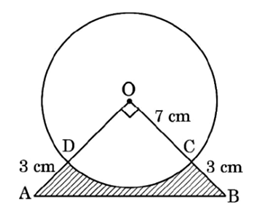
Q12: In an annual day function... Each memento is made as shown in the figure and its base ABCD is shown from the front side. The rate of silver plating is 20 per cm^2.
Solution:
(i) What is the area of the quadrant ODCO?
The radius r of the quadrant is OD = 7 \text{ cm}.
\text{Area of Quadrant} = \frac{1}{4} \pi r^2
\text{Area of Quadrant} = \frac{1}{4} \frac{22}{7} \times (7)^2
\text{Area of Quadrant} = \frac{1}{4} \times 22 \times 7
\text{Area of Quadrant} = \frac{154}{4} = 38.5 \text{ cm}^2
(ii) Find the area of \Delta AOB.
Given the lengths are OD = 7 \text{ cm} and DA = 3 \text{ cm}
OA = OD + DA = 10 \text{ cm}.
Similarly, height OB = 10 \text{ cm}.
Given \angle AOB = 90^\circ
\text{Base} = OA = 10
\text{Height} = OB =10
\text{Area of } \Delta AOB = \frac{1}{2} \times \text{base} \times \text{height}
\text{Area of } \Delta AOB = \frac{1}{2} \times 10 \times 10
\text{Area of } \Delta AOB = 50 \text{ cm}^2
(iii) (A) What is the total cost of silver plating the shaded part ABCD?
\text{Area of Shaded Region} = \text{Area of } \Delta AOB - \text{Area of Quadrant}
\text{Area} = 50 - 38.5 = 11.5 \text{ cm}^2
\text{Total Cost} = 11.5 \text{ cm}^2 \times 20 \text{ per cm}^2 = \text{Rs. } 230
OR
(iii) (B) What is the length of arc CD?
\text{Length of Arc} = \frac{90^\circ}{360^\circ} \times 2\pi r
\text{Length of Arc} = \frac{1}{4} \times 2 \times \frac{22}{7} \times 7
\text{Length of Arc} = \frac{1}{4} \times 44 = 11 \text{ cm}